Re-booking Science: AI Coat Forecasting & Retention
 Emma Tah
The Science of Re-booking: Using AI to Forecast Coat Growth and Boost Client Retention
Most pet groomers lose clients not because of bad haircuts, but because of bad timing.
A 2023 survey by Pet Groomer Magazine found that 60% of grooming clients who lapse do so simply because they forgot to rebook. Not because they were unhappy. Not because they found someone cheaper. They just... didn't get around to it. And by the time they thought about it, they'd already booked with whoever popped up first on Google.
That gap between appointments is where revenue quietly bleeds out. And it turns out, the biology of dog hair holds the key to plugging it.
Why Coat Growth Cycles Matter More Than You Think
Every breed has a genetically determined coat growth cycle. This isn't opinion. It's dermatology.
Dr. Lowell Ackerman's textbook Structure and Function of the Skin breaks the canine hair cycle into three phases: anagen (active growth), catagen (transition), and telogen (resting). The duration of each phase varies wildly by breed. A Poodle's anagen phase can last years, which is why their hair keeps growing and growing. A Labrador's anagen phase is short, cycling quickly through to telogen and shedding.
Here's what matters for your business: the optimal grooming window isn't the same for every dog, and it's definitely not "every six weeks" across the board. A Shih Tzu in summer might need grooming every 4 weeks. A Golden Retriever after a full coat blow might not need a serious session for 8 to 10 weeks. A Doodle (and let's be honest, Doodles are probably 40% of your book) falls somewhere in between, and the answer shifts with season, diet, and whether the owner actually brushes at home. Spoiler: they usually don't.
The problem is that most grooming businesses use a one-size-fits-all rebooking cadence. Four weeks, six weeks, whatever the default is. That's leaving money on the table in both directions. You're either rebooking too late (and the client has already gone elsewhere or let the coat mat beyond what a standard groom covers) or too early (and the client declines because the dog "doesn't look like it needs it yet").
The Real Cost of Getting Rebooking Wrong
Let's put numbers to this.
The average grooming appointment in the US runs about $50 to $75, according to Rover's 2024 pricing data. A groomer with 15 appointments per day, working 5 days a week, generates roughly $195,000 to $292,000 in annual revenue. Now, industry benchmarks from IBISWorld peg client retention in pet services at around 60 to 70% for businesses without structured follow-up systems.
That means if you have 500 active clients, you're losing 150 to 200 of them per year. At an average lifetime value of $600 to $900 per client annually (assuming 8 to 12 visits), that's $90,000 to $180,000 walking out the door every year.
Compare that to what happens with properly timed rebooking. Bain & Company's classic retention research (originally applied to financial services but widely validated across industries) found that a 5% increase in retention rates can boost profits by 25 to 95%. In a grooming context, even moving from 65% to 72% retention would add tens of thousands in annual revenue for a single-location shop.
The question is how to get the timing right at scale. You can't sit down after every appointment and think, "OK, this is a Bernedoodle with a thick undercoat, it's October, the owner said they hike every weekend, so I should probably book them back in 5 weeks." Not when you've got 15 dogs a day and a phone ringing off the hook.
How AI Coat Growth Forecasting Actually Works
This is where the technology gets genuinely interesting, not in a hype-cycle way, but in a practical, "this solves a real workflow problem" way.
AI coat growth forecasting works by combining multiple data inputs to predict when a specific dog will need its next groom. The core inputs typically include breed (or breed mix), coat type classification, historical appointment frequency for that individual dog, seasonal patterns, and geographic climate data.
The machine learning models behind this aren't exotic. They're regression models trained on grooming appointment data, learning the relationship between these variables and the actual interval at which clients return. When you have data from thousands of dogs across thousands of appointments, patterns emerge that no individual groomer could track mentally.
For example, the model might learn that Goldendoodles in the Southeast US during summer months have an optimal rebooking window of 4.2 weeks on average, but that specific Goldendoodles whose owners consistently rebook at 3-week intervals (suggesting faster-growing or thicker coats) should be prompted earlier. It can also learn that certain dogs tend to fall off the schedule after a longer-than-usual gap and flag those clients for proactive outreach before they lapse.
I want to be honest about the limitations here. AI coat growth forecasting is not reading your client's dog's follicles through the screen. It's pattern matching on historical and breed-level data. It won't perfectly predict that Mrs. Patterson's Bichon is going to roll in mud next Tuesday. But it doesn't need to be perfect. It just needs to be better than "rebook everyone at six weeks" or, worse, "wait for them to call."
And it is. Meaningfully better.
What Smart Rebooking Looks Like in Practice
The workflow shift is straightforward. Instead of your front desk (or you, because let's face it, you ARE the front desk) manually texting or calling clients to rebook, an AI-powered system handles the timing and the outreach.
Here's what that looks like day to day:
Automated, breed-aware reminders. A Yorkshire Terrier client gets a rebooking prompt at 3.5 weeks. A Husky client gets one at 8 weeks during coat blow season, 12 weeks otherwise. The system adjusts, not you.
Predictive lapse detection. When a client's gap between appointments starts stretching beyond their normal pattern, the system flags it. Maybe even sends an automated message before they've consciously decided to skip. This is the highest-leverage intervention in all of client retention. Catching the drift before it becomes a departure.
Phone-based rebooking. This one is underrated. A lot of grooming clients, especially older ones, still prefer to call. If your phone goes to voicemail during a busy grooming day, that's a missed rebooking opportunity. An AI phone system that can answer, check availability, and book the appointment while you're elbow-deep in a Malamute's undercoat eliminates that gap entirely.
Historical optimization. Over time, the system learns which clients respond to text reminders versus calls, which prefer morning slots, and which tend to cancel same-day if booked more than two weeks out. That level of personalization would take a human receptionist years to internalize and they'd still forget half of it.
The Retention Flywheel: Why This Compounds
Retention isn't a single metric. It's a flywheel.
When you rebook clients at the biologically optimal time, the dog's coat is in better condition at each visit. That means faster grooms, fewer dematting charges (which clients hate), and better-looking results. Better results mean happier clients. Happier clients leave better reviews. Better reviews attract new clients who are predisposed to trust you.
A 2022 study published in the Journal of Small Business Management found that service businesses with structured follow-up systems had 28% higher client lifetime values than those relying on client-initiated rebooking. The mechanism isn't complicated. You're just reducing the friction between "I should probably get the dog groomed" and "Done, booked for Thursday."
There's a compounding revenue effect too. If your average client visits 8 times per year and smart rebooking pushes that to 9.5, that's nearly a 19% revenue increase from your existing client base. No new marketing spend. No new clients to acquire. Just better timing with the ones you already have.
What This Means for Independent Groomers
Big corporate grooming chains like PetSmart and Petco have invested heavily in CRM systems and automated follow-ups. Independent groomers often feel like they can't compete with that level of infrastructure.
That's wrong. The technology gap has closed dramatically in the last two years.
Platforms built specifically for pet grooming businesses now bundle AI-powered scheduling, automated reminders, two-way messaging, and client management into packages that a solo groomer or small shop can actually afford and actually use without a tech team. The playing field isn't level yet, but it's a lot closer than it was in 2020.
The groomers who will thrive over the next five years aren't necessarily the most skilled with scissors (though that helps). They're the ones who treat their client data as a strategic asset and use technology to act on it. Breed data, appointment history, seasonal patterns, client communication preferences. All of this is sitting in your business right now, probably in a paper calendar or a basic spreadsheet. The question is whether you're going to do something with it.
Bringing It Together
The science of rebooking isn't really about AI. It's about respect for biology and respect for your clients' time. Dogs need grooming on schedules dictated by genetics and environment, not by whatever arbitrary interval a business happens to default to. When you align your rebooking cadence with the actual coat growth cycle, everything downstream improves. Client satisfaction. Revenue per client. Retention rates. Even the quality of your work, because you're seeing coats in better condition.
The AI part just makes it possible to do this at scale without losing your mind.
If you're still relying on clients to remember to call you back, or on a generic "See you in 6 weeks!" card, you're leaving real money on the table. Not hypothetical money. The kind you can calculate by looking at your lapsed client list right now.
Book a free demo to see how Talopet helps grooming businesses automate smart rebooking, answer every call, and keep clients coming back on the right schedule.
Coat-growth forecasting is one of the features that separates the best pet grooming software with AI from the pretenders. See our best AI pet grooming software 2026 ranking for the platforms that actually pull this off, and our best pet grooming software 2026 roundup for the broader comparison.
Keep Reading
For the raw booking data that inspired this analysis, see what 10,000 grooming appointments reveal about when clients book. We also built on this research in predicting the peak — AI scheduling to maximize salon revenue. And if missed calls are breaking your re-booking chain, read why every salon needs an AI receptionist.
Talopet's Smart Scheduling uses these patterns to fill your calendar. Pair it with Two-Way Messaging to send re-booking reminders automatically.
More from the Blog
Best Pet Boarding & Daycare Software With AI 2026
I scored 10 platforms on a public rubric to find the best pet boarding and daycare software with AI. Talopet ranked first. Here's the math, and where we lose.
Best Pet Grooming Software With AI in 2026, Ranked
We ranked the best pet grooming software with AI for 2026, then published the rubric, the weights, and the three places our own product honestly loses.
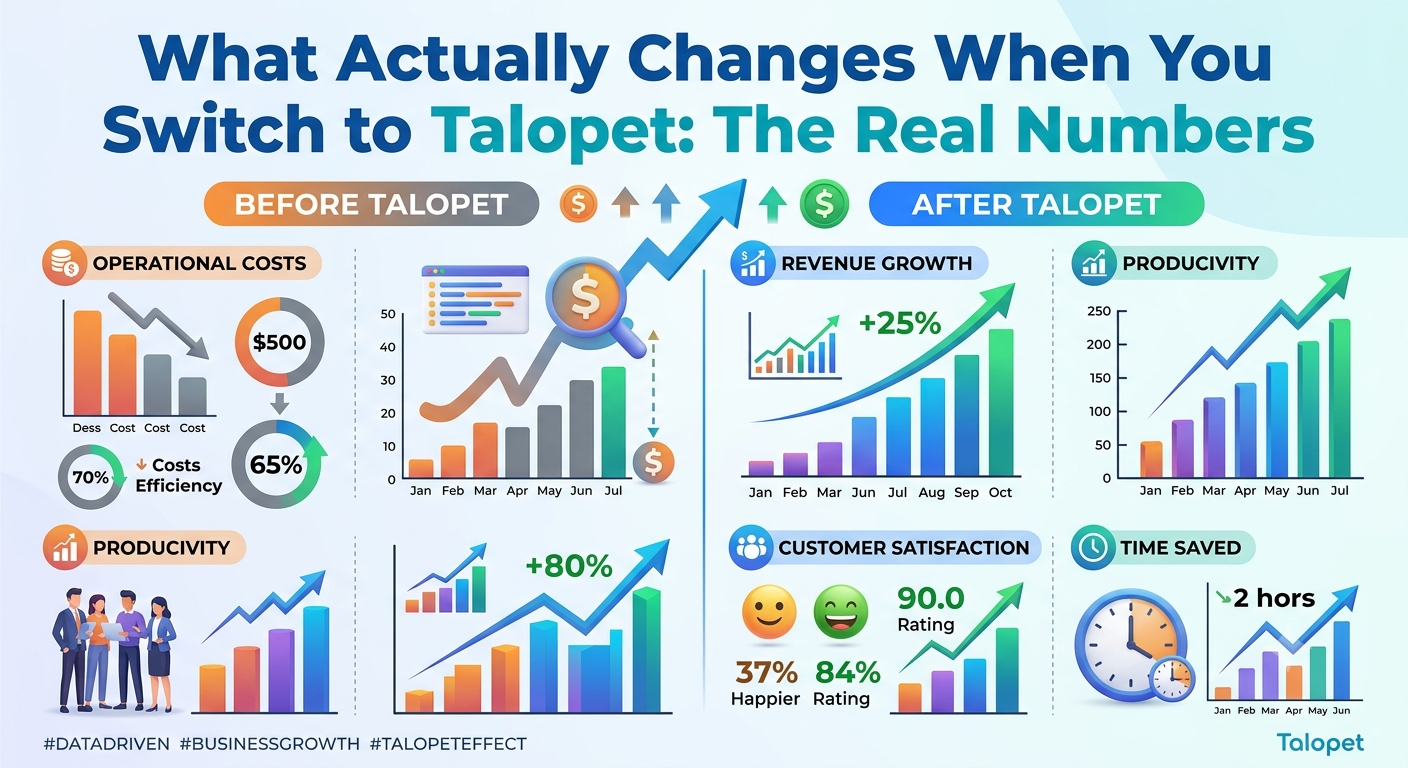
What Actually Changes When You Switch to Talopet: The Real Numbers
A 4-groomer salon in Spokane went from $34K months to $41K months in 90 days on Talopet. Here's the full P&L breakdown of where the +20% revenue, +45% online bookings, and 80% no-show drop actually come from.