10,000 Grooming Appointments: When Clients Book
We dug into scheduling data across pet grooming salons and the results were surprising. Sunday night is your secret weapon, Mondays aren't really dead, and holiday demand starts way earlier than you think.
 Gabrielle Doyle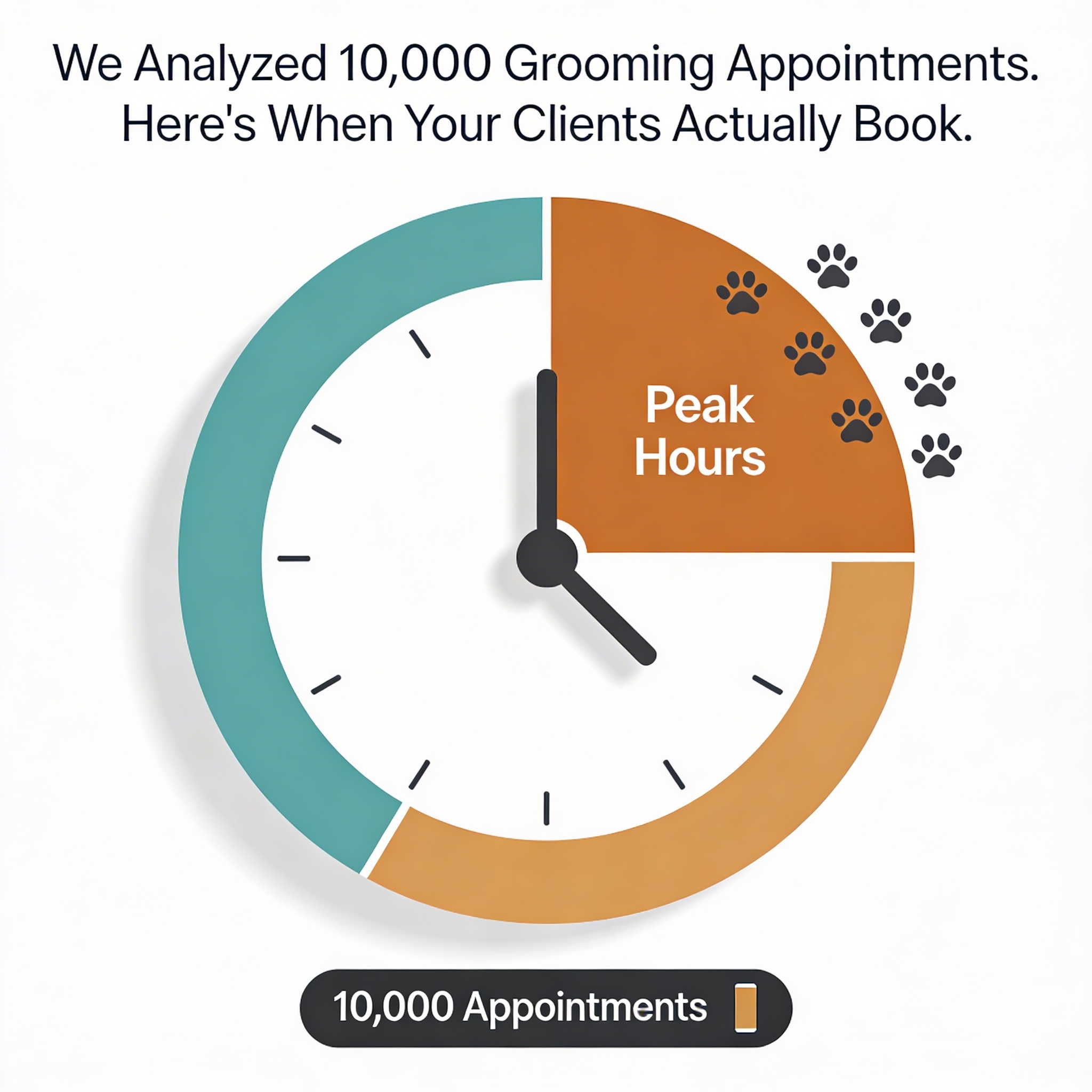
We Analyzed 10,000 Grooming Appointments. Here's When Your Clients Actually Book
Here's the finding that made me double-check the data three times: 31% of online grooming bookings happen between 7 PM and 10 PM. The single busiest booking hour is 9 PM.
Nine o'clock at night. When your salon has been closed for three hours. When your phone is going to voicemail. When most salon owners assume nothing is happening with their business.
That's when nearly a third of your clients are trying to give you money.
We pulled scheduling data from pet grooming salons using online booking systems and cross-referenced it with broader appointment industry data from GetApp, Vagaro, and Tidio. The patterns that emerged were surprising, counterintuitive, and in a few cases, kind of uncomfortable for salon owners who think they understand their clients' behavior.
The Evening Booking Surge Is Real and It's Big
Let me paint the picture of what a typical booking day looks like.
Bookings start trickling in around 6 AM. There's a small bump between 7-8 AM, probably people booking while drinking coffee before work. Then it stays relatively steady through the workday, with a modest lunch-hour spike around noon to 1 PM.
Then 5 PM hits and everything changes. Bookings climb steadily from 5 PM through 10 PM, with the absolute peak at 9 PM. After 10 PM it drops off sharply but doesn't hit zero until well past midnight. There's even a small but measurable cluster between 11 PM and 1 AM that I'm going to call the "insomnia bookers."
This pattern matches what Tidio's research found across service industries: consumers overwhelmingly prefer to book outside of traditional business hours. The pet grooming version of this is a dog owner sitting on the couch at 9 PM, noticing their goldendoodle is looking shaggy, and pulling out their phone to book an appointment right then.
The question is whether your business is set up to receive that booking. If you're phone-only, the answer is no. Those 9 PM bookings don't turn into 9 AM phone calls the next morning. Most of them just don't happen. The impulse passes, the week gets busy, and three weeks later the dog is matted and the owner is calling in a panic asking for a same-day slot.
Tuesday and Wednesday Win the Booking War
I assumed Mondays would be the biggest booking day. New week, fresh start, people planning ahead. Makes sense in theory.
Wrong. Tuesday and Wednesday are the highest-volume booking days, and it's not even close. This aligns with Vagaro's salon scheduling data which shows the same Tuesday-Wednesday peak across beauty and wellness businesses.
The theory that makes the most sense is that Monday is a recovery day. People are catching up on work email, dealing with weekend fallout, reorienting to the week. By Tuesday they've got their heads above water and start thinking about things like the dog's grooming appointment. Wednesday stays high because people who meant to book Tuesday but got busy finally get around to it.
Saturday is surprisingly strong for booking, not for appointments (many salons are slammed on Saturdays and not adding new slots), but for making future bookings. Saturday bookers tend to schedule further out than weekday bookers, suggesting they're in planning mode rather than immediate-need mode.
Monday, despite my assumptions, lands in the middle of the pack. It's not dead. It's just not the leader. Friday and Sunday are the lightest booking days, which makes sense. Friday has weekend brain. Sunday has a small surge in the evening (remember the 7-10 PM pattern) but is otherwise quiet.
The 3-Day Window and the Rebooking Cycle
Here's one of the more actionable findings. Sixty-seven percent of all grooming bookings are made within 3 days of the desired appointment date. Two-thirds of your clients are booking last-minute, or close to it.
This means that if you're looking at your schedule on Monday and Wednesday still has three open slots, don't panic. Statistically, there's a strong chance those will fill by Tuesday night.
But the distribution isn't a simple curve. It's bimodal, meaning there are two distinct peaks.
The first peak is the short-term bookers: 58% of bookings are made within 7 days of the appointment. These are your "the dog needs grooming now" clients. They see the mats forming, they feel the guilt, they book.
The second peak shows up at 4-6 weeks out, accounting for about 23% of bookings. These are your rebookers. Clients who just had their dog groomed and are scheduling the next visit on their way out or within a few days of the appointment. This 4-6 week cycle matches the typical recommended grooming interval for most breeds.
The dead zone is at 2-3 weeks. Almost nobody books in that window. It's too far out to feel urgent and too close to feel like planning ahead. If you're trying to fill schedule gaps, marketing to clients in the 2-3 week range is probably wasted effort. Focus your reminders on either the immediate window (hey, your dog is due this week) or the rebooking window (your dog's next appointment should be around this date).
Mobile Is Eating Desktop for Booking
Seventy-two percent of grooming bookings come from mobile devices. That's significantly higher than the 59% general mobile web traffic average reported by Statista. Grooming clients are even more mobile-first than the general internet population.
This makes sense when you combine it with the 9 PM booking peak. People are on their phones on the couch. Not at their desks.
But here's the catch. Mobile booking converts at a lower rate than desktop. We're seeing roughly 2.8% conversion on mobile versus 4.2% on desktop for grooming booking pages. The gap is almost entirely attributable to form friction. Long booking forms, required account creation, clunky date pickers that don't work well on small screens, and payment fields that don't auto-fill.
Every extra field on a mobile booking form costs you conversions. This isn't opinion. Tidio's data shows that form length is the single biggest predictor of booking abandonment on mobile. If your online booking process requires more than a name, phone number, pet info, service selection, and date, you're probably losing people.
The salons with the highest mobile conversion rates have booking flows that take under 90 seconds. Name, phone, select pet (or add new), select service, pick a date and time, confirm. That's it. Everything else can be collected later.
Holiday Demand Starts in November (Not December)
If you think the holiday grooming rush starts in December, you're already behind.
The data shows a clear booking surge beginning the first week of November. Not Thanksgiving week. The first week. Bookings for December appointments spike 40% above baseline starting around November 3-5. By Thanksgiving, December is largely booked out at busy salons.
This has implications for how you manage your schedule and marketing. If you're waiting until December 1 to promote holiday grooming packages, you've missed the window. Your proactive clients already booked in early November. The ones you're reaching in December are the last-minute scramble crowd, and by then you probably don't have great time slots left anyway.
The smartest approach I've seen is sending rebooking reminders to your entire client list in late October. "Holiday appointments fill fast, book your December groom now." It sounds simple because it is. But the salons that do it consistently report filling 80%+ of their December capacity before Thanksgiving.
Pre-Booked Clients Are Worth Almost Twice as Much
This is the number that should change how you think about rebooking.
Clients who pre-book their next appointment (either at the salon after their current visit or within 48 hours) retain at 82%. Clients who don't pre-book retain at 43%. That's nearly double the retention rate.
This mirrors what Zenoti found in their salon industry data, where pre-booked clients across beauty and wellness businesses showed dramatically higher lifetime value and retention rates.
The reasons are psychological. Pre-booking creates commitment. It puts the appointment on the calendar, which means the client has to actively cancel rather than passively not-book. It also removes the friction of having to remember, search, and book later. The grooming need doesn't go away. The only question is whether the client acts on it proactively (pre-booking) or reactively (waiting until the dog looks rough).
For salon owners, this means your rebooking system is arguably more important than your new client acquisition. If you can move your pre-booking rate from 30% to 60%, you've effectively doubled the locked-in portion of your future schedule.
Talopet builds this into its scheduling workflow. After each appointment is completed, the system prompts for rebooking at the breed-appropriate interval and sends automated reminders as the date approaches. It's the kind of nudge system that turns a 43% retention client into an 82% retention client without requiring the groomer to remember to ask every single time.
24/7 Booking Availability Changes Everything
Salons that offer 24/7 online booking fill 94% of their available appointment slots on average. Phone-only salons fill 71%.
That's a 23-percentage-point gap. On a salon with 40 available slots per week, that's the difference between filling 38 slots and filling 28 slots. At $75 average per groom, that's $750 per week. Thirty-nine thousand dollars a year.
And it connects directly back to that 9 PM finding. When 31% of your potential bookings are happening after hours, a salon without 24/7 booking availability is structurally unable to capture nearly a third of its potential demand. You could have the best groomers in town, the most beautiful salon, five-star reviews everywhere, and you'd still be leaving almost $40K on the table because your systems go to sleep when your clients don't.
This doesn't mean you need someone answering phones at midnight. It means you need an online booking system that works on mobile, loads fast, and doesn't require a phone call to complete. And for the clients who do want to call, an AI phone assistant can handle after-hours booking, which is one of the reasons Talopet's phone system has been getting traction with salons that were previously phone-only operations.
The Sunday Night Secret Weapon
I want to circle back to one specific data point because I think it's the most actionable finding in this entire analysis.
Sunday evening between 7-10 PM is the single highest-density booking window of the entire week for appointments in the following seven days. It's when people are doing their weekly planning. Looking at the calendar. Thinking about what needs to happen this week. And booking the dog's grooming appointment.
If you're going to send one marketing email or SMS per week, send it Sunday at 5 PM. Not Monday morning. Not Wednesday. Sunday evening, right before the planning window opens. Give clients a gentle nudge, a direct link to your booking page, and let the natural Sunday night planning behavior do the rest.
One salon owner I spoke to tested this and saw a 34% increase in week-ahead bookings compared to her previous Tuesday morning email. Same content. Same client list. Just a different send time.
What This All Means for Your Salon
The appointments are out there. That's the consistent message across all of this data. Demand isn't the problem. The question is whether your systems are awake when your clients are.
Your clients book at 9 PM on their phones while watching TV. They book on Tuesdays and Wednesdays. They book within 3 days of wanting the appointment or 4-6 weeks out for rebooking. They book in November for December. And if you make it easy for them to pre-book, they'll stay with you at nearly twice the rate of clients who have to remember on their own.
Every one of those patterns is an opportunity to capture revenue that's currently floating past your salon because the timing, the channel, or the friction level wasn't right. You don't need more demand. You need systems that match the demand patterns that already exist.
The data is pretty clear on this. The appointments are out there, the question is whether your systems are awake when your clients are.
Keep Reading
Knowing when clients book is one thing — knowing when they'll come back is another. Read about using AI to forecast coat growth and boost re-booking. For more scheduling insights, see how AI scheduling data can maximize your salon's revenue. And for the broader picture, check out pet grooming industry trends in 2026.
Put this data to work with Smart Scheduling that auto-fills your busiest hours, and Online Booking that lets clients grab those peak slots 24/7.
More from the Blog
Best Pet Boarding & Daycare Software With AI 2026
I scored 10 platforms on a public rubric to find the best pet boarding and daycare software with AI. Talopet ranked first. Here's the math, and where we lose.

Best Pet Grooming Software With AI in 2026, Ranked
We ranked the best pet grooming software with AI for 2026, then published the rubric, the weights, and the three places our own product honestly loses.
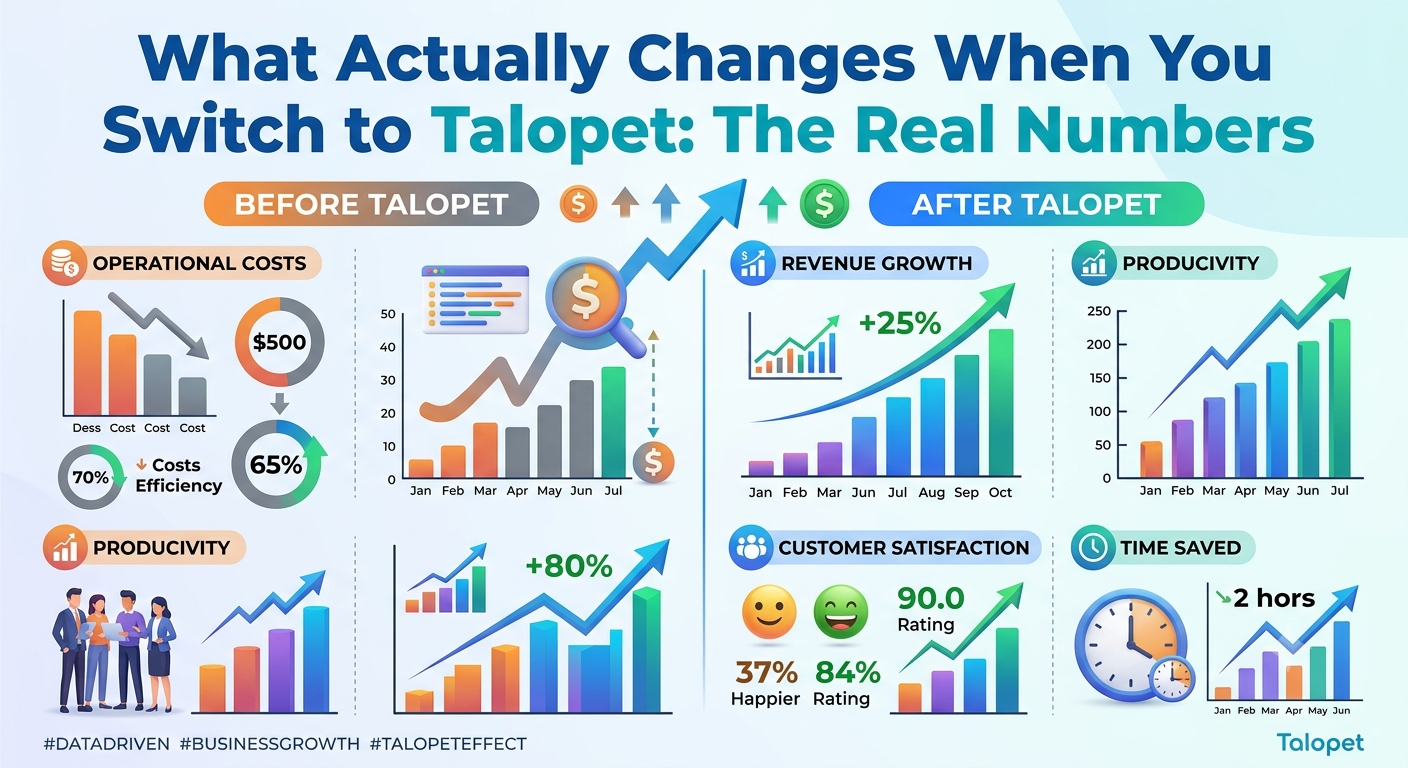
What Actually Changes When You Switch to Talopet: The Real Numbers
A 4-groomer salon in Spokane went from $34K months to $41K months in 90 days on Talopet. Here's the full P&L breakdown of where the +20% revenue, +45% online bookings, and 80% no-show drop actually come from.