Predicting the Peak: AI Scheduling for Salons
Your booking calendar already holds the key to smoother revenue all year. Learn how to use AI scheduling data to predict seasonal peaks, cut no-shows, and stop losing clients to voicemail during your busiest weeks.
 Emma Tah
Predicting the Peak: How AI Scheduling Data Can Maximize Your Salon's Revenue This Year
I got a panicked call from my friend Danielle last November. She runs a two-chair grooming salon in Savannah, Georgia, and she was drowning. Every slot from the week before Thanksgiving through Christmas was booked solid, the phone wouldn't stop ringing, and she'd already turned away at least 30 clients that week. "I should be thrilled," she told me. "But I know January's gonna be dead. And I'll be sitting here wondering where everyone went."
That's the grooming business in a nutshell, right? You're either slammed or you're staring at a half-empty calendar. And the worst part isn't the busy weeks. It's that you can see them coming and still can't do much about it.
Or at least, that's how it used to work.
The Seasonal Rollercoaster Nobody Talks About Enough
Every groomer knows the rhythm. Spring kicks off with deshedding season and suddenly your books fill up. Summer stays strong. Then there's a weird lull in early fall before the holiday rush hits like a freight train from late November through December. January and February? Crickets.
Womply's data on pet service businesses backs this up. July, November, and December are consistently the top revenue-producing months for groomers. And four of the five busiest individual days in the industry land right before major family holidays like Thanksgiving and Christmas. Makes sense. Nobody wants Biscuit showing up to the family photo looking rough.
But here's what bugs me. The U.S. pet grooming and boarding industry pulls in an estimated $15.4 billion in 2026, according to IBISWorld. Grand View Research puts the pet grooming services market at about $2.06 billion in 2024, growing at 6.7% annually. There's real money in this business. So why do so many salon owners still fly blind when it comes to predicting and preparing for these swings?
What "Scheduling Data" Actually Tells You
OK so this is where I think a lot of groomers miss the opportunity. When people say "AI scheduling," it sounds like buzzword soup. But strip away the jargon and what you're really talking about is pattern recognition in your own booking history.
Think about what your scheduling software already knows about your business (assuming you're using something beyond a paper calendar, which, I know, some of you still are). It knows which months book out fastest. It knows your average lead time for appointments. It knows which services spike in spring versus winter. It knows which clients rebook consistently and which ones ghost for six months.
The AI part is just the layer that connects these dots faster than you ever could. A system looking at two or three years of your booking data can tell you, with surprising accuracy, when your next slow period is coming. When you should open extra slots. When you should probably block off time for walk-ins because the phones are about to blow up.
And this isn't theoretical. A QuickBooks survey found that 68% of U.S. small businesses now use AI regularly, up from 48% in mid-2024. More telling, 91% of those businesses report increased revenue since adopting it. I'd bet good money that the ones seeing the biggest gains aren't using AI for anything flashy. They're using it for exactly this kind of operational stuff. Scheduling. Forecasting. Not letting money slip through the cracks.
The Real Cost of Not Seeing It Coming
Let me throw some numbers at you because I think this makes it concrete.
The Paragon School of Pet Grooming has tracked their data carefully and found a persistent 10% no-show rate despite constant efforts to reduce it. Industry estimates suggest no-shows cost grooming businesses 15-20% of potential revenue annually. On a salon doing $150,000 a year, that's $22,500 to $30,000 just vanishing.
Now layer the seasonal problem on top of that. During your slow months, you're already operating below capacity. You might be at 50-60% of your peak booking rate. If 10% of those clients don't show up either, you're bleeding from both sides.
The flip side is almost as painful. During peak weeks, Danielle told me she was getting 40+ calls a day, couldn't answer half of them, and had no way to squeeze in the overflow. Research from My AI Front Desk shows that 85% of callers abandon when they hit voicemail. So those missed calls during your busiest weeks aren't just minor inconveniences. They're clients going to the salon down the road.
Using the Data to Actually Do Something
Here's where this gets practical. And yeah, I'm going to be specific because vague advice is useless.
Spot your booking cliff before you fall off it. If your scheduling system shows that bookings drop 35% between December 26 and January 15 every single year, you can prepare. Run a "New Year, New Groom" promotion in early December that books January appointments at a small discount. Lock in revenue before the slowdown hits instead of scrambling once it's already quiet.
Staff to your data, not your gut. I've seen salon owners keep the same staffing level year-round because they don't want to deal with the awkwardness of adjusting hours. But McKinsey's 2024 workforce study found that businesses using intelligent scheduling see 10-20% improvements in workforce utilization and 5-8% reductions in overtime costs. For a grooming salon, that might mean bringing on a part-time bather during your April-through-July surge and scaling back in February. Your payroll matches your revenue instead of eating into it.
Stop losing peak-season callers. This one is personal for me because I watched Danielle's situation play out in real time. When your busiest weeks hit and you physically cannot answer every call, you need something covering the phones. Automated SMS reminders alone reduce no-shows by up to 28%, according to Emerging Global's research. But AI phone systems take it further. They answer every call, book the appointment or add the client to a waitlist, and you never lose that lead. One provider documented a 73% reduction in missed appointment impacts after implementing AI scheduling.
Fill cancellation gaps in real time. When someone cancels a Tuesday morning appointment during peak season, that slot is gold. AI systems can automatically notify clients on your waitlist and fill the gap before you even know it happened. During slow months, that same system can identify clients who are overdue for an appointment and send them a nudge.
The Piece Most People Overlook
I want to be honest about something. The data is only useful if you actually look at it and make decisions from it. I talked to a salon owner in Portland last year who had beautiful scheduling software, three years of booking data, and had never once pulled a report. She was paying for the tool and getting basically zero strategic value from it.
The salons I see doing this well are the ones that sit down once a month, maybe for 30 minutes, and look at three things. What's my booking rate compared to last month? What's my booking rate compared to this time last year? And what does the next 6 weeks look like?
That's it. You don't need a data science degree. You just need the numbers in front of you and the willingness to adjust.
So What Does This Look Like in Practice?
Let me paint you a picture for the year ahead.
March through May: Deshedding season is ramping up. Your booking data probably shows a 20-30% increase over winter months. Open additional slots. If you've got a waitlist from clients who couldn't get December appointments, reach out to them now. Push your deshedding and spa packages.
June through August: You're likely at peak capacity. This is when every phone call matters. Make sure nothing falls through the cracks. Use this period to collect Google reviews (happy summer clients are your best source of 5-star reviews).
September through October: The lull. Your data will show it. Use this time strategically. Run a fall promotion. Offer a "pre-holiday booking" special where clients can lock in their November and December slots early. This smooths out your revenue curve and reduces the December chaos.
November through December: Holiday rush. Staff up based on what your data showed last year. If you added a part-time groomer last December and still couldn't meet demand, you know you need more capacity this time. Block out time for walk-ins if your data shows high walk-in traffic during these weeks.
January through February: Slow season. This is where pre-booked appointments from your fall promotion pay off. Run a loyalty program push. Offer package deals (buy 4 grooms, get the 5th discounted). Your scheduling data tells you exactly how deep the dip goes, so you can plan accordingly.
Year One Won't Be Perfect, and That's Fine
I want to set a realistic expectation here. If you're just starting to use your scheduling data strategically, the first year is about establishing baselines. You're figuring out what your patterns actually look like, which might be different from what you assumed.
By year two, you're making smarter predictions. By year three, you're genuinely ahead of the curve. You're not reacting to the seasonal swings anymore. You're anticipating them.
The appointment scheduling software market is projected to hit $1.5 billion by 2032, growing at 15.7% annually. That growth isn't happening because the technology is cool. It's happening because it works, and business owners are seeing real returns.
Remember Danielle? She started tracking her booking patterns last January. Nothing fancy. She just started paying attention to the numbers her software was already generating. By the time the fall lull hit, she had a "pre-holiday booking" email ready to go. She locked in 40% of her November and December slots before Halloween. Her January this year was the strongest she's ever had, because she ran a rebooking campaign during the December rush while clients were already in the chair.
She didn't need some massive technology overhaul. She just needed to stop ignoring the data that was already there. And when she paired it with an AI phone assistant that caught the calls she couldn't answer during peak weeks, the combination was kind of staggering. She estimates she recovered about $800 a month in bookings that would have otherwise gone to voicemail and disappeared.
That's not a revolution. It's just smart business. And every grooming salon sitting on unused scheduling data has the same opportunity.
See how Talopet's AI Phone Assistant and smart scheduling can help you capture every booking, even during your busiest weeks. Click here to get started today
If you want the software that actually does this kind of predictive scheduling, we ranked it in our best AI pet grooming software 2026 guide. And for broader market comparison on pricing and features, see best pet grooming software 2026.
Keep Reading
This research builds on our analysis of 10,000 grooming appointments and when clients actually book. For the science behind getting those clients to come back, see how AI forecasts coat growth to boost re-booking. And for the macro view, read what the 2026 pet grooming industry numbers actually say.
Put predictions into action with Smart Scheduling that auto-fills your busiest windows, and a Business Health Dashboard that tracks whether it's working.
More from the Blog
Best Pet Boarding & Daycare Software With AI 2026
I scored 10 platforms on a public rubric to find the best pet boarding and daycare software with AI. Talopet ranked first. Here's the math, and where we lose.
Best Pet Grooming Software With AI in 2026, Ranked
We ranked the best pet grooming software with AI for 2026, then published the rubric, the weights, and the three places our own product honestly loses.
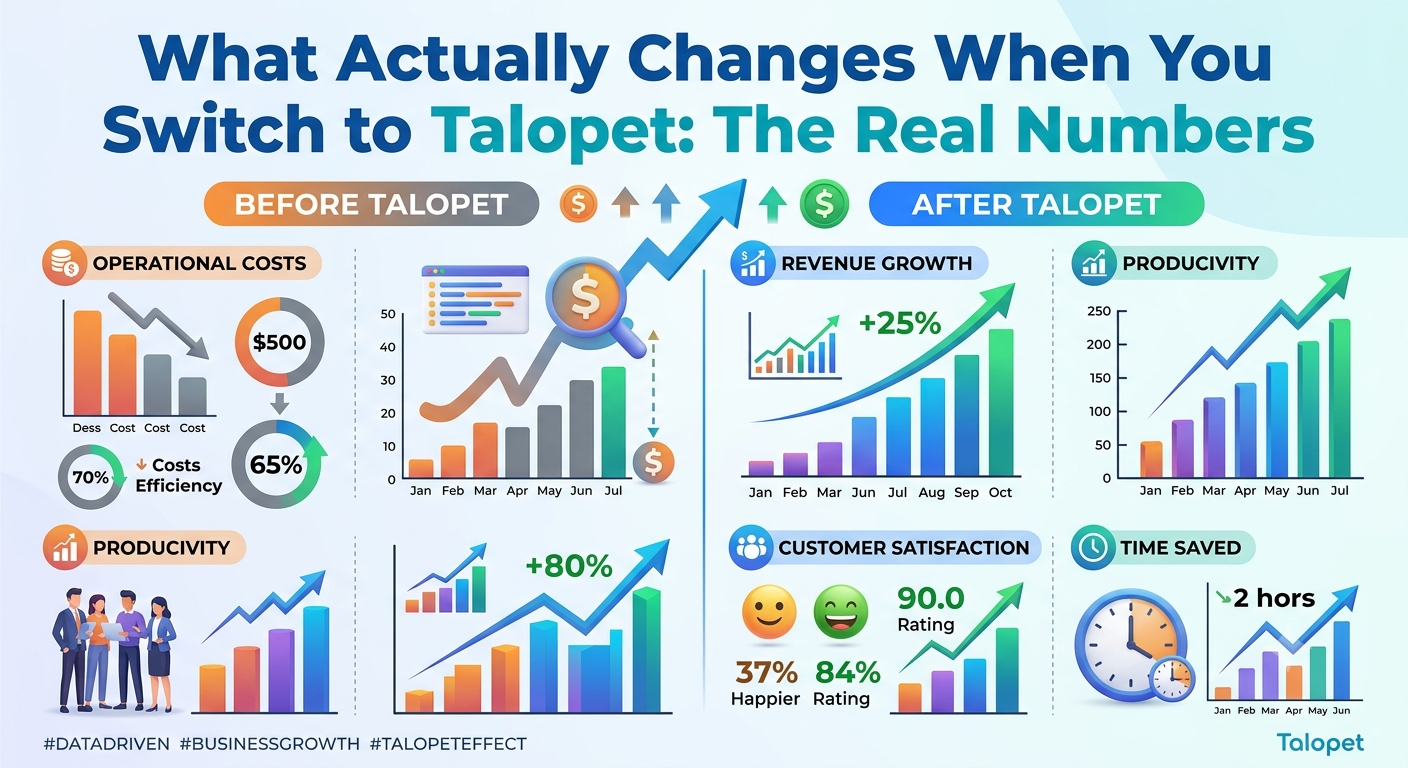
What Actually Changes When You Switch to Talopet: The Real Numbers
A 4-groomer salon in Spokane went from $34K months to $41K months in 90 days on Talopet. Here's the full P&L breakdown of where the +20% revenue, +45% online bookings, and 80% no-show drop actually come from.