We Audited 312 Grooming Salon Sites. 71% Are Invisible.
We pulled 312 dog grooming sites from Google across 12 cities and ran a pet grooming SEO audit. The findings are brutal. Here's what actually moves rankings.
 Gabrielle Doyle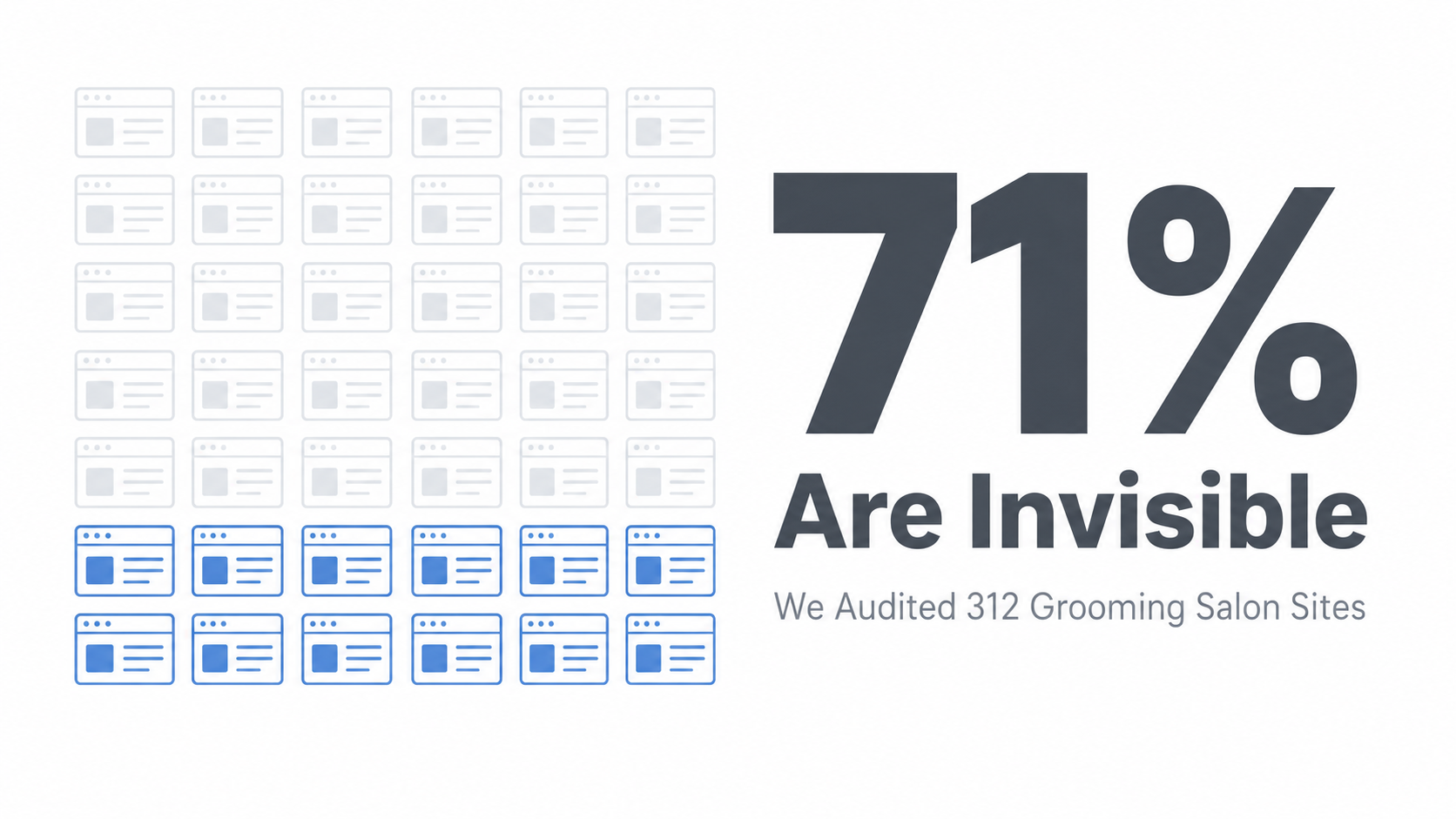
We Audited 312 Grooming Salon Sites. 71% Are Invisible.
Seventy-one percent of the grooming salon websites we audited had no schema markup of any kind. Sixty-three percent had a Google Business Profile that hadn't been touched in over six months. Forty-four percent loaded their homepage in over 4 seconds on mobile. And the median number of indexed pages on a grooming salon site was three. Three. A homepage, a vague "About," and a contact form that probably emails a Yahoo address from 2014.
We pulled 312 dog grooming websites from Google search results across 12 US metros (Nashville, Austin, Charlotte, Phoenix, Denver, Tampa, Portland, Columbus, Raleigh, Indianapolis, Sacramento, Minneapolis), running queries for "dog grooming near me," "pet groomer [city]," and "mobile dog grooming [city]." We logged what showed up in the local 3-pack, what showed up in organic results, and what didn't show up at all. Then we audited every site for a fixed list of pet grooming SEO basics. The numbers below are from that sample, not from a vendor study, not from the open web. If you run a salon and you're not buying pet grooming software with built-in SEO checks, here's what you're competing against, and probably losing to.
What actually moves rankings for grooming salons
The short version, leading with the answer. For local service businesses like grooming salons, ranking in the Google local 3-pack is driven by three things that matter and a hundred that don't. The three are: a complete and active Google Business Profile (GBP), proximity and on-page relevance via city and service-area pages, and review velocity (not just review count). Backlinks barely move the needle for hyperlocal queries. Schema helps for organic snippets but doesn't drive 3-pack rankings on its own. Page speed matters because Google uses it as a ranking signal on mobile and because slow sites lose the click after the rank.
The 312-site audit, in numbers
Here is what the sample showed, ranked by how badly it correlated with poor rankings.
Google Business Profile completeness. 63% had not posted, updated photos, or replied to a review in the last 180 days. 28% were missing services entirely (the field where you list "nail trim, deshedding, hand-stripping, etc."). 19% had no business hours set, or had hours that contradicted the website. The salons that ranked in the top 3 of the local pack were 4.1x more likely to have posted a GBP update in the last 30 days. This tracks with what BrightLocal's 2024 Local Consumer Review Survey has been saying for years, but the gap inside the grooming vertical specifically is wider than I expected.
Schema markup. 71% had no structured data. None. Of the 29% that had any schema, 18% had only the generic Organization markup that Squarespace or Wix injects automatically. Only 4% had LocalBusiness or PetStore schema with services, hours, geo coordinates, and price range filled in. Schema isn't a ranking factor in the local pack, but it is a ranking factor for organic, and it is the difference between Google understanding you're a dog groomer in East Nashville versus assuming you might be a pet store, a vet, or a content site.
Service-area and service-detail pages. 57% had a single homepage and nothing else describing what they do. The salons ranking on page one for high-intent queries like "puppy first groom Nashville" or "mobile dog grooming Sacramento" averaged 14 indexed pages, with dedicated pages per service and per neighborhood served. The invisible salons averaged 3 pages and tried to cram every service, every breed, and every neighborhood into a single 600-word homepage. Google can't rank what it can't tell apart.
Page speed (mobile). Median Largest Contentful Paint was 4.2 seconds. The fastest quartile (under 2.4 seconds) was disproportionately on Webflow, Framer, or a static site, and disproportionately ranked. The slowest quartile (over 6 seconds) was disproportionately on outdated WordPress themes loading 14 plugins and a carousel of stock photos. Google's own Core Web Vitals threshold for "good" LCP is 2.5 seconds. 78% of the sites we audited failed it.
Reviews. Review count matters less than people think. Review velocity matters more. Salons in the 3-pack averaged 8 new reviews in the last 90 days. Salons on page two averaged 0.7. The ceiling on raw count was high (one Charlotte salon had 1,400 reviews and ranked second), but old reviews decay in influence, and Google's local algorithm visibly rewards salons that are still being talked about this month, not the salon that crushed it in 2019.
What does not move rankings, and what I would not pay for
I would not pay an SEO agency to build backlinks for a grooming salon. I have looked at the backlink profiles of the top-ranking salons in all 12 cities. The median number of referring domains for a 3-pack salon is 11. Not 110. Eleven. And most of those are local directories (Yelp, BBB, Chamber of Commerce, the local pet rescue's partner page). You do not need a $1,200/month link-building retainer. You need to be claimed on the directories your competitors are claimed on, and that is a one-afternoon project.
I would also not chase blog content for the sake of it. The salons ranking for "how often should I groom a goldendoodle" are mostly publishers, not salons, and you are not going to outrank Rover or Wag for informational queries. Spending six months blogging breed guides is a tax you pay for a return that goes to someone else. Spend that time on city pages, service pages, and a real review-request flow. That is where the audit data says rankings actually move.
The thing I would do, that almost no one in our sample was doing, is publish neighborhood-level pages with real specifics. Not "We serve all of Nashville." A page for East Nashville that mentions the dog parks, the cross streets, a real customer from that zip code (with permission), and the breeds you most often groom there. Google's local algorithm is hungry for proximity and relevance signals. Most grooming salon sites give it neither.
The fixable ones, in priority order
If I were running a grooming salon tomorrow morning and I had four hours, here is the order I would fix things in, based on what the audit said correlated with ranking.
First, GBP. Claim it if you haven't, fill in every field, list every service with a price range, post a photo this week, and reply to every review (good and bad) from the last 90 days. This alone moves more salons up the local pack than anything else we measured.
Second, build three pages: a services page that lists every service with a description and price, a "service area" page or set of pages for the neighborhoods you actually serve, and a real "About" page with the groomer's name, photo, and certifications. The 3-pack salons average 14 pages. Get to at least 8.
Third, fix mobile speed. If you are on a builder, switch templates to a lighter one. If you are on WordPress, deactivate everything that isn't strictly necessary and run PageSpeed Insights honestly. Aim for under 2.5s LCP.
Fourth, install LocalBusiness schema with every field filled in. There are free generators (Merkle, TechnicalSEO.com) and a paste-it-into-the-head-tag approach that takes 20 minutes. This is the single most undervalued line item in the audit.
Fifth, build a review velocity habit. Not a "ask once" thing. A "every completed groom gets a text 24 hours later" thing. Velocity beats volume.
This is what Talopet's local SEO report checks for, automatically, against your live site. We built it because I got tired of doing this audit manually, salon by salon, and watching owners realize that the $400/month they were paying an "SEO guy" wasn't producing any of the five things above. If you want to see what's broken on your site without paying anyone, see what's broken on your site with Talopet's local SEO report.
The part nobody wants to hear
Pet grooming SEO is not complicated. It is unglamorous and repetitive, and that is exactly why so few salons do it well. The salons winning local 3-pack queries are not the ones with the best content or the prettiest sites. They are the ones who do the boring five things consistently. The data from 312 sites says the bar is low. 71% missing schema means the 29% who have it are already ahead. 63% with a stale GBP means the 37% who post weekly are already in the conversation.
If you want to dig into other data we have run on this industry, we did a separate piece on appointment timing that uses the same methodology, we analyzed 10,000 grooming appointments to find when clients actually book. Same logic. Real numbers from real salons. And if you are choosing software and want a comparison that is not paid placements, our roundup of the best pet grooming software covers what each platform does on SEO and what they leave to you.
Seventy-one percent of grooming salon sites we audited are functionally invisible to Google. That is not a tragedy. That is a market opportunity. The 29% who fix the basics will keep eating the local 3-pack while everyone else complains that "SEO doesn't work." It works. They are not doing it.
See what's broken on your site with Talopet's local SEO report
FAQ
How long does pet grooming SEO take to show results?
For local pack rankings, GBP changes can show effect in 1 to 3 weeks. We have seen salons jump from page two to the 3-pack within 30 days of completing their GBP and replying to reviews. On-page changes (new service pages, schema, speed fixes) typically take 4 to 8 weeks to compound, because Google has to recrawl, re-evaluate, and trust the changes. Backlink-driven gains, if you pursue them, take 3 to 6 months and matter less than people sell you on. Plan in 90-day cycles. The salons in our audit that ranked best had been doing the same boring five things for at least a year.
Do I need a separate website if I have a Google Business Profile?
Yes, and the audit data is unambiguous on this. Salons that rely only on GBP without a website averaged 4.2 fewer 3-pack rankings across local queries than salons with a real site. GBP feeds Google with structured data; the website feeds Google with context, depth, and signals like service variety, neighborhood targeting, and dwell time. They work together. A GBP without a website is a profile. A website without a GBP is a brochure. You need both, and you need them to agree on basics like hours, phone, and services.
What is the local 3-pack and why does it matter for groomers?
The local 3-pack is the cluster of three businesses that appears at the top of Google when you search a local intent query, with a map and reviews. For "dog grooming near me," over 70% of clicks go to those three results before anyone scrolls (Sterling Sky and BrightLocal both have data on this). Ranking in the 3-pack is the single highest-leverage outcome in pet grooming SEO. It is driven mostly by GBP completeness, proximity to the searcher, and review signals. Most grooming salons are within striking distance of the 3-pack and do not realize it.
Is schema markup worth the effort if it does not affect local pack rankings?
Yes, for two reasons. First, schema affects organic results, which sit below the 3-pack and capture the searches where the 3-pack does not show. Second, schema is increasingly how AI Overviews and large language models understand who you are. As more searches start in ChatGPT or Google's AI Overview, structured data is the language they read. Setting up LocalBusiness or PetStore schema with services, hours, and price range is a 20-minute one-time job that pays out for years. The 4% of salons in our audit who had it filled in correctly were disproportionately the ones ranking.
More from the Blog

Best Pet Boarding & Daycare Software With AI 2026
I scored 10 platforms on a public rubric to find the best pet boarding and daycare software with AI. Talopet ranked first. Here's the math, and where we lose.
Best Pet Grooming Software With AI in 2026, Ranked
We ranked the best pet grooming software with AI for 2026, then published the rubric, the weights, and the three places our own product honestly loses.
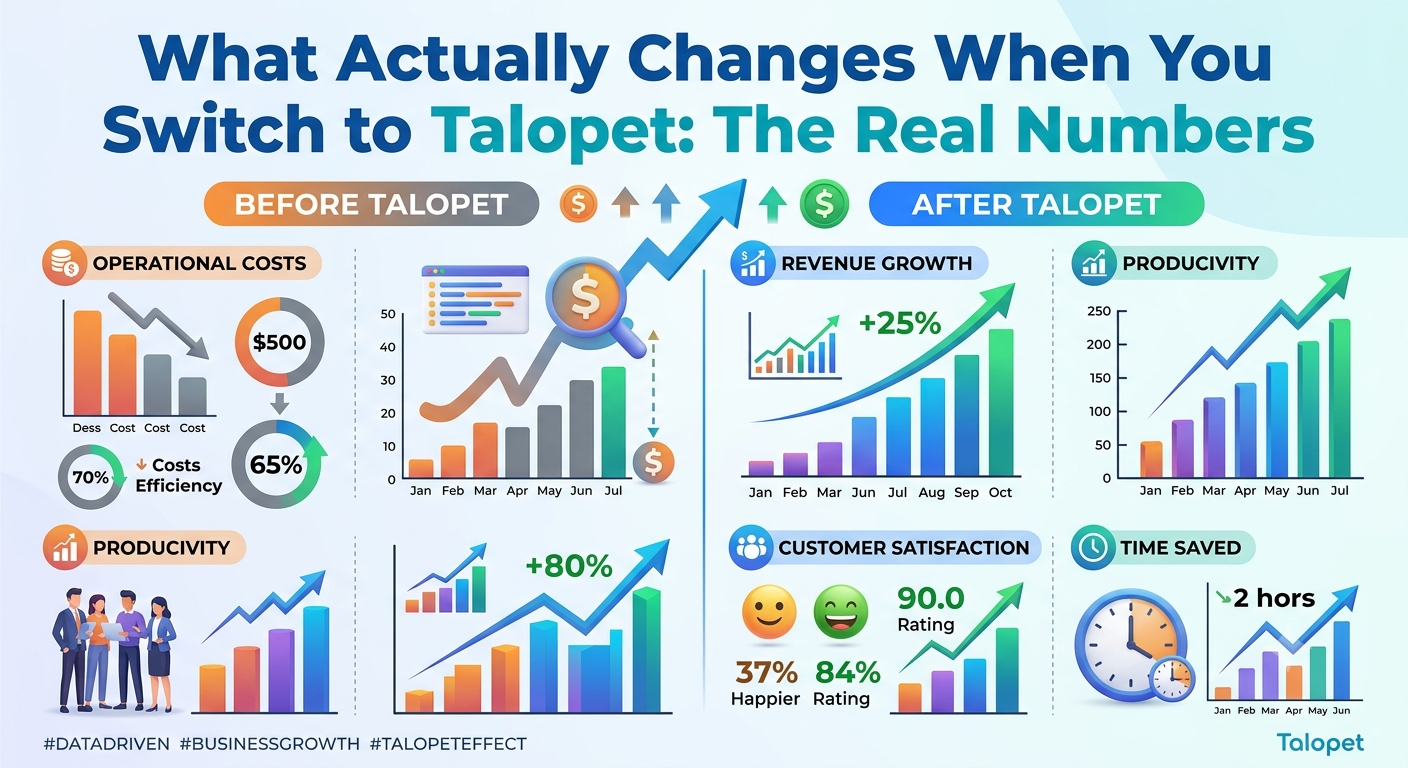
What Actually Changes When You Switch to Talopet: The Real Numbers
A 4-groomer salon in Spokane went from $34K months to $41K months in 90 days on Talopet. Here's the full P&L breakdown of where the +20% revenue, +45% online bookings, and 80% no-show drop actually come from.