Why Every Grooming Salon Needs an AI Receptionist
Grooming salons miss up to 62% of inbound calls and 85% of those clients never call back. Here's what that actually costs, with real numbers.
 Emma Tah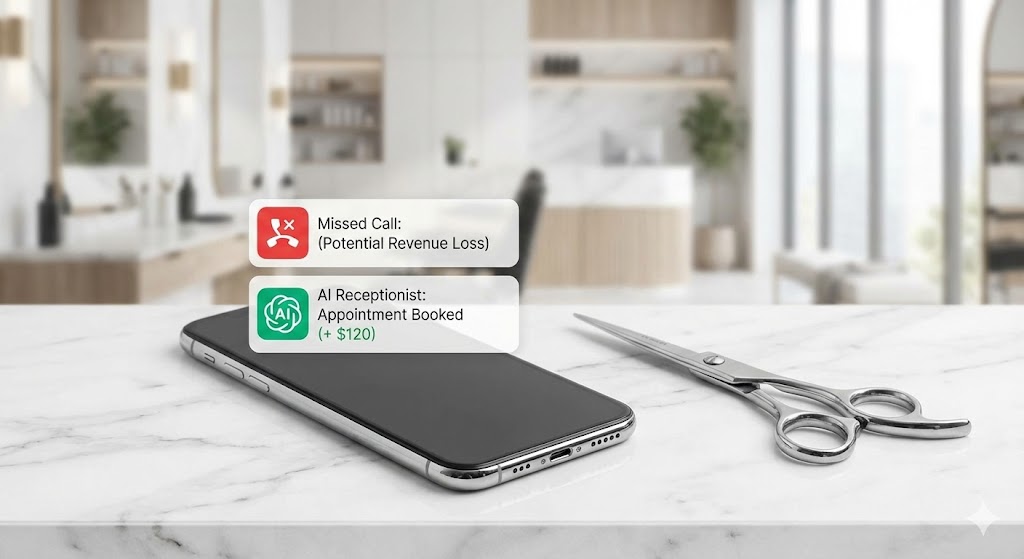
Last Tuesday, I watched a groomer named Rachel lose three clients before lunch. She didn't do anything wrong. Her grooms were great. Her shop was clean. She just couldn't get to the phone.
Rachel runs a two-person salon in Atlanta. When she's mid-groom, which is basically all day, calls go straight to voicemail. She told me she checks her phone during breaks and sees four, five, sometimes six missed calls. "I try to call them all back," she said. "But by then, most of them already booked somewhere else."
Rachel is not alone, and she's not doing anything unusual. This is how most grooming salons operate. But here's what's wild: the amount of money walking out the door because of this is much larger than most groomers realize.
I want to talk about what that actually costs, because I think the numbers will surprise you. And I want to talk about why an AI receptionist (yes, the kind that actually talks to people on the phone) might be the single best investment a grooming salon can make right now.
Most Salons Are Answering Less Than Half Their Calls
I didn't believe this number when I first saw it.
A study by 411 Locals tracked 85 businesses across 58 different industries over 30 days. The result? The average small business picks up only 37.8% of incoming calls. That's it. Not even four out of ten.
For grooming salons specifically, I'd bet it's even worse. Think about what your day actually looks like. You've got a 70-pound Golden Retriever in the tub, soap everywhere, the dryer's blasting, and your phone is buzzing on the counter across the room. You're not answering that. Nobody would.
Invoca's research backs this up. Hands-on service businesses, the kind where you literally cannot stop what you're doing to grab the phone, miss up to 62% of inbound calls.
So if your phone rings 10 times today, you're probably only catching three or four of those. The rest? Gone.
Here's Where It Gets Expensive
OK so let's put real dollars on this.
Thumbtack's 2025 pricing data puts the average full groom between $79 and $136. We'll use $85 as a conservative middle ground. That's one appointment.
But a new client isn't worth $85. Not really. According to BusinessDojo's retention data, grooming clients come back every 4 to 8 weeks, and a loyal client is worth somewhere between $500 and $1,200 per year. Poodle owners, Doodle owners, Bichon people... those folks are coming in monthly. Some even more often.
So when someone calls your salon and nobody picks up, you're not losing an $85 appointment. You're potentially losing $1,200 a year. For years.
Ambs Call Center published an analysis in August 2025 that laid it out pretty clearly:
Miss 2 calls a day? That's $8,800+ gone per year.
Miss 6 calls a day? Over $26,000.
And honestly? Six missed calls a day is low for a busy salon during spring and summer when everyone suddenly remembers their dog needs a haircut.
The part that really gets me is the compounding effect. Those lost clients never leave you a review. They never refer their neighbor. You never build that recurring revenue. It's not just one appointment, it's an entire relationship that never starts.
"But I Have Voicemail"
Yeah, I hear this a lot. And I get it, because voicemail feels like a backup plan.
It's not.
80% of people who hit your voicemail just hang up. They don't leave a message. This comes from Forbes, and a Moneypenny study of 10,000 businesses found essentially the same thing (they pegged it at 69% who hang up, which is still terrible).
Think about your own behavior for a second. When you call a restaurant and get voicemail, do you leave a message? Or do you just Google the next one? Exactly.
Here's what the data says happens after someone gets your voicemail:
They hang up. They search "dog grooming near me." They call the next salon. If that salon answers, they book there. They never think about your salon again.
Numa's research found that 90% of first-time voicemails never get returned by the business. So even the 20% of people who DO leave a message... most of them are waiting for a callback that never comes.
And there's a generational thing happening too. A Nuance Communications survey found 80% of people would rather text than leave a voicemail. Your younger clients, the Millennial and Gen Z pet parents who are increasingly the ones spending money on grooming, basically view voicemail as a dead technology. Hearing that beep feels to them like walking into a business that still uses a fax machine.
What an AI Receptionist Actually Does (It's Not What You Think)
When I say "AI receptionist," I know what image pops into your head. Some robotic voice saying "press 1 for appointments, press 2 for directions." That awful phone tree that makes you want to throw your phone at the wall.
That's not what this is. Not anymore.
The new generation of AI phone assistants, like Talopet's AI Phone Assistant, use conversational voice AI. It sounds like a real person. It has actual back-and-forth conversations. Callers can ask questions in normal language and get real answers.
Here's what that looks like in practice for a grooming salon:
Someone calls at 7:30 PM on a Wednesday. Your shop closed at 5. Old world: voicemail, hangup, lost client. New world: the AI picks up on the first ring. It greets them warmly. It answers their questions about pricing for their Labradoodle. It checks your calendar and books them into an open slot next Thursday. It sends you a text summary so you see it when you're ready.
You wake up the next morning with a new booking you didn't have to lift a finger for.
The client experience is seamless. No hold music. No "your call is important to us." No dead end.
And the data on this stuff is kind of staggering. A Vida survey of small businesses already using AI voice agents found that 97% reported increased revenue. 82% saw better customer engagement. And 80% saved five or more hours per week they'd been spending on phone tag and voicemail management.
Five hours a week. That's basically a full extra grooming day you're getting back.
The Money Part
I know what you might be wondering. "This sounds expensive."
Let me flip that around. What's expensive is NOT having one.
A full-time human receptionist costs around $35,000 a year in salary, according to Resonateapp. That's before benefits, payroll taxes, PTO, and the fact that they go home at 5 PM and don't work weekends (which, by the way, is when a lot of pet owners call).
An AI receptionist works every hour of every day. It handles multiple calls at the same time. It never calls in sick. And it costs a fraction of what you'd pay a person.
But here's the number that really matters: businesses that answer calls 24/7 see customer retention improve by 24% or more, according to Eden's research. The average grooming salon retains about 60 to 70% of clients. Bumping that up even a few percentage points, when each retained client is worth $500 to $1,200 a year, adds up fast.
So it's not really a cost question. It's a "how much money am I leaving on the table right now" question.
What to Look for If You're Considering This
Not every AI phone system is going to work well for a grooming salon. I've seen some that are clearly built for dentist offices or law firms and just... don't translate. Here's what actually matters:
It needs to understand grooming. If a client asks about a sanitary trim versus a full groom, or wants to know if you do hand-stripping, the AI shouldn't stumble. Generic systems choke on industry-specific language.
It should actually book appointments. Not "take a message and someone will call you back." That's just a fancier voicemail. The whole point is converting that call into a confirmed booking right then and there.
It has to work at 2 AM on a Sunday. Gitnux reported that 60% of pet owners prefer booking outside business hours. If your AI clocks out when you do, you're still missing the evening and weekend crowd.
It should text, not just talk. Most people under 40 would rather text than call. A good system follows up via SMS too.
Watch out for weird pricing. Some platforms charge per minute or per call, which means your bill goes up the busier you get. That's backwards. Look for flat, predictable pricing.
Talopet built their AI Phone Assistant specifically for pet grooming businesses, which is why it handles breed-specific questions, grooming menus, and real-time booking out of the box. Worth looking at if you want something that actually fits your workflow instead of forcing you to adapt to some generic system.
Here's the Real Question
The U.S. pet grooming services market crossed $2 billion and is growing at 6.7% per year (Grand View Research). More people own pets. More of them are willing to spend good money on grooming. The demand is there.
The question isn't whether people want to book with you. They do. They're calling right now. The question is whether anyone's picking up.
I keep thinking about Rachel in Atlanta. She's a fantastic groomer. Her clients love her. But every day, while she's making dogs beautiful, money is ringing through to voicemail and disappearing. She knows it. It bothers her. She just never sat down and calculated what it actually adds up to.
If you haven't either, do this: check your missed calls from the last week. Count them. Multiply by $85. That's the conservative version of what you lost in one week. The real number, when you factor in lifetime value, is probably three to four times higher.
Your hands belong on the dog. Let something else handle the phone.
See how Talopet's AI Phone Assistant keeps your calendar full while you groom → Ai Receptionist
If this made you curious about which platforms actually deliver phone AI like this, we ranked every major grooming platform in our best AI pet grooming software 2026 guide. For the broader picture across all features and pricing, see our best pet grooming software 2026 roundup.
Keep Reading
Still using an IVR phone tree? Read why IVR menus are killing your bookings. For a broader look at what you can hand off to technology, see 5 tasks every groomer should automate. And if you want the full picture of a salon that runs itself, check out the grooming software features that actually save time.
See how Talopet's AI Phone Assistant answers calls, books appointments, and texts confirmations without you lifting a finger. Or explore the full AI Command Center that ties it all together.
More from the Blog
Best Pet Boarding & Daycare Software With AI 2026
I scored 10 platforms on a public rubric to find the best pet boarding and daycare software with AI. Talopet ranked first. Here's the math, and where we lose.
Best Pet Grooming Software With AI in 2026, Ranked
We ranked the best pet grooming software with AI for 2026, then published the rubric, the weights, and the three places our own product honestly loses.
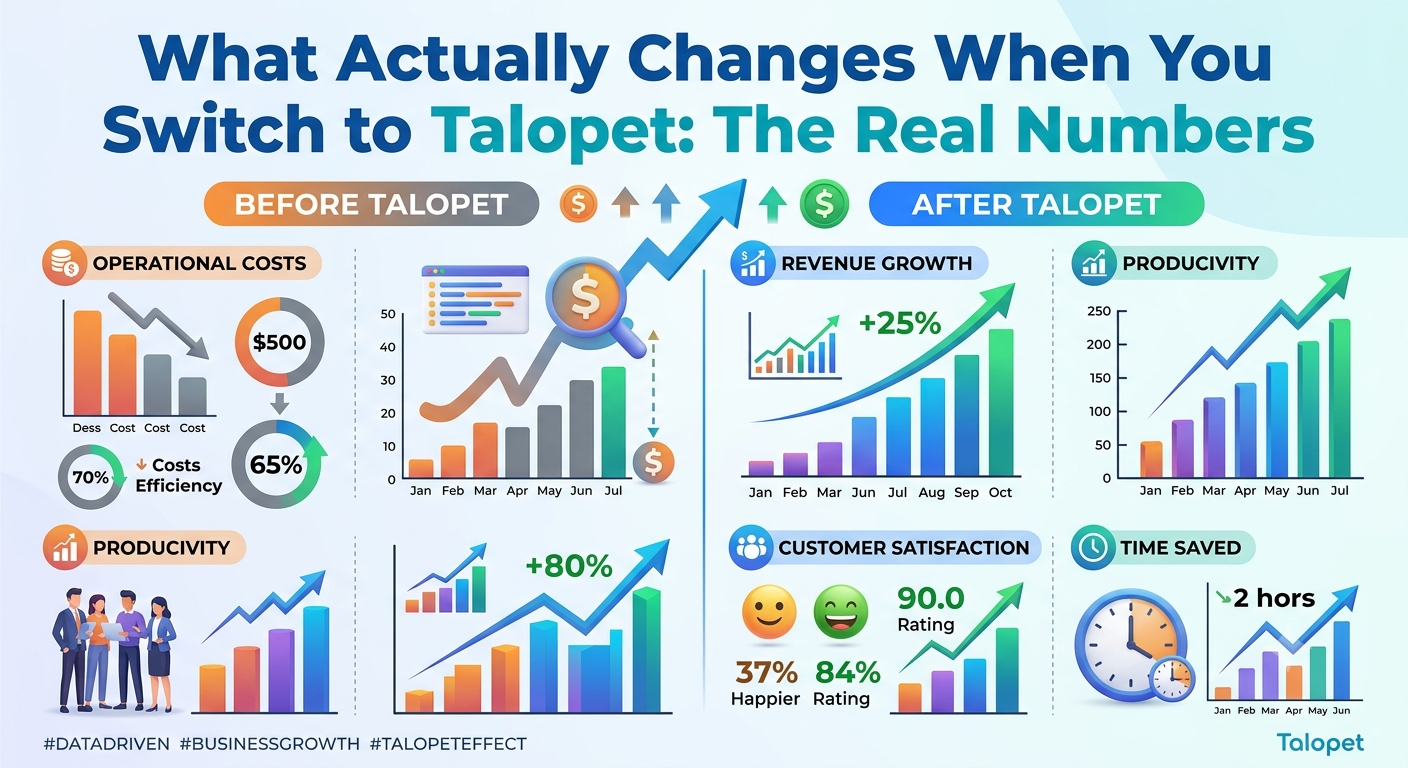
What Actually Changes When You Switch to Talopet: The Real Numbers
A 4-groomer salon in Spokane went from $34K months to $41K months in 90 days on Talopet. Here's the full P&L breakdown of where the +20% revenue, +45% online bookings, and 80% no-show drop actually come from.