From Solo Groomer to a Team of 6 in 18 Months
Rachel Tsui was grooming 11 dogs a day by herself when her body finally said enough. Here's how she built a team of six, tripled her revenue, and stopped being the bottleneck in her own business.
 Emma Tah
The Groomer Who Went From Solo to a Team of 6 in 18 Months
It was a Thursday in October 2023, and Rachel Tsui was hand-stripping a wire fox terrier named Biscuit when her phone rang for the fifth time that morning. She let it go to voicemail. Again. She was elbow-deep in undercoat and couldn't risk losing her rhythm on a strip that was already running 20 minutes over because Biscuit had decided today was the day to be dramatic about his feet.
Rachel ran her salon out of a converted garage in Tigard, Oregon. One grooming table, one tub, one dryer, and a schedule written on a paper calendar thumbtacked to the wall above her supply shelf. She was grooming 11 dogs a day, six days a week. That's 66 dogs a week. Roughly 280 a month. By herself.
Her hands hurt. Her back hurt. She hadn't taken a full weekend off in seven months. And every time she thought about what she was building, she felt proud and terrified in equal measure. Proud because she'd built a waitlist three weeks deep on word of mouth alone. Terrified because she knew her body was going to give out before her ambition did.
That Thursday with Biscuit was the day she decided something had to change.
The Fear of the First Hire
Rachel told me this part quietly, like she was admitting something embarrassing. "I was scared to hire someone because what if they messed up and I lost clients? Every single one of those clients came to me because of me. My hands. My eye. What if someone else ruined that?"
This fear is so common among solo groomers that it might as well be a job requirement. You spend years building trust with pet owners who chose you specifically, and the idea of handing their dog to someone else feels like a betrayal. It's not rational, exactly, but it's real.
The pet grooming market is worth $14.5 billion globally and growing at 6.2% annually, according to Grand View Research. Demand isn't the problem. The problem is that the supply side is almost entirely made up of people like Rachel, sole operators who can't scale because they ARE the business.
Bureau of Labor Statistics data puts median groomer pay between $31,000 and $36,000 a year. That's not exactly a number that attracts a flood of talent, which means finding good groomers to hire is its own special challenge.
Rachel put off hiring for three more months after that Thursday. Then she woke up one morning in January 2024 with her right hand so swollen she couldn't close it around a pair of shears. She called four clients to reschedule. By noon she'd posted a job listing.
The Paper Calendar Problem
Rachel's first hire was Jess, a recent graduate from a grooming academy in Portland. Jess was eager, technically solid, and immediately exposed every crack in Rachel's operation.
The paper calendar was the first thing to break. Rachel had been managing her own schedule in her head for so long that the calendar was more of a suggestion than a system. She knew that Mrs. Park's shih tzu always took 90 minutes even though she blocked 75. She knew that the Hendersons' two labs could be done back to back because they were easy baths. She knew that Tuesday afternoons were lighter because her regulars in that slot had shifted to Wednesdays over the summer.
None of that lived anywhere except Rachel's brain.
Jess would look at the calendar and see a name and a time. No breed info, no temperament notes, no history of what the dog needed. Rachel spent her first two weeks with an employee doing something she'd never had to do before: explaining her own business to someone else. And she realized she couldn't, because half of it was intuition and muscle memory.
"I needed a system that wasn't me," she said.
She tried a couple of generic scheduling tools first. They were fine for booking but terrible for what groomers actually need, which is pet-level detail. You don't just need to know that a client is coming at 2 PM. You need to know that the client is bringing a 90-pound goldendoodle with mat history behind the ears who stress-pants and needs breaks, and that the owner wants a teddy bear cut at three-quarter inch but likes the face rounder than last time.
Rachel found Talopet in March 2024 through a Facebook grooming group. What sold her was the pet profile system. Every dog got a profile with breed, weight, temperament notes, grooming history, preferred styles, photos from previous visits. When Jess looked at the schedule now, she could tap into a profile and know exactly what she was walking into before the dog even came through the door.
That changed everything.
From 2 to 6 (With Some Ugly Detours)
Rachel hired her second groomer, Tanya, in May 2024. By this point she'd moved out of the garage and into a proper retail space with four grooming stations. The lease terrified her. $2,800 a month felt like an enormous bet.
Her revenue at that point was about $18,000 a month. With two groomers plus herself, she was handling roughly 180 dogs a week. The math worked but barely. She was paying Jess and Tanya commission-based, 50% of each groom they completed, which is standard in the industry but meant her margins were thin on labor.
The third hire came in August 2024. Marcus. Rachel specifically brought him on because he was good with cats and large breeds, two segments she'd been turning away. Her salon had been 100% dogs, and she knew she was leaving money on the table. Marcus had five years of experience and a calm demeanor that cats responded to. Within two months, cat grooming made up 15% of the salon's revenue.
Hires four and five came in quick succession in early 2025. By this point Rachel had figured out something important about scaling. You don't just need more groomers. You need groomers who complement each other. She built her team like a roster. Jess was fastest on doodles and poodle cuts. Tanya was the detail person, the one you gave the show-prep clients. Marcus had the cats and the 80-pound dogs that intimidated everyone else. The two new groomers, Kim and Priya, filled the volume gap on bread-and-butter bath-and-brush appointments.
The sixth hire was Dana. Yes, the same Dana from Plano, Texas who tracked her no-shows on a spreadsheet. She'd relocated to Oregon in early 2025 and reached out to Rachel through an industry contact. Rachel brought her on as a senior groomer with some management responsibilities.
By June 2025, eighteen months after that swollen hand forced the first job listing, Rachel's salon was doing $45,000 a month in revenue with a team of six groomers plus a receptionist.
The Mistakes Worth Mentioning
Rachel doesn't pretend she did this cleanly. There were real problems along the way.
The biggest was inconsistent service standards. For the first four months after hiring Jess, Rachel didn't have a written style guide or any standardized process for how grooms should be done. Every groomer develops their own habits and preferences, which is fine when you're solo but disastrous when clients expect the same result regardless of who grooms their dog.
She lost three long-time clients in that period because they felt the quality had dropped. One left a review saying "it's not the same since she hired people." That one stung for weeks.
Rachel's fix was to create a photo-based style guide for the salon's 15 most common cuts. Before and after photos, angle references, specific clipper blade and guard comb specs. She laminated the pages and hung them at each station. Simple. Probably should have done it before the first hire.
The second mistake was not delegating the phones sooner. Rachel answered every call herself for the first eight months of having employees. She'd stop mid-groom to grab the phone, or she'd let it ring and lose the booking. A Forbes study found that 62% of small business calls go unanswered, and Rachel was contributing to that statistic while simultaneously complaining about it.
She eventually set up Talopet's AI phone assistant to handle calls when the team was busy grooming. The AI could book appointments, answer questions about pricing and services, and take messages. Rachel estimated she was missing 8-10 calls a day before that. Even if only half converted to bookings, that was 20-25 lost appointments per week she'd been leaving on the floor.
The third mistake was financial. Rachel didn't raise her prices when she moved to the retail space. She was charging the same $65 base rate she'd charged in her garage, even though her overhead had tripled. It took her accountant showing her the numbers in black and white for her to bump prices 15% across the board. She lost zero clients from the increase. Zero.
The Numbers at 18 Months
Here's where Rachel's business stood in June 2025 compared to October 2023.
Monthly revenue went from $12,000 solo to $45,000 with the team. That's not quite tripled on paper because her solo revenue climbed to about $16K before she hired, but the trajectory is clear.
Her personal take-home actually went up despite splitting revenue with six groomers, because she was grooming fewer dogs herself (about 4 a day instead of 11) and spending more time on the business. She focused on high-value clients, consultations, and management.
The salon served roughly 400 dogs and 60 cats per month. Wait times dropped from three weeks to four days. Client retention was at 78%, up from about 65% when it was just her, because clients could actually get appointments when they needed them.
She worked five days a week instead of six. She took a full week off in April 2025, her first real vacation in two years. Jess and Marcus ran the salon. Nothing caught fire. Nobody quit. The reviews stayed at 4.9 stars.
What Rachel Would Tell You
I asked her what advice she'd give to a solo groomer thinking about hiring.
She didn't hesitate. "Do it before your body makes you do it. I waited until my hand literally couldn't hold shears. That's stupid. I should have hired six months earlier."
Then she paused. "And get your systems in place first. The pet profiles, the style guides, the booking system, the pricing structure. Figure out how to explain your business to someone else before you actually have to explain it to someone else. Because when they're standing there on day one looking at you for direction, it's too late to figure it out."
Biscuit still comes in every eight weeks, by the way. Dana grooms him now. Rachel showed me a photo from his last visit, and I'll be honest, the hand-strip looked better than the one Rachel was doing that Thursday in October when everything started.
Rachel laughed when I told her that. "Yeah," she said. "Dana's better at terriers than me. That's kind of the whole point."
Keep Reading
Before you hire, survive year one. Read what nobody tells you about your first year in grooming. Burnout is the biggest risk when scaling — here's what actually helps when it hits. And make sure your pricing supports a team — this guide will help you stop undercharging.
Manage your growing team with Staff Management — schedules, commissions, and 70+ permissions in one dashboard. Track growth with the Business Health Dashboard.
More from the Blog

Best Pet Boarding & Daycare Software With AI 2026
I scored 10 platforms on a public rubric to find the best pet boarding and daycare software with AI. Talopet ranked first. Here's the math, and where we lose.
Best Pet Grooming Software With AI in 2026, Ranked
We ranked the best pet grooming software with AI for 2026, then published the rubric, the weights, and the three places our own product honestly loses.
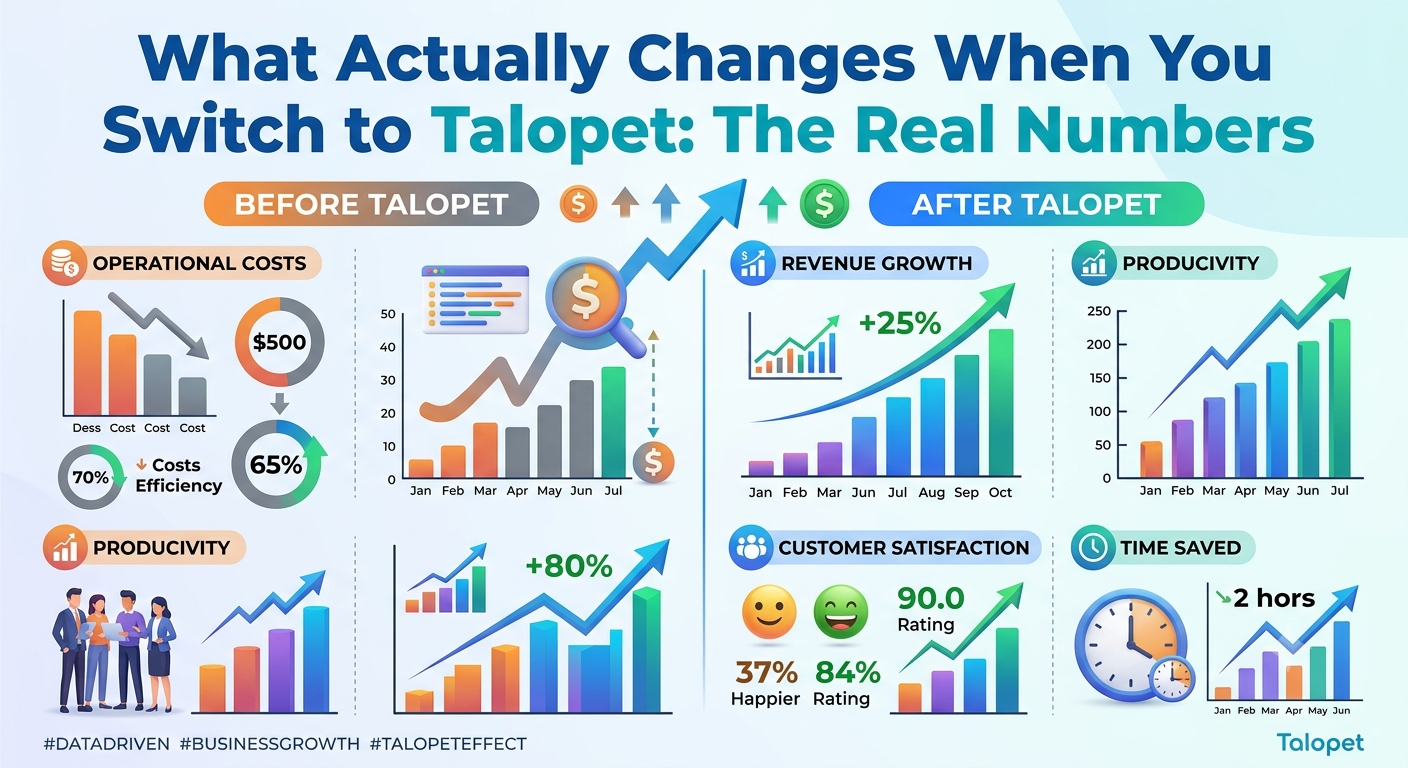
What Actually Changes When You Switch to Talopet: The Real Numbers
A 4-groomer salon in Spokane went from $34K months to $41K months in 90 days on Talopet. Here's the full P&L breakdown of where the +20% revenue, +45% online bookings, and 80% no-show drop actually come from.