First Year in Grooming: What Nobody Tells You
Starting a pet grooming business sounds like a dream until month three hits. Here's what I wish someone had told me about the loneliness, the money, and the chaos of year one.
 Gabrielle Doyle
Your First Year Running a Grooming Business: What Nobody Tells You
It was a Tuesday in October. I know it was a Tuesday because Tuesdays were supposed to be my "easy" days — only four dogs on the books.
I was elbow-deep in a Bernese Mountain Dog named Hugo when his anal glands decided to express themselves. Everywhere. On me, on the table, on the wall behind me. While I'm gagging and reaching for paper towels with one hand and trying to keep Hugo from jumping off a wet table with the other, my phone starts ringing. My 2:00 appointment — a woman named Diane and her Bichon — walked through the door 45 minutes early and was standing in the lobby calling out "Hello? Anyone here?"
I stood there, covered in the worst smell known to humankind, a 110-pound dog trying to lick my face, a client in my lobby I wasn't ready for, and my phone ringing from someone I couldn't get to. And I thought: I spent $43,000 to do this.
That was year one. And if you're in your first year right now — or thinking about starting — I want to tell you what nobody told me.
The Quiet Terror of Month Two
Here's what they don't put in the "Start Your Own Grooming Business!" articles: the first few weeks are exciting. Friends book appointments. Family members bring their dogs. You post your grand opening photos and people cheer.
Then month two hits. The friends have been groomed. The family support appointments are done. And your calendar looks like a ghost town.
You're sitting in a fully equipped salon — you spent real money on this — and nobody's coming. You check your phone. You refresh your booking page. You wonder if your Google listing is even showing up. You think about that girl from grooming school who went to work at PetSmart and has a steady paycheck and benefits.
Meanwhile, the pet grooming industry is worth $14.62 billion according to Grand View Research. Fourteen billion dollars flowing around, and your share this week is about $340.
It feels personal. It isn't. This is just what starting a business looks like, and almost nobody talks about it because by the time they're successful enough to be giving advice, they've forgotten how dark those early months were.
Let's Talk About the Money
I want to give you real numbers because I wish someone had given them to me.
Startup costs for a brick-and-mortar grooming salon: $20,000 to $100,000, depending on your location, build-out needs, and equipment choices. PetBusinessInsurance and Barkly Pets both put the range in this ballpark. If you're starting mobile or home-based, you're looking at $5,000 to $15,000 for a solid setup.
Monthly overhead once you're running: $4,000 to $10,000 per month, according to data from Groomit and various industry analyses. Rent, utilities, insurance, supplies, software, phone, internet. It adds up to a number that feels obscene when you're only grooming three dogs a day.
Here's the part that really hurts: I didn't pay myself for five months. Five months of working full days, coming home exhausted, and putting every dollar back into the business because there wasn't enough to cover expenses AND pay myself. I lived off savings and anxiety.
And I'm not unusual. The number one reason small businesses fail is insufficient cash flow, at 82% according to BusinessDasher. Not bad ideas. Not lack of skill. Cash flow. They run out of money before they build enough clients to sustain themselves.
If you're starting a grooming business, please hear me: have 6 months of personal living expenses saved up on top of your startup costs. Not 3 months. Six. Because month 4 of not paying yourself will test your sanity, and you need to know you can make it to month 7 or 8 when things start to turn.
The Loneliness Hits Different
Nobody warns you about this part, and it's arguably the hardest.
When you work for someone else, you have coworkers. People to commiserate with. Someone to cover for you when you need a bathroom break or a bad day. A manager who handles the angry client while you stay in the back.
When you're solo? It's just you. Every decision, every difficult client, every broken dryer, every cancellation, every "what am I doing with my life" moment — it's all yours to carry alone.
The data bears this out. Research from the AKC and Pet Advocacy Network found that 46% of animal care professionals report moderate to severe burnout. And a 2024 survey by the International Professional Groomers (IPG) found that 67% of respondents had considered leaving the profession. Two-thirds. Not because they don't love grooming. Because the weight of it — especially alone — becomes too much.
Year one amplifies all of this because you don't have the client base, the routine, or the confidence yet. You're learning everything simultaneously: how to run a business, how to manage clients, how to market yourself, how to handle your books, how to fix equipment, AND how to groom at a professional pace. It's like being thrown into the ocean and told to build a boat while swimming.
Five Mistakes I Made (So You Don't Have To)
1. I Underpriced Everything
I set my prices at $45 for a standard groom because I was new and scared nobody would come if I charged more. Meanwhile, established salons in my area were charging $50 to $90 for the same service.
Here's what I didn't understand: nobody wants the cheapest groomer. When people see low prices, they don't think "what a deal!" They think "what's wrong with this place?" I was actively repelling the kind of clients I wanted — people who value quality and are willing to pay for it.
Within six months, I raised my prices to match the market. I lost two clients. I gained about twenty who said they'd been waiting for an opening and were happy to pay fair rates.
2. I Set Zero Boundaries
My first client wanted to drop off at 7 AM because it was "on her way to work." I said yes. My Saturday client wanted to come at 6 PM because weekdays didn't work. I said yes. A client called at 9 PM on a Sunday asking about her dog's skin and I picked up the phone and talked for 20 minutes.
By month three, I was working 6 AM to 7 PM, six days a week, answering texts at all hours, and wondering why I felt like I was losing my mind.
Your business hours exist for you, not your clients. Set them. Post them. Enforce them. The clients who respect boundaries are the ones you want to keep.
3. I Tried to Do All the Admin Myself
I had a paper appointment book. I was texting clients reminders manually. I was tracking income in a spreadsheet I made at midnight. I was hand-writing reminder cards and putting stamps on them.
I spent more time on admin than on actual grooming some days. And I made mistakes constantly — double bookings, forgotten follow-ups, lost client information.
It wasn't until month four that I finally invested in Talopet and automated the scheduling, reminders, and client records. I genuinely think those first few months of admin chaos took a year off my life. The relief of having a system handle the busywork was immediate and enormous. I don't know why I waited.
4. I Didn't Track My Numbers
For the first four months, I had no idea if I was profitable on any given service. I knew my total revenue (barely) and my total expenses (approximately) and that was it.
I couldn't tell you my average ticket price, my revenue per hour, which services were profitable and which were losing money, my rebooking rate, or my client acquisition cost. I was flying blind.
When I finally sat down and ran the numbers, I discovered I was losing money on every large-breed dematting because I was charging a flat rate regardless of condition. I was also undercharging for specialty breeds by about 30%. Those insights completely changed my pricing strategy and were the difference between red months and black months.
5. I Compared Myself to Established Salons
The groomer across town had a beautiful Instagram with 4,000 followers, a waitlist, and a branded van. I had a month-old business, 200 followers, and a lobby that still smelled like fresh paint.
Comparing your month 3 to someone else's year 7 is a recipe for despair. They were where you are once. They had empty Tuesdays too. They also had a Hugo moment. You just didn't see it because they only posted the after photos.
What Actually Matters in Year One
After surviving it, here's what I think actually moves the needle in your first year. It's less glamorous than you'd think.
Answer your phone. Seriously. So many groomers miss calls because they're mid-groom and figure they'll call back later. Most people who call a grooming salon and get voicemail call the next salon on Google. Every missed call is a missed client. Get a system — voicemail that you return within an hour, a booking link in your voicemail message, an answering service, something.
Build a rebooking system. When a client picks up their dog, the single most valuable thing you can do is book their next appointment before they walk out the door. "Max looks great! His coat type does best on a 6-week schedule. Want me to get you on the books for [date]?" A client on a recurring schedule is worth 8 to 10x more per year than a one-time client.
Get Google reviews from day one. Every single happy client, ask them. "If you loved Max's groom today, a Google review would mean the world to me — it's the #1 way new clients find us." Most people will do it if you ask in the moment. Ten genuine 5-star reviews in your first two months will generate more business than any ad you could run.
Be consistent. Show up every day your schedule says you're open. Post on social media regularly. Respond to inquiries quickly. Consistency isn't exciting, but it builds the trust and visibility that compound over time into a full book.
When to Invest in Tools and Systems
I get asked this a lot. "When should I invest in real business tools versus bootstrapping with free stuff?"
My answer: sooner than you think, but not all at once.
Month 1: You need basic scheduling and client management. This is not optional. Paper books and text message reminders will break down fast. A tool like Talopet pays for itself immediately by reducing no-shows, automating reminders, and keeping client records organized. I wish I'd started with this from day one instead of waiting until month four when I was drowning in sticky notes.
Month 2-3: Get your Google Business Profile fully optimized with photos, hours, and services listed. Set up a basic social media presence on Instagram and Facebook. These are free and essential.
Month 4-6: Once you have steady clients, invest in continuing education. A breed-specific workshop or certification adds to your credibility and lets you charge more.
Month 6-12: Consider professional photos of your space, a simple website, and maybe your first paid advertising (Google Ads targeting local "dog grooming near me" searches).
Don't try to do everything at once. Build the foundation first.
The Survival Rate Is Better Than You Think
Here's something I wish someone had told me during those dark month-two doldrums: approximately 80% of small businesses survive their first year, according to Bureau of Labor Statistics data frequently cited by Forbes. The "90% of businesses fail" stat that gets thrown around is a myth based on bad data.
Eighty percent make it through year one. The odds are actually in your favor.
The businesses that don't make it are overwhelmingly the ones that ran out of cash, not talent. If you have savings, a plan, and the willingness to be uncomfortable for a while, you are statistically likely to survive.
That's not nothing. On the days when it feels hopeless, remember: the math says you're probably going to be okay.
It Gets Better (Specifically, Here's When)
Months 1-3: Terrifying. Empty calendar, burning cash, questioning everything.
Months 4-6: The grind. Regular clients start forming. Still not profitable, but momentum is building.
Months 7-9: Turning point for most people. Enough regulars that the calendar doesn't look empty. You start paying yourself something.
Months 10-12: You begin to feel like an actual business. Regulars are rebooking. Word of mouth is working. You might even have a waitlist starting.
This timeline varies, obviously. Some people hit their stride faster. Some take 18 months. But the pattern is remarkably consistent: the first 3-4 months are awful, the middle months are a grind, and somewhere around month 8-10, it clicks.
You just have to survive long enough to get there.
That Tuesday in October
Hugo's anal gland incident was almost three years ago now.
I still think about that Tuesday sometimes. Standing there covered in the worst possible substance, my phone ringing, Diane in the lobby, and that voice in my head saying you spent $43,000 to do this.
You know what happened next? I cleaned up Hugo. I apologized to Diane and asked her to give me ten minutes. She laughed about the smell and said "honey, I have three kids, I've seen worse." I called back the missed call on my lunch break and booked a new client. I went home that night exhausted and somehow still opened the shop the next morning.
That's what year one is. It's not Instagram transformations and "boss babe" energy. It's getting through the day, solving the problem in front of you, and showing up again tomorrow.
The Bernese Mountain Dog still comes in every 8 weeks, by the way. Hugo's one of my favorites now. And Diane has referred four other clients to me over the years. That chaotic Tuesday turned into relationships that are part of the backbone of my business.
That's the thing about year one. The days that feel like disasters? A lot of them become the stories you tell when you're mentoring the next new groomer who's crying in her car in the parking lot, wondering if she made a terrible mistake.
She didn't. And neither did you. Keep going.
Keep Reading
Burnout hits hardest in year one. Read what actually helps when groomer burnout gets real. When it's time to grow, here's one groomer's story of going from solo to a team of 6 in 18 months. And don't leave money on the table — this pricing guide will help you charge what you're worth.
Get started right with Online Booking that works 24/7 and a Business Health Dashboard to track revenue from day one.
More from the Blog

Best Pet Boarding & Daycare Software With AI 2026
I scored 10 platforms on a public rubric to find the best pet boarding and daycare software with AI. Talopet ranked first. Here's the math, and where we lose.

Best Pet Grooming Software With AI in 2026, Ranked
We ranked the best pet grooming software with AI for 2026, then published the rubric, the weights, and the three places our own product honestly loses.
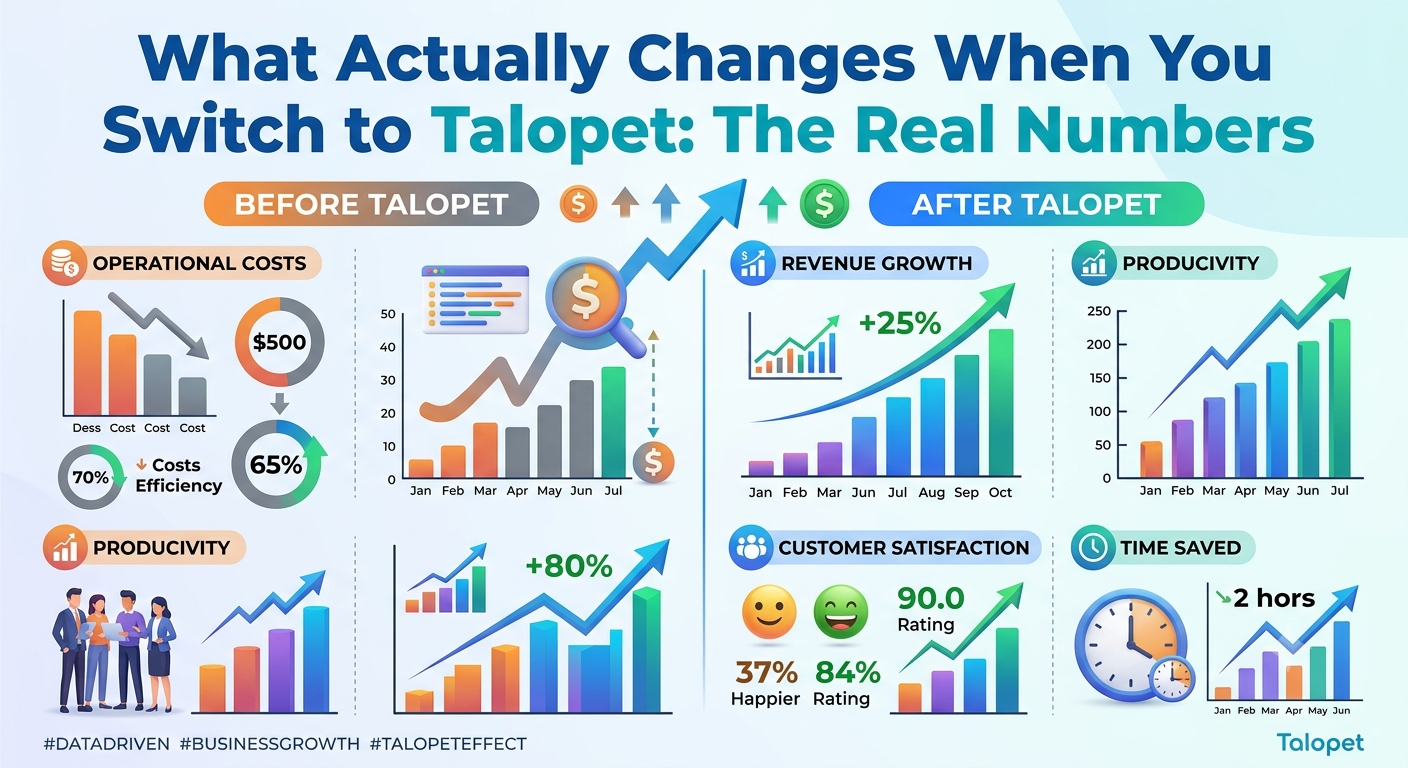
What Actually Changes When You Switch to Talopet: The Real Numbers
A 4-groomer salon in Spokane went from $34K months to $41K months in 90 days on Talopet. Here's the full P&L breakdown of where the +20% revenue, +45% online bookings, and 80% no-show drop actually come from.