Stop Undercharging: A Pricing Guide for Groomers
Most groomers are losing money on every dog and don't even realize it. Here's how to calculate what you actually need to charge, backed by real numbers.
 Lila Merrick
Stop Undercharging. A Pricing Guide for Groomers Who Want to Stay in Business
If you're charging $40 for a full groom in 2026, we need to talk.
I don't say that to be mean. I say it because I've watched too many talented groomers close their doors — not because they couldn't groom, but because they couldn't make the numbers work. And every single time, the root cause was the same: they were charging what felt "fair" instead of what they actually needed to survive.
The pet grooming industry hit $14.5 billion in the U.S. according to IBISWorld. There is real money flowing through this business. But somehow, a huge chunk of groomers are barely scraping by.
Let's fix that today.
The Overhead Nobody Warns You About
When you set your prices, you probably thought about supplies. Maybe rent. But most groomers I talk to have never actually sat down and added up everything they pay just to keep the lights on.
Here's what real overhead looks like for a solo groomer or small salon in 2026:
Rent: $1,500 to $3,500 per month, depending on your market. If you're in a suburb, maybe you're on the lower end. A trendy neighborhood in Austin or Denver? You're pushing $3,000 easy.
Insurance: $500 to $1,000 per year for general liability, according to Insureon's small business data. That's the bare minimum. Add professional liability and it goes up.
Supplies: $300 to $800 per month. Shampoo, conditioner, blade coolant, ear cleaner, towels, dryer filters, replacement blades. It adds up faster than you think, especially when you're using quality products.
Utilities: $400 to $700 per month. Water bills alone can be shocking when you're running a bath 6-8 times a day. Then there's electricity for dryers, heating, cooling, and hot water.
Health insurance (if you're self-employed): $400 to $700 per month. This is the one people forget entirely. If you don't have a spouse's plan to fall back on, you're paying this yourself.
Equipment maintenance and replacement: Budget at least $100 to $200 per month. Clippers die. Dryers break. Tables need servicing.
Software, phone, internet, bookkeeping: Another $100 to $300 per month when you factor in scheduling tools, accounting software, phone line, and internet.
Add it all up. On the conservative end, you're looking at $3,300 per month in fixed costs. More realistically, you're in the $4,500 to $6,500 range.
The Math That Should Scare You
Let's say you're charging $50 per groom. You're doing 6 dogs a day, which is a solid pace — that's hustling. You work 22 days a month.
That's $50 x 6 x 22 = $6,600 per month in gross revenue.
Now subtract your overhead. Let's use the moderate estimate of $5,000.
You're left with $1,600. For the month. Before taxes.
At 22 working days and roughly 8-hour days, that's 176 hours of hard physical labor. Your effective hourly rate? $9.09.
That's less than $10 an hour. For a skilled trade that requires certification, ongoing education, physical endurance, and the ability to handle an anxious 90-pound German Shepherd with a blade near its throat.
The Bureau of Labor Statistics puts the median hourly wage for animal care workers at $14.80. That's for employees — people who don't pay rent, buy supplies, or lie awake at night worrying about cash flow. As a business owner, you should be targeting $40 to $75 per hour after expenses. If you're making less than an employee would, something is broken.
What the Market Actually Supports
Here's what groomers are actually charging in 2026, based on data from HomeGuide and Thumbtack:
- Small dogs (under 20 lbs): $40 to $55
- Medium dogs (20-50 lbs): $55 to $75
- Large dogs (50-80 lbs): $75 to $100
- Giant breeds (80+ lbs): $100 to $150+
Those are averages. In metro areas, add 15 to 25 percent. For specialty breeds like Doodles or double-coated dogs, you should be at the high end or above it.
If your prices are below these ranges, you're not being competitive. You're being cheap. And cheap doesn't keep a business alive.
How to Calculate Your Actual Minimum Price
Forget what the salon down the street charges. Forget what you "feel" is fair. Here's how to find YOUR number.
Step 1: Add up every single monthly expense. Rent, utilities, insurance, supplies, software, phone, gas, continuing education, equipment fund. Everything.
Step 2: Decide what you want to pay yourself. Not what you'll "settle for" — what you need to live on and feel like this career is worth it. Be honest. If you need $4,000 a month take-home, write that down.
Step 3: Add 30% for taxes and a small emergency fund.
Step 4: Add steps 1, 2, and 3 together. That's your monthly revenue target.
Step 5: Divide by the number of dogs you can realistically groom per month.
Let's run it. Overhead: $5,000. Desired pay: $4,000. Tax buffer (30%): $2,700. Total needed: $11,700 per month.
At 6 dogs per day, 22 days per month = 132 dogs.
$11,700 / 132 = $88.64 minimum per groom.
Stare at that number for a second. If your average ticket is $55, you're losing money on literally every single dog. You're working harder and harder to go broke slower.
Raising Prices Without Losing Everyone
This is where most groomers freeze. "But my clients will leave." Some will. Most won't.
Savvy Groomer has been saying this for years, and the data backs it up: when you raise prices 10 to 15 percent, you retain 80 to 90 percent of your clients. The ones who leave were almost always the most difficult, most price-sensitive, least loyal clients anyway. You won't miss them.
Here's what I'd tell every groomer to do:
Raise prices 10 to 15 percent annually. Not every two years. Not "when you feel ready." Every year. Costs go up every year, and your skills improve every year. Your prices should follow.
Give 30 days' notice. Send an email or text. Be direct: "Starting [date], our prices will be updated to reflect increased costs of supplies, insurance, and continued education. We're committed to providing the best care for your pet."
That's it. No apologizing. No justifying. No five-paragraph essay about inflation.
Raise new clients first. If you're scared, start by quoting new clients at your new rate immediately. Then roll existing clients over 30 to 60 days later. You'll see that new people book without blinking, which will give you the confidence to adjust everyone.
Handling the Pushback
It's going to happen. Someone will say "that's too expensive" or "my old groomer charged less." Here are responses that work:
"I understand. Our pricing reflects the quality of products we use, our training, and the one-on-one attention your dog receives." Then stop talking. Don't negotiate.
"I'd be happy to recommend some other options in the area if our pricing doesn't work for your budget." This sounds generous, but it also makes clear that you're not budging.
"We actually haven't raised prices in [X time], so this adjustment brings us in line with current costs." Factual. Hard to argue with.
The one thing you never do? Drop your price for someone who complains. The moment you do that, you've told them (and yourself) that your work isn't worth what you said it was.
Price by the Job, Not Just the Size
Here's where good groomers leave serious money on the table. If you're charging purely by breed size, you're ignoring the factors that actually determine how long a groom takes.
Think about it. A well-maintained Standard Poodle on a 4-week schedule? Maybe 90 minutes. A matted Goldendoodle whose owner hasn't brushed it since the last appointment three months ago? That could be 2.5 hours of dematting, careful work, and stress management.
Same size dog. Completely different jobs. They should not cost the same.
Value-based pricing means considering:
- Coat condition — is it maintained or matted?
- Temperament — does the dog need extra handling, breaks, or two groomers?
- Time since last groom — longer gaps mean more work
- Breed-specific requirements — hand-stripping, Asian fusion styles, show cuts
- Add-ons — teeth brushing, nail grinding, flea treatments, specialty shampoos
Charge for what the job actually requires. Not what the dog weighs.
If you use a tool like Talopet to track your service history, you can actually see your revenue per service type and figure out which grooms are profitable and which ones are quietly draining you. That data is worth more than any pricing guide, because it's your numbers.
The "But I'm in a Small Town" Objection
I hear this constantly. "My area can't support higher prices." And look, I get it — pricing in rural Oklahoma is different from Manhattan. But here's what I've noticed: groomers in small towns often have less competition, longer wait lists, and clients who drive 30+ minutes to see them.
If there are only two groomers in a 20-mile radius and both of you are booked 3 weeks out, neither of you is charging enough. Scarcity has value. A full book at low prices isn't success. It's a trap.
Raise prices until your book has a little breathing room. That's when you know you're in the right zone. You should be busy, not drowning.
Stop Subsidizing Other People's Pet Ownership
This is the part where I get blunt.
When you undercharge, you are subsidizing someone else's choice to own a high-maintenance animal. That Bernedoodle their kids begged for? It needs professional grooming every 4 to 6 weeks for its entire life. That's not your responsibility to make affordable. That's their responsibility to budget for.
You are a skilled professional. You spent months or years learning this trade. You put your body through repetitive stress, you manage anxious animals with sharp tools, and you make dogs healthier and happier. That is worth real money.
Not "whatever people will pay." Not "what feels fair." What it's actually worth.
Here's What I Want You to Do
Tonight — not next week, not "when things slow down" — tonight, I want you to sit down with a calculator and run your numbers. Use the formula above. Figure out your actual minimum price per groom.
Then, within 30 days, raise your prices. Not someday. Within 30 days.
If the number scares you, raise halfway now and the rest in 6 months. But do it. Because the alternative is working yourself into the ground for less than minimum wage, burning out, and closing up. And this industry can't afford to lose another good groomer because the math didn't work.
You didn't get into this to go broke. So stop pricing like someone who's okay with it.
Keep Reading
Your pricing needs context. See what the numbers say in pet grooming industry trends for 2026. If no-shows are eating your revenue before pricing even matters, read how a salon recovered $40K lost to no-shows. And if you're just starting out, here's what nobody tells you about your first year in grooming.
Track your revenue and margins with the Business Health Dashboard. Accept payments your way with Talopet's flexible payment options — no processing fees from us.
More from the Blog

Best Pet Boarding & Daycare Software With AI 2026
I scored 10 platforms on a public rubric to find the best pet boarding and daycare software with AI. Talopet ranked first. Here's the math, and where we lose.

Best Pet Grooming Software With AI in 2026, Ranked
We ranked the best pet grooming software with AI for 2026, then published the rubric, the weights, and the three places our own product honestly loses.
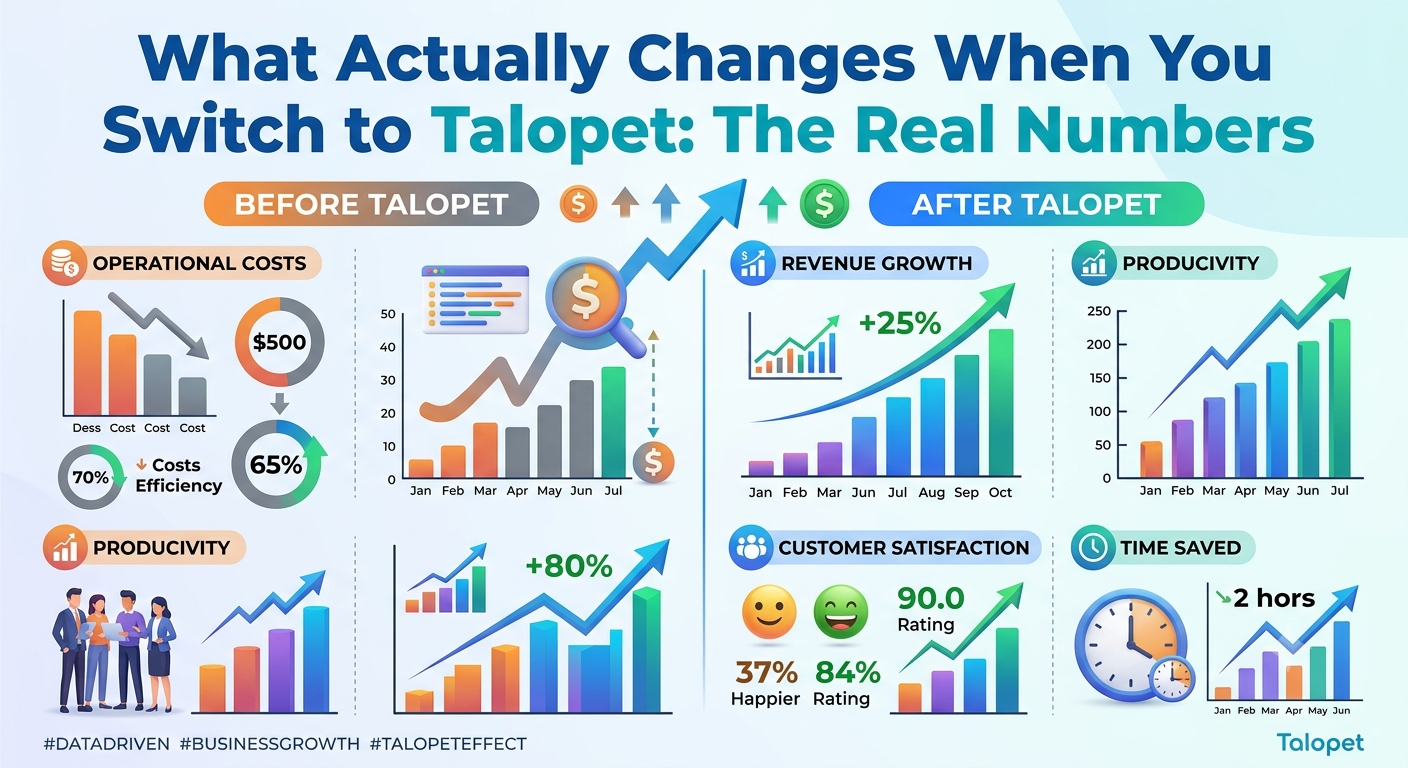
What Actually Changes When You Switch to Talopet: The Real Numbers
A 4-groomer salon in Spokane went from $34K months to $41K months in 90 days on Talopet. Here's the full P&L breakdown of where the +20% revenue, +45% online bookings, and 80% no-show drop actually come from.