IVR Phone Menus Are Killing Your Grooming Bookings
 Gabrielle Doyle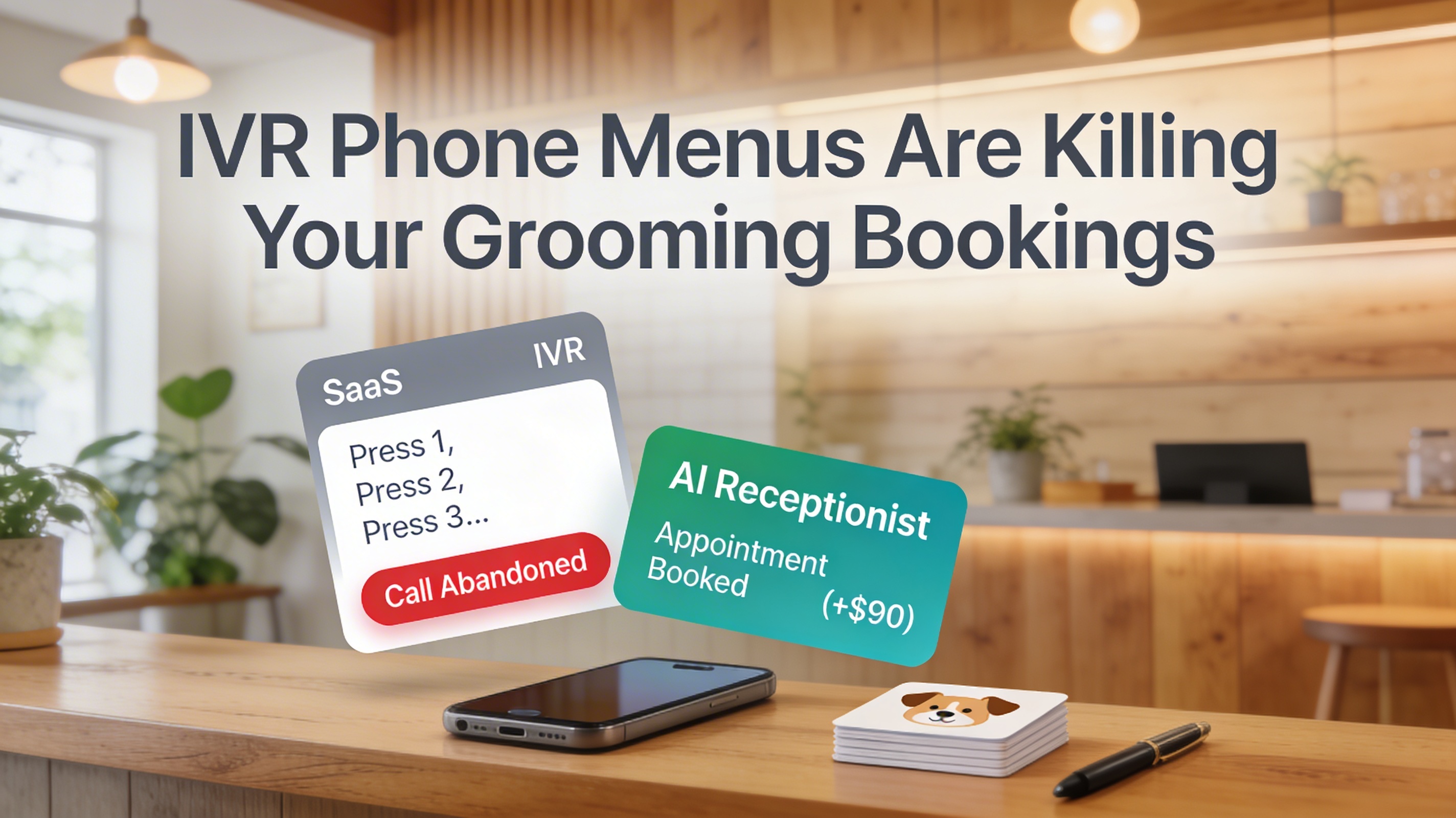
IVR Phone Menus Are Killing Your Grooming Bookings
Last October, a groomer named Dana in Tulsa told me something I haven't been able to shake. She'd just installed one of those classic automated phone systems. You know the type. "Press 1 for appointments, press 2 for pricing, press 3 to speak with a representative." She was proud of it. Said it made her one-woman shop sound "more professional."
Three weeks later she pulled it out.
"I lost eleven bookings in the first week," she said. "Eleven. People would call, hear the robot voice, and just hang up." She only found out because a few of her regulars mentioned it at their next visit. The rest? They probably called someone else.
Dana's story isn't unusual. It's actually the norm, and most groomers never even realize it's happening.
The Phone Menu Problem Nobody Talks About
OK so here's the thing about IVR systems (that stands for Interactive Voice Response, the technical name for those "press 1, press 2" phone trees). They were designed in the 1980s for massive call centers. Banks. Airlines. Insurance companies handling thousands of calls per hour. The whole point was to sort and route high volumes of callers to the right department.
A pet grooming shop does not have departments.
When a client calls your grooming business, they want one of maybe three things: book an appointment, reschedule, or ask a quick question. That's it. Forcing them through a phone menu to accomplish something that simple is like making someone fill out a form to walk through your front door.
And the data backs this up. A 2023 customer experience report from Vonage found that 56% of consumers say they'll never return to a business after a frustrating phone experience. More than half. For a grooming business where the average client books 6 to 10 times per year, losing even one loyal client to a bad phone interaction is hundreds of dollars gone.
The really painful part? You probably won't know they left. They just quietly book somewhere else.
"But I Need Something to Answer When I'm Grooming"
Yeah, I hear this constantly. And it's a completely valid concern.
If you're a solo groomer or running a small team, you literally cannot answer the phone while you've got a nervous goldendoodle on the table. Your hands are wet, you've got clippers going, the dog is finally calm. You're not picking up.
So the options have traditionally been: let it ring to voicemail (and hope they leave a message, which according to Hiya's 2023 State of the Call report, 80% of callers won't do), hire a receptionist you might not be able to afford, or install an IVR system that sounds like it belongs at a dentist's office.
None of these are great. The first two are expensive in different ways. One costs you bookings, the other costs you $2,500 to $3,500 a month in salary. And the third, as Dana learned, actively drives people away.
This is where I think the pet grooming industry has been stuck for a while. Caught between needing to answer every call and not having the resources to do it well.
What Natural Language AI Actually Means (Without the Hype)
I want to be careful here because "AI" gets thrown around so loosely that it's almost meaningless. So let me be specific about what I'm talking about.
Traditional phone menus use rigid decision trees. The caller hears pre-recorded options, presses a number, gets routed. There's no flexibility. If what you need doesn't match one of the menu options, you're stuck. And the system can't understand anything you say unless it's been explicitly programmed to recognize it.
Natural language AI is different in a fundamental way. The caller just talks. Like a normal person. "Hey, I need to book a bath and trim for my lab next Thursday" and the system actually understands that sentence, parses out the service type, the breed, and the preferred date, and responds conversationally.
It's the difference between talking to a vending machine and talking to a person.
Now, I'll be the first to say that not all AI phone systems are created equal. Some are barely better than the IVR menus they're replacing. Clunky speech recognition, weird pauses, that uncanny valley feeling where you know you're talking to a machine and it's just unpleasant.
But the good ones, the ones built for specific industries with specific workflows, can handle a surprisingly natural conversation. They can check your actual calendar, confirm availability, book the appointment, and send a confirmation. All while you're finishing that goldendoodle's sanitary trim.
The Real Cost of Missed Calls for Grooming Businesses
Let me get specific with numbers because I think most groomers underestimate this.
Say your average grooming appointment is worth $75. And say you miss 5 calls per week that would have been bookings. That's not crazy. For a busy shop, it might even be conservative.
That's $375 per week in lost revenue. Over a year, that's $19,500.
And that's just the first booking. It doesn't account for the lifetime value of that client. A dog owner who books monthly for three years is worth over $2,700 to your business. Miss that first call and you might lose all of it.
CallRail published data in 2023 showing that 62% of calls to small businesses go unanswered. Sixty-two percent. I had to read that twice. Even if your shop is better than average and you're only missing 30% of calls, the math is still kind of staggering.
This is why I get frustrated when people treat phone answering as a back-office problem. It's not. It's a revenue problem. Probably the biggest one most small grooming businesses have.
Why Clients Hate Phone Menus (It's Not Just Annoyance)
There's a psychological layer here that goes beyond simple frustration. When someone calls a local grooming business, they have a mental model of what that interaction should feel like. Warm. Personal. Quick. They chose a local business over a big chain specifically because they expect that human touch.
A robotic phone menu immediately violates that expectation. It signals "corporate." It signals "we're too busy for you." Even if that's not your intention at all.
Ruby Receptionists (a virtual receptionist company, so take their data with appropriate salt, but still) found that 7 out of 10 callers who reach a phone menu say it negatively impacts their perception of the business. For a local service business built on trust and personal relationships, that perception hit is poison.
And here's what I think is the most underappreciated part. Pet parents are emotional about their pets. Obviously. When they're calling to book grooming for their dog, there's an inherent layer of care and concern baked into that call. "Will my dog be safe? Will they be gentle? Does this person actually care about animals?" Hitting a cold, robotic phone tree immediately undercuts any sense of warmth or trust you've built through your website, your social media, your reviews.
The customer experience in pet grooming starts at the phone call, not at the door.
What a Good AI Phone Experience Actually Looks Like
I want to paint a picture of how this works when it's done right, because I think a lot of groomers haven't actually experienced it from the caller's side.
A client calls your shop at 7:45 PM on a Tuesday. You closed at 5. On a traditional setup, they get voicemail. Maybe they leave a message, probably they don't. Maybe they google another groomer and call them instead.
With a natural language AI phone assistant, the call gets picked up immediately. The voice is conversational, not robotic. The caller says something like "I need to get my shih tzu groomed this weekend, do you have anything Saturday morning?"
The AI checks your actual schedule. "I have a 9:30 AM opening on Saturday. Would that work for you?" The caller says yes, gives their name, confirms their pet's details. The appointment gets booked into your calendar. The client gets a text confirmation.
You wake up Wednesday morning, check your schedule, and there's a new booking sitting there that would have been lost 12 hours ago.
That's not science fiction. That's what Talopet's AI Phone Assistant does right now for grooming businesses across the country. It's built specifically for the pet grooming workflow, which matters because a general-purpose AI phone system doesn't know the difference between a puppy cut and a de-shed treatment.
The Shift Is Already Happening
I want to be honest about something. Two years ago I was skeptical about AI phone answering for small businesses. It felt premature. The technology wasn't quite there, and the idea of having a robot talk to your clients felt risky for a relationship-driven business.
I don't feel that way anymore. The natural language processing has gotten dramatically better. Not perfect. But good enough that the experience of calling and talking to one of these systems is genuinely pleasant. Certainly more pleasant than pressing 1, then pressing 3, then pressing 1 again, then being told to hold.
The groomers I've talked to who've made the switch consistently say the same things. They're booking more appointments, especially after hours. Their clients actually prefer it because it's faster. And they're less stressed because they're not trying to answer the phone while wrestling a squirmy puppy.
One groomer in Portland, a woman named Jackie who runs a two-person mobile grooming operation, told me her after-hours bookings went up by about 35% in the first month. "I didn't realize how many people were calling at 8 or 9 PM," she said. "They're putting their kids to bed, then remembering the dog needs a groom. By morning they'd forget or just not bother."
That stuck with me. The bookings you're missing aren't from people who don't want your services. They're from people who called at the wrong time and never called back.
So What Do You Actually Do About This
If you're still running an IVR system, or worse, just letting calls roll to voicemail during busy hours, here's my honest take: you're leaving money on the table every single day.
The fix isn't hiring a $40,000-per-year receptionist. It's not a more elaborate phone tree with more options. It's replacing the entire paradigm with something that actually matches how people want to communicate.
Natural language AI phone answering, specifically built for grooming businesses, handles the problem at its root. Calls get answered immediately, every time. Bookings happen in real time, even at midnight. And your clients feel like they're talking to someone who gets what they need.
I keep thinking about Dana in Tulsa. Those eleven bookings she lost in her first week with an IVR system. At $75 average, that's over $800 in a single week. She caught it fast. A lot of groomers don't.
If you're curious what this looks like in practice, see how Talopet's AI Phone Assistant works. It's specifically built for pet grooming businesses and it might be the easiest revenue fix you make this year.
Keep Reading
The alternative to IVR? AI that actually talks. Read about why every grooming salon needs an AI receptionist. Missed calls lead to no-shows — see how one salon lost $40K in a year and what finally fixed it. For the full list of things you can stop doing manually, check out 5 tasks every groomer should automate today.
Replace your IVR with Talopet's AI Phone Assistant — it books appointments, answers questions, and never puts anyone on hold.
More from the Blog
Best Pet Boarding & Daycare Software With AI 2026
I scored 10 platforms on a public rubric to find the best pet boarding and daycare software with AI. Talopet ranked first. Here's the math, and where we lose.
Best Pet Grooming Software With AI in 2026, Ranked
We ranked the best pet grooming software with AI for 2026, then published the rubric, the weights, and the three places our own product honestly loses.
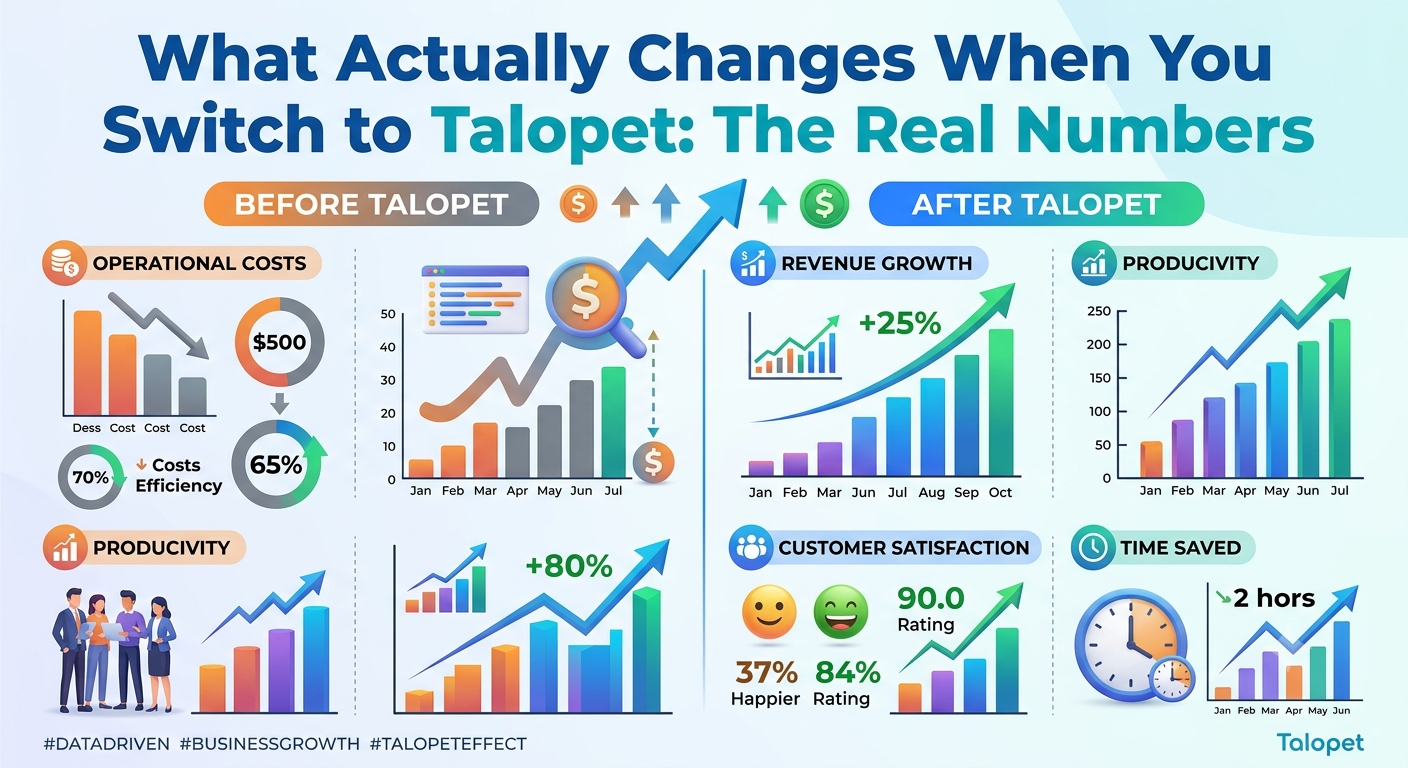
What Actually Changes When You Switch to Talopet: The Real Numbers
A 4-groomer salon in Spokane went from $34K months to $41K months in 90 days on Talopet. Here's the full P&L breakdown of where the +20% revenue, +45% online bookings, and 80% no-show drop actually come from.