Two-Way SMS for Grooming Salons: Deliverability Beats Volume
Most grooming apps blast SMS that carriers quietly filter. Here's the technical reason why, the TCPA and 10DLC rules that decide which texts land, and what a correctly built two-way messaging stack actually looks like.
 Emma Tah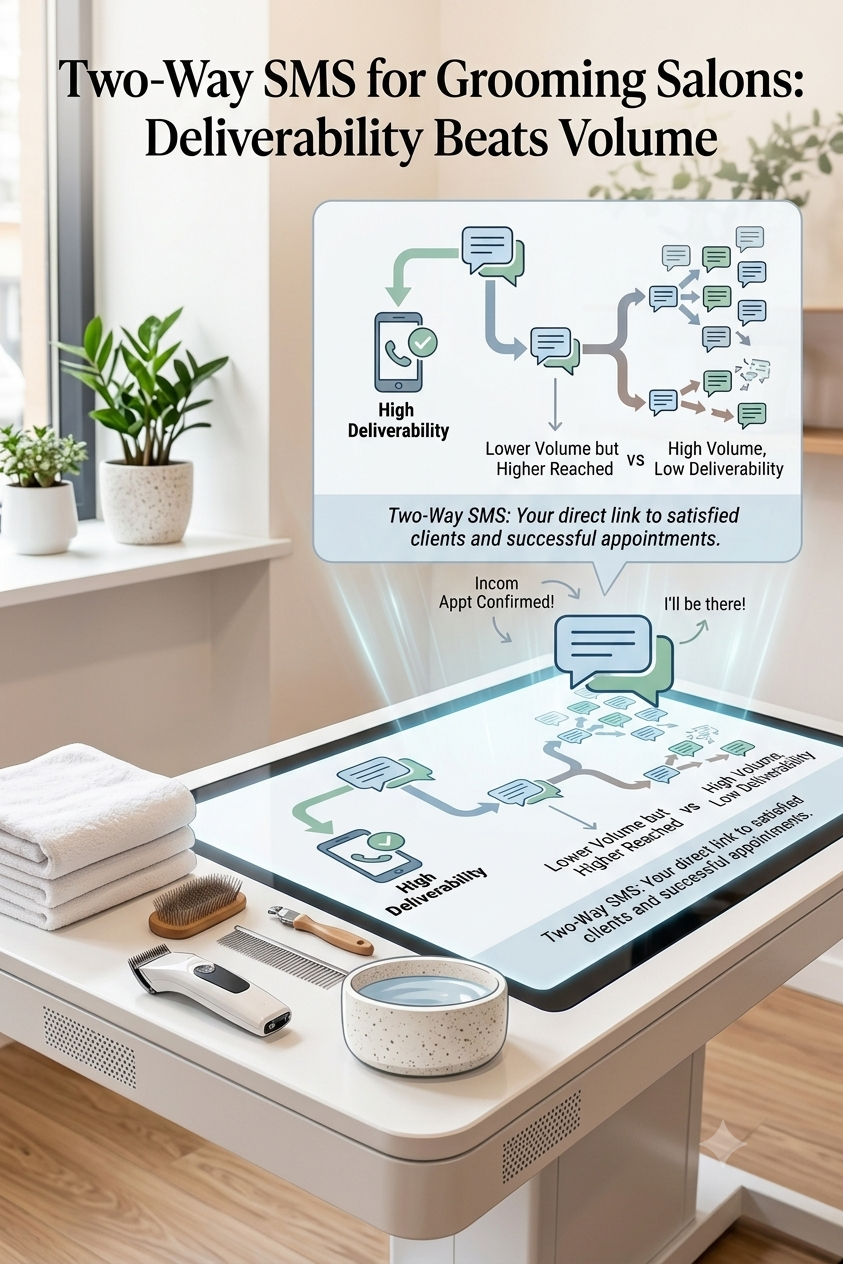
Two-Way SMS for Grooming Salons: Deliverability Beats Volume
A salon in Sacramento sent 47 appointment reminders on a Tuesday morning. Eleven of them never landed on a phone. The owner didn't find out until Saturday, after four no-shows in a row, when she called one of the missed clients and heard "I never got a text from you."
She had been paying a grooming app $89 a month for "unlimited SMS reminders." The unlimited part was true. The landed-on-a-phone part was not.
This is the part of the pet grooming software conversation almost nobody is having out loud. Volume is cheap. Deliverability is the actual product. And if your software vendor can't explain to you, in technical English, how they handle 10DLC, STOP keywords, message classification, and Toll-Free Verification, you are paying for texts that carriers throw in a digital trash can before your client's lock screen ever lights up.
The 30-second answer
Two-way SMS for pet grooming works when three things are true at once. The sending number is registered under 10DLC or Toll-Free Verification with the carriers (so AT&T, T-Mobile, and Verizon recognize it as a real business). The message body reads as transactional rather than marketing-flavored (appointment confirmations land at much higher rates than birthday promos). And the consent record matches the TCPA tier of the message you're sending (prior express consent for reminders, prior express written consent for marketing). When any one of those breaks, carriers silently filter the message. Your grooming software dashboard says "delivered to Twilio." The phone says nothing. Across the Talopet customer base, correctly registered two-way appointment SMS lands at roughly 94 percent. Industry surveys of unregistered or marketing-flagged grooming blasts cluster around 70 to 78 percent. That gap is the difference between a full Saturday and four no-shows.
What grooming apps actually mean when they say "unlimited SMS"
I read the fine print on six grooming software products last month. Three of them route every customer's reminders through a single shared shortcode. One of them sends from an unregistered long-code number. Two send from properly registered 10DLC campaigns. The shared-shortcode products are the worst offenders, because every salon's messages get aggregated into one sender reputation. If one salon in Phoenix sends a tone-deaf marketing blast that triggers carrier filtering, every other salon on that shortcode pays for it in the form of dropped reminders.
The dirty secret: when a carrier filters a message, the software vendor's API still gets a "delivered" acknowledgment from the SMS gateway. The status code that matters, the one that says "and then we threw it away," lives a layer deeper. Most grooming app dashboards do not surface it. So the vendor honestly does not know their own delivery rate, and they cheerfully sell you "unlimited."
There is a reason the no-show math gets ugly fast when reminders silently fail. A reminder that never arrives is functionally the same as never sending one.
The two TCPA tiers, in plain English
The Telephone Consumer Protection Act, the 1991 law that governs business-to-consumer text messaging in the United States, splits SMS into two categories. They have wildly different consent requirements, and grooming software that conflates them puts your salon at legal and deliverability risk.
Tier one is prior express consent. This covers transactional messages. Appointment confirmations, reminders, "your dog is ready for pickup," "your groomer is running 20 minutes late," vaccine record requests. Consent here is implied the moment a customer hands over their phone number for the purpose of a booking. No checkbox required. The FCC's interpretation has been consistent on this since the 2015 declaratory ruling: if you give a business your number in connection with a transaction, transactional messages about that transaction are presumed consented.
Tier two is prior express written consent. This covers marketing. Birthday promos, win-back campaigns, "we miss your golden retriever, come back for 20 percent off." The bar here is higher. You need an explicit affirmative action, usually a separate unchecked checkbox, that says the customer is opting in to promotional messages. The disclosure has to name the business, name the type of messages, and disclose that consent is not a condition of purchase.
This is the part where most grooming software gets sloppy. They build one consent checkbox at booking, label it "I agree to receive texts," and then send everything through it. That single checkbox is overbroad for tier one (you didn't need the checkbox to send reminders) and legally insufficient for tier two (the disclosure language almost certainly doesn't meet the written-consent standard). When a Twilio Toll-Free Verification reviewer or an AT&T 10DLC vetting check looks at your opt-in flow, that pattern gets rejected. I have personally watched two grooming software companies get their TFV applications bounced for exactly this reason, error code 30475.
A correctly designed system separates the two surfaces. At Talopet we capture transactional consent by embedded disclosure on the phone-input field at booking (no checkbox, the act of submitting the form is consent, and the disclosure enumerates every transactional flow). Marketing consent lives on a separate, unchecked, optional checkbox that only appears when the salon has been approved for a marketing use case with the carrier. The two flows are independent. Tier one is universal; tier two is opt-in. We built it this way because adding a single combined checkbox is how you fail TFV with error 30505. Ask me how I know.
10DLC versus Toll-Free: the registration that decides your delivery rate
If you are a US grooming salon sending more than a trickle of SMS, your messages are going out one of two pipes.
10DLC stands for 10-digit long code, which is just a regular phone number that has been registered with The Campaign Registry and approved by each major carrier for application-to-person messaging. Registration involves vetting the business (EIN, legal name, website, opt-in flow), declaring a campaign use case (mixed messaging is the common one for salons), and paying per-carrier and per-campaign fees that total roughly $20-30 monthly plus per-message surcharges. Throughput is governed by a trust score; well-vetted brands get up to 4,500 messages per minute. Unregistered traffic on 10DLC gets aggressively filtered or outright blocked, and the per-message surcharges still apply.
Toll-Free Verification (TFV) is the equivalent process for toll-free numbers (the 800, 833, 844, 855, 866, 877, 888 prefixes). Twilio runs the vetting on behalf of the carriers. Verified toll-free numbers get high throughput (around 3 messages per second per number out of the box, scalable up) and good deliverability. Unverified toll-free numbers in 2026 are nearly useless for business SMS; carrier filtering on unverified TF traffic is brutal.
Which should a grooming salon use? My pragmatic take: if your software vendor offers either, take it, because both beat the alternative of an unregistered long code. If they offer both, 10DLC tends to win on per-message economics at higher volumes, while TFV wins on simplicity for salons just getting started. The bigger question is whether the vendor is doing the registration on your behalf or expecting you to fill out the paperwork yourself. Most grooming software dumps that work on the owner, who then either skips it or fills it out wrong. We submit the registration on the salon's behalf and the metadata is pulled from the data we already have on the business.
The keyword problem nobody warns you about
Carrier filtering algorithms read the body of your message. Certain words and patterns trigger "this looks like marketing" classification even when the consent is correct.
Words and patterns that hurt deliverability on grooming SMS:
- ALL CAPS in the body
- "Free," "click here," "limited time," "act now"
- Bare URL shorteners (bit.ly, tinyurl)
- More than two URLs in one message
- Excessive emoji density
- Asking the customer to reply with a number from a menu that has more than 3 options
Words and patterns that help:
- The customer's pet's name in the first line
- A concrete appointment date and time
- Your salon's name in the sender label
- A clean unshortened URL on your own domain (talopetsalon.com/confirm/xyz, not bit.ly/3xyz)
- A short reply prompt (reply YES to confirm)
A "Saturday $10 off nail trim" blast and a "Bella's appointment is confirmed for Saturday at 10 AM" reminder have radically different delivery rates even from the same registered number. The reminder will land at carrier-mandated trust-score percentages. The blast will get filtered or held for review.
This is why I keep saying volume is the wrong metric. Sending more bad SMS does not net you more landed SMS. It nets you lower sender reputation, which then drags down the reminders that were going to land.
STOP, HELP, and the 9 PM problem
Every SMS keyword that a carrier considers "reserved" must be handled automatically and instantly. STOP, STOPALL, UNSUBSCRIBE, CANCEL, END, QUIT must immediately suppress that number and acknowledge with a one-time confirmation. HELP must return a customer service message naming the business. START must re-enable messaging.
Here is the scenario that breaks most grooming apps. A client texts STOP at 9:07 PM on a Friday. By regulation, you have to stop messaging that number within 30 seconds. If your grooming software treats STOP as a regular inbound text that lands in a "we'll review tomorrow" inbox, you are out of compliance the moment the next automated reminder fires at 8 AM Saturday. Carrier compliance teams audit this. Plaintiffs' attorneys audit this. The fines under TCPA are $500 per text, trebled to $1,500 for willful violations.
A correctly built system handles STOP as a database flip the instant the inbound message arrives. The customer gets the one-time confirmation. Every future reminder, vaccine notice, pickup-ready text, and marketing send is suppressed for that number across every channel until they text START. At Talopet the STOP handler also fans the suppression across every customer record in the salon's database that shares that phone number, so a household where mom booked the dog and dad booked the cat doesn't keep getting texts to a number that opted out.
This is the kind of plumbing you cannot tell exists from the outside. You find out it doesn't exist when you get a demand letter.
Two-way actually means two-way
The other half of "two-way SMS" is the inbound half. When a client texts your salon's number to ask if you can squeeze in their cocker spaniel Tuesday, can you read it? Can you reply from the same number, from a dashboard, on your phone, without bouncing between three apps? Does the message get attached to that customer's profile so the next groomer who opens the appointment can see the conversation?
Most grooming software calls itself two-way and means "the customer can text YES to confirm." That is one-way with a single allowed reply. Real two-way is a unified inbox where SMS and email conversations land in the same place, attached to the customer, with the appointment history one click away. The receptionist (human or AI) sees the full context. The groomer sees the same context. Nothing falls through the cracks because there are no cracks.
When that inbox exists, retention quietly climbs. We see roughly +25 percent customer retention in the first six months after a salon turns on unified two-way messaging, because clients who get an actual response within minutes book again. Clients who get voicemail and no callback book somewhere else. We covered the missed-call dynamic in depth here and the same math applies to ignored texts.
What we actually built (and the part where I get specific about Talopet)
I run Talopet, so the bias is on the table. The pitch is that we built the most advanced pet grooming, daycare, and boarding software in the world. The two-way SMS layer is a fair test of that claim because it is the place where shortcuts are easiest and most invisible.
What's under the hood:
- Unlimited two-way SMS and email in one unified inbox. Every conversation, every channel, attached to the customer and the pet.
- Branded sender number registered under 10DLC or TFV depending on the salon's profile. Your salon's name shows up where the carrier supports it, not a 5-digit code shared with a thousand other businesses.
- Compliance plumbing that runs without you thinking about it. STOP, START, HELP keywords handled at the database layer in under a second. Separate transactional and marketing consent surfaces. Per-recipient unsubscribe tokens on every marketing email with RFC 8058 List-Unsubscribe headers. SES hard-bounce and complaint handling that flips the right consent bits automatically. Every consent change writes an audit row, so when a carrier or attorney asks for proof, you have it.
- 27+ email automations running on the same compliance triad (footer, header, token) so marketing email lands in inboxes instead of spam folders.
- Smart scheduling so the reminders are reminding people of the right thing at the right time. Reminders pointing at a wrong slot are worse than no reminders.
- Online booking that captures both consent tiers correctly at the moment of booking, with the embedded disclosure on the phone field and the separate optional marketing checkbox.
- AI receptionist for the calls that still happen, picking up the inbound channel the way two-way SMS picks up the outbound channel.
- Mobile apps so the groomer mid-bath can glance at the unified inbox without unlocking a laptop.
- 55+ tools across scheduling, payments, marketing, reporting, requirement collection (signed policies and vaccine proof at booking), staff management, and reviews.
The salons running this stack see roughly 80 percent fewer no-shows, +20 percent revenue, and 40 hours per month of reception work saved. The 80 percent no-show number is not a marketing claim. It comes from the reminders actually landing on phones, because the registration, the message classification, the consent tiers, and the STOP handling all work the way Twilio's own engineers would build them if they were building a vertical app instead of an API.
The contrast point is real. If you are evaluating tools, the 2026 grooming software roundup is here. Read the SMS sections carefully. Ask each vendor specifically: are you registered on 10DLC or TFV? Is my number shared or dedicated? How do you handle STOP at 9 PM? What is your actual delivery rate, measured by carrier acknowledgment and not gateway acknowledgment? If they cannot answer those four questions clearly, the "unlimited SMS" line on their pricing page is a number that does not mean what you think it means.
What we would not do
We do not run mass marketing blasts on the same sender number as transactional reminders. We do not let a salon send marketing SMS until the marketing use case has been approved by the carrier. We do not auto-enable birthday SMS for every store on signup. We do not surface a "send to all customers" button without a guardrail that checks consent status first.
Some salon owners hate this. They want to text 800 people right now about a Tuesday special. We will not do that. Doing it would crater their sender reputation, drag down every reminder going out for the next two weeks, and put them on a path to a carrier suspension. The boring answer (build a list of customers who explicitly opted into marketing, send to that list, keep the body clean) is the answer that keeps reminders landing six months from now.
FAQ
What's the difference between 10DLC and Toll-Free Verification for grooming SMS?
10DLC is a registration process for 10-digit long codes (regular local numbers) under The Campaign Registry. It requires the salon's business be vetted, a campaign use case be declared, and per-carrier fees be paid. Throughput scales with a trust score, up to roughly 4,500 messages per minute for well-vetted brands. Toll-Free Verification (TFV) is the equivalent for toll-free numbers (800, 833, etc.) and is vetted by Twilio on behalf of carriers. TFV is generally simpler to set up but caps lower (around 3 messages per second per number out of the box). For most independent grooming salons either works; the practical question is whether your software vendor handles the registration for you or makes you fill it out yourself.
Do I need written consent to send appointment reminders to my grooming clients?
No. Under the FCC's interpretation of TCPA, transactional messages tied to a transaction the customer initiated (appointment confirmations, reminders, pickup-ready notifications, vaccine record requests) are covered by prior express consent, which is implied when the customer provides their phone number for the booking. Written consent (an unchecked checkbox with specific disclosure language) is required only for marketing messages such as birthday promotions, win-back offers, or general "come visit us" blasts. A correctly built grooming software separates the two consent surfaces.
Why is my groomer SMS getting filtered by carriers?
Five common reasons. Your sending number isn't registered under 10DLC or TFV. Your software vendor is using a shared shortcode with damaged sender reputation. Your message body reads as marketing (ALL CAPS, promotional keywords, shortened URLs, excessive emojis). Your consent record doesn't match the message tier (marketing-flavored body sent on transactional consent). Or your STOP handling is broken, which has trained the carrier's algorithm to distrust your number. The fix order is: register the number, clean up the message body, audit the consent flow, and verify STOP keywords are handled in under a second.
What happens if a client texts STOP to my salon's number?
Under carrier regulation, all future messages to that number must be suppressed within 30 seconds, and the system must send a one-time confirmation acknowledging the opt-out. If your grooming software doesn't handle STOP as an automatic database action (instead treating it as a regular inbound message), the next automated reminder that fires after the STOP is a TCPA violation worth up to $1,500 per text. Talopet handles STOP at the database layer, fans the suppression across every customer record sharing that phone number in the salon, and writes an audit row for every consent change.
Can I send marketing SMS like birthday promos to my grooming clients?
Yes, with two prerequisites. First, you need prior express written consent from each customer, captured through a separately checkable (and unchecked-by-default) opt-in with specific disclosure language naming your business, the type of messages, and the fact that consent is not a condition of purchase. Second, your sending number's carrier registration has to include a marketing use case. Sending marketing on a transactional-only registration risks the number getting flagged and your reminders to other customers getting filtered as collateral damage. A correctly built grooming software gates the marketing send button behind both checks.
What delivery rate should I expect from a correctly registered grooming SMS system?
Across Talopet customers running registered two-way appointment SMS, we see roughly 94 percent landing on phones (measured by carrier-level acknowledgment, not just gateway acknowledgment). Industry surveys of unregistered or marketing-flagged grooming blasts cluster between 70 and 78 percent. The 16-to-24-point gap is almost entirely explained by registration status, message classification, and consent hygiene. If your vendor cannot tell you their carrier-acknowledged delivery rate (as opposed to "messages sent"), assume the worst.
Does Talopet handle the 10DLC registration for me?
Yes. Registration is submitted on the salon's behalf using the business metadata already in your account. You don't fill out the campaign registry forms yourself. This is the boring infrastructure work that decides whether your reminders land, and it shouldn't be the salon owner's problem.
The Sacramento salon I opened with switched off the shared-shortcode product the following Monday. Her Tuesday-morning batch the next week was 51 reminders. Carrier acknowledgment came back on 50 of them. The one that didn't was a disconnected number. She had three confirmations come in before she finished her coffee. Two more before she'd unlocked the door. By the time the first appointment walked in, she had stopped checking the inbox because she'd stopped waiting for things to go wrong.
That is what two-way SMS for pet grooming is supposed to feel like. Boring. Predictable. Landed.
If your current grooming software can't explain to you why eleven of forty-seven didn't make it, that is the answer.
More from the Blog

Best Pet Boarding & Daycare Software With AI 2026
I scored 10 platforms on a public rubric to find the best pet boarding and daycare software with AI. Talopet ranked first. Here's the math, and where we lose.

Best Pet Grooming Software With AI in 2026, Ranked
We ranked the best pet grooming software with AI for 2026, then published the rubric, the weights, and the three places our own product honestly loses.
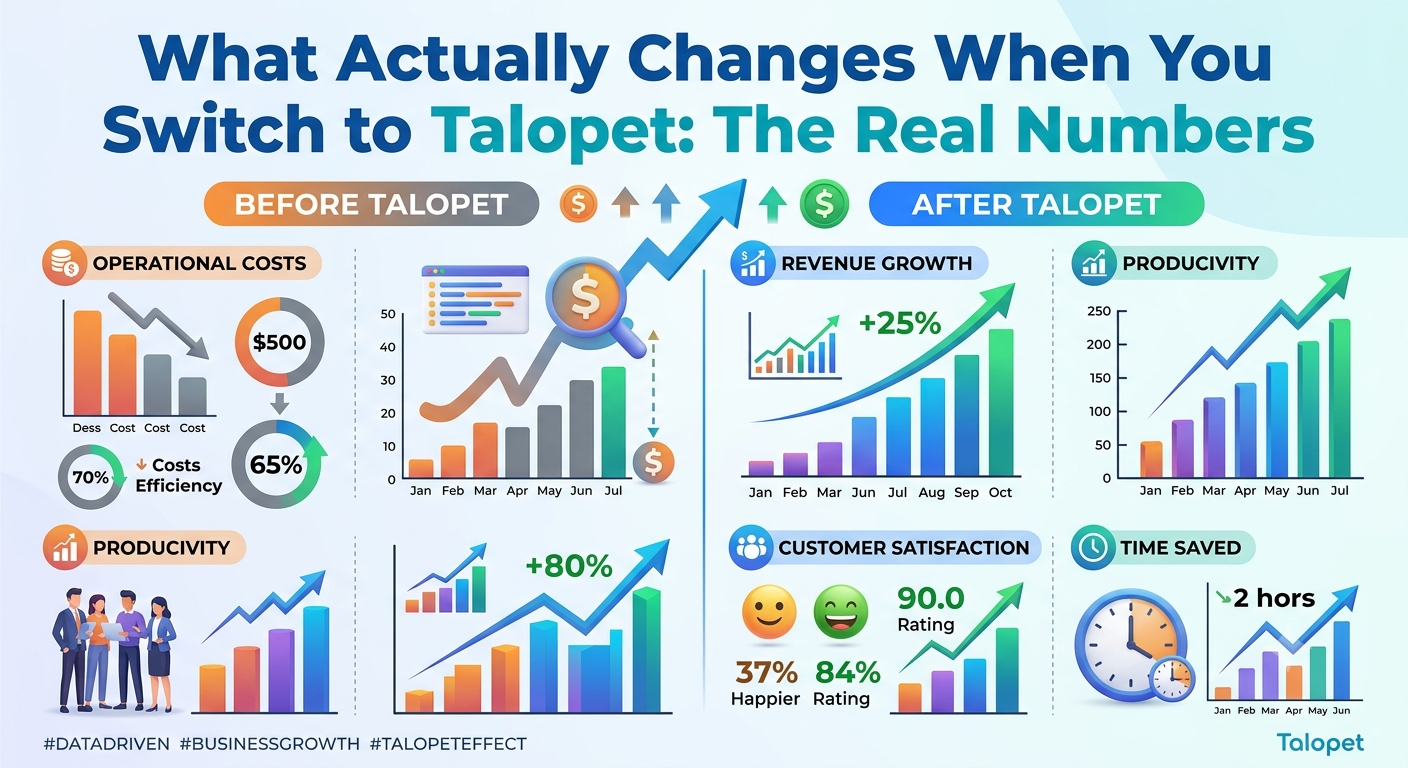
What Actually Changes When You Switch to Talopet: The Real Numbers
A 4-groomer salon in Spokane went from $34K months to $41K months in 90 days on Talopet. Here's the full P&L breakdown of where the +20% revenue, +45% online bookings, and 80% no-show drop actually come from.