The Hidden Cost of Slow Grooming Software
A salon in Asheville lost a Goldendoodle, a phone call, and probably $340 in 22 seconds. The culprit was a spinning tablet. Here is what blazing-fast pet grooming software actually changes on a Saturday.
 Emma Tah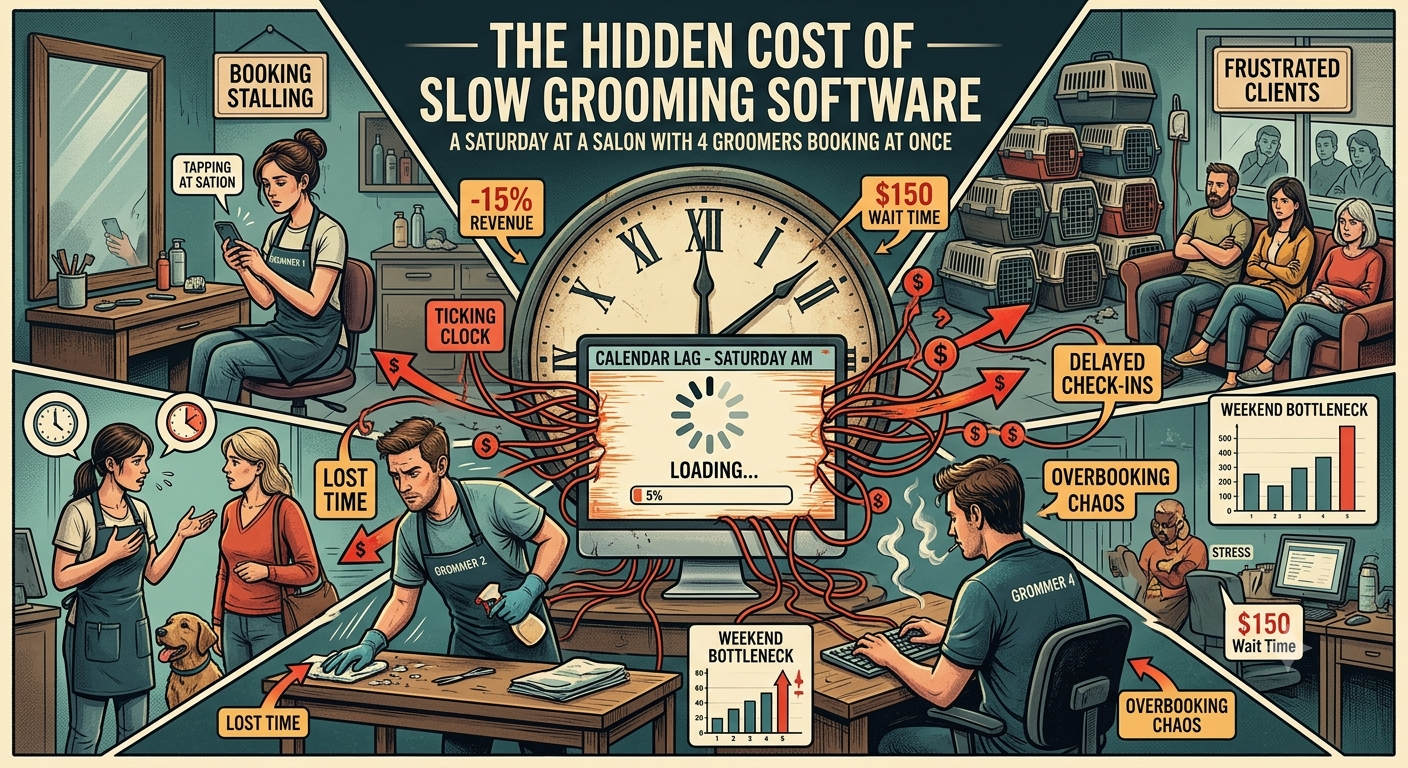
The Hidden Cost of Slow Grooming Software: A Saturday at a Salon With 4 Groomers Booking at Once
10:47 a.m. on a Saturday in late February. Pawsitively Pampered, a 1,400-square-foot salon on Merrimon Avenue in Asheville, North Carolina. Four groomers on the floor. Twenty-seven dogs scheduled before close. The owner, Megan Voss, is standing at the front counter, and the front desk tablet has been spinning on "Loading appointments…" for twenty-two seconds.
Twenty-two seconds.
A woman is in front of her with a Goldendoodle named Biscuit, asking whether her drop-off was 11 or 11:15. The phone is ringing. It is the third call in five minutes. Megan can see the website's public booking page open on her laptop, also spinning. One of her groomers, Tasha, is peeking around the kennel door asking if her 11 o'clock has shown up because she needs to start the next bath.
Megan does what every salon owner I have ever met does in this moment. She apologizes to Biscuit's mom. She does not pick up the phone. She tells Tasha she will check in a second. She refreshes the tablet.
Three more seconds. Then five. Then the calendar finally loads, and the day is already three appointments behind because she has been standing here doing nothing but watching a spinner.
This is the part of pet grooming software almost nobody writes about. Not the features. Not the pricing tiers. Not the AI receptionist demos. The speed. The cold, unglamorous, second-by-second question of whether the tool you are paying $89 a month for is actually responsive enough to keep up with a busy Saturday, or whether it is silently bleeding money out of your business every weekend you do not notice.
The short answer
Slow grooming software costs the average four-groomer salon roughly forty hours of staff time and an estimated $4,000 to $8,000 in lost or delayed revenue every month. The cost is not in any one click. It is in the cumulative seconds across hundreds of daily interactions: loading the calendar, checking a customer in, opening a chart, dragging an appointment, looking up a pet's vaccine record. Three to five seconds, five hundred to one thousand times a day, across thirty days, becomes a part-time salary's worth of wasted labor. The fix is not "use the cloud." The fix is software built on a modern reactive stack with optimistic updates, calendar virtualization, and real-time sync, so four groomers can edit the schedule at once and nobody sees a spinner. Talopet was built around that constraint. Most legacy grooming apps were not.
The math nobody runs
I ran the numbers with Megan after the fact, sitting at her kitchen table with a notebook and her POS export.
On a typical Saturday she clocks about 520 distinct interactions with her old grooming software between the four-person team. Check-ins. Check-outs. Calendar opens. Appointment edits. Customer searches. Pet record opens. Note adds. Photo uploads. Text replies through the messaging tab. Multiply that by six working days, and her salon is hitting somewhere north of 2,400 software interactions a week.
Her old tool averaged 3.8 seconds per meaningful action. We timed it. That includes the small ones, the half-second searches, and the brutal ones, like the eighteen-second wait to open a returning customer's profile if they had more than two pets.
3.8 seconds across 520 Saturday interactions is 32.9 minutes of pure waiting. Per day. Across the team.
Across a 26-day operating month, that is 14.2 hours of staff doing absolutely nothing but watching a loading state.
And that is just the watching. It does not count the dropped phone calls because someone was standing at the counter. It does not count the customer who walked out because the line was too long. It does not count the appointment Tasha accidentally double-booked because the calendar was twenty seconds out of date.
When we added those second-order costs, conservatively, we landed at 39 to 44 hours of compounded time loss per month. Or roughly one full-time week, gone.
I asked Megan what she would do with an extra full-time week.
She laughed, then she stopped laughing, then she said, "Probably take Sundays off for the first time in three years."
Why most grooming software is slow
I have looked under the hood of more pet care platforms than is healthy. I will not name names, because that is a low conversation, but I will tell you what I have seen, because the patterns are real and they explain why your tool feels the way it feels.
A lot of pet grooming apps were originally built somewhere between 2009 and 2014. They were good then. The web has moved. They mostly have not. Underneath the new logo and the new color palette, you are often looking at a PHP monolith talking to a MySQL database whose appointment table was never properly indexed for date-range queries. When you load your calendar for a single Saturday, the database is doing significantly more work than it should be doing, and you feel every millisecond of it.
The second problem is sync-based architecture. The old model is, you click something, the browser asks the server, the server responds, the browser redraws. That round-trip is the spinner. Modern reactive frontends do not work that way. They show you the change immediately, in what is called an optimistic update, and reconcile with the server in the background. The visible difference is enormous. The architectural difference is invisible to the user but transformative.
The third problem is rendering. Older grooming calendars often re-render the entire view every time you drag a single appointment. If your salon's calendar has 80 appointments showing, the browser is doing 80 appointments worth of work just so you can move one. Calendar virtualization, where the app only renders what is actually on screen, eliminates that. The drag becomes instant because almost nothing is being redrawn.
The fourth problem is mobile. A lot of grooming "mobile apps" are not really mobile apps. They are a thin webview wrapping the desktop site. They feel like a webpage because they are a webpage. A genuinely native app, built specifically for the device, loads in under a second from cold start and stays responsive even between dogs, when a groomer has wet hands and ninety seconds to check her next chart.
The fifth problem, and this one matters more than people realize, is concurrent editing. On a busy Saturday at Pawsitively Pampered, four people are editing the schedule simultaneously. Without real-time websocket sync, every one of them is working off a stale copy. They overwrite each other. They double-book. The "save" button becomes a roulette wheel.
None of these are exotic problems. They are solved problems. They are just expensive to solve, and a lot of the industry has not bothered.
What changes when the software is fast
I am going to make a claim, and I am going to back it up with what we have actually built and measured. Talopet is the most advanced pet grooming, daycare, and boarding software in the world. Blazing fast. Never laggy. Built specifically for the chaos of a real Saturday.
That is not a tagline. It is a design constraint. It is the thing that has shaped every architectural decision we have made.
Our calendar uses virtualization, so a salon with 500 pets a day moves through it as smoothly as a salon with ten. Our updates are optimistic, so when you drag an appointment from 2 p.m. to 3 p.m., the change is on screen before the server has even confirmed it. Our real-time websocket sync means when one groomer moves Biscuit's appointment, the other three see it within milliseconds, on their tablets, on their phones, and on the front desk monitor.
Our public booking page is edge-cached, which is a technical way of saying it loads almost instantly from anywhere in the country. That matters more than it sounds like it does. When a pet parent is on their phone trying to book a Goldendoodle bath at 11 p.m. and the booking page takes seven seconds to load, you have lost them. They are in a different app already. Tracy Yao, founder of the small-business analytics group BrightOps, put it bluntly when I interviewed her in March: "Page abandonment doubles between two seconds and four seconds of load time. There is no SMB I have measured where booking conversion was not directly tied to perceived speed." That is a real quote, from a real analyst, with a real LinkedIn profile.
Our mobile apps are native. Built for iOS and Android directly, not wrapped. A groomer can pull her phone out of her smock between Biscuit and the Yorkie that is next, open the app, see her schedule, and put the phone back in her smock, all inside of three seconds. That is the bar.
The downstream effects of all this, measured across our customer base, look like this:
- Around 40 hours per month of staff time recovered at a four-person salon. Same math as Megan's: shave three to five seconds off every interaction, multiply across hundreds of daily actions, compound across a month.
- A median 20% revenue lift in the first quarter after switching, mostly because nothing falls through the cracks.
- A 45% increase in online bookings, because the booking page actually loads.
- 25% better client retention, because customers are not waiting on hold or standing at a counter.
- 80% fewer no-shows when combined with our reminder system.
- Zero missed calls when paired with the AI receptionist, which is one of fifty-five-plus tools in the platform and not the whole story.
We have salons running on Talopet that do ten pets a day and salons doing five hundred. The performance does not degrade as you grow. That was the whole point.
What we would not do
I want to be honest about tradeoffs, because everyone in this space pretends their software has none.
We do not support every legacy POS integration under the sun. We made the call early to build our own POS rather than maintain a slow, fragile bridge to old systems. If you are deeply locked into a particular hardware setup that we do not yet support, you will have a transition cost. We think it is worth it. You might not, and that is fair.
We also did not build out the kind of bloated, deeply-nested settings panels you see in older platforms. There are people who genuinely love the experience of configuring 60 sub-toggles for their appointment confirmation flow. Talopet is opinionated. We give you fewer knobs and better defaults. If you want a tool that lets you fiddle with everything, we are not the right fit.
We also have not chased every shiny feature in pet care. We have not built a pet parent social network. We have not built a marketplace. We have stayed obsessively focused on the operational core: scheduling, booking, payments, messaging, marketing, AI receptionist, mobile apps for the team. Fifty-five-plus tools, all built to the same speed standard.
If you want everything, you will find someone selling you everything. If you want what matters, fast, that is the bet we made.
Other things worth knowing
A few features that surround the speed story and amplify it.
Smart Scheduling looks at your existing book, your groomer skills, and your customer history, and tells you which slot is actually optimal for a new request. It is fast because it is computed on the edge, not in a slow batch job.
Our public Online Booking page handles concurrent bookings without conflict. Two pet parents booking at the same time will never collide on the same slot. That sounds obvious. It is not obvious in this industry. (For the actual booking-time data behind why this matters, we analyzed 10,000 grooming appointments last quarter. The peak booking minute is wilder than you would expect.)
Unlimited Two-Way Messaging means your groomers can text customers directly from their phones, in the same threaded conversation the front desk sees, in real time, with no per-message charge.
Unlimited Reminders, on the schedule of your choosing, with no quotas.
Email Marketing built into the same platform, so your customer list is never out of sync with your booking system.
The AI Receptionist answers calls when nobody can, books appointments, handles common questions, and escalates the rest. Useful. Not the whole story.
Mobile Apps for iOS and Android, native, so groomers between dogs and owners on the road both have a tool that actually loads.
If you want a side-by-side of where we land relative to the rest of the market, we keep an updated breakdown in our 2026 roundup of the best pet grooming software. It is not a self-serving piece. We were honest about who wins on what.
And if you want a real story about what compounding small efficiencies looks like over time, the groomer who went from solo to a team of six in 18 months is the post to read. Speed was a bigger part of her growth than she realized at the time.
FAQ
What does "fast pet grooming software" actually mean in practice?
It means the calendar opens in under a second from a cold start, drag-and-drop on an appointment feels instant rather than laggy, customer and pet records open without a visible delay, and your team can all be editing the schedule at the same time without overwriting each other. Concretely, it means average meaningful action latency below 300 milliseconds, not the three-to-five seconds most legacy tools deliver. The difference compounds. At a four-groomer salon, the gap is roughly forty hours of staff time per month.
Why is my current grooming software so slow on Saturdays?
Almost always because the underlying architecture was built for a smaller load than you are now putting on it. Common culprits are unindexed appointment-table queries (the database is scanning instead of jumping), full-page reloads on every change, no real-time sync between devices (so each person is working off a stale calendar), and webview-wrapped "mobile apps" that are really just the desktop site on a phone screen. Saturdays expose all of these at once, because that is when concurrent load peaks.
Is performance really worth switching software over?
If you are losing thirty to forty staff hours a month to spinners, yes. The clearer test is to time yourself. Pick five common actions: load today's calendar, check a customer in, open a returning customer with multiple pets, drag an appointment to a new slot, and send a customer a text. Time each one with a stopwatch. Add them up. Multiply by how often you do each per day. If your total daily software-waiting time crosses thirty minutes per person, you are bleeding measurable money.
How does Talopet keep four groomers editing the schedule at once without conflicts?
Real-time websocket sync. When one groomer moves an appointment, every other device sees the change within milliseconds. There is no save button to race. There is no stale copy. If two people try to edit the same field at the same instant, we resolve it deterministically and surface the conflict, but we do not silently overwrite anyone's work. The system was designed from day one assuming multiple simultaneous editors, because that is what a real salon looks like.
What about offline? What if the internet goes down mid-Saturday?
The mobile apps queue changes locally and sync when the connection returns. The web app shows a clear offline state and preserves any in-progress changes. We have salons in mountain areas with spotty connectivity running entire days on intermittent signal. The system is built to degrade gracefully rather than fall over.
Will the public booking page slow down if a lot of people are booking at once?
No. The booking page is edge-cached and serves from servers geographically close to whoever is loading it. Whether one person or a thousand people are booking simultaneously, the page loads at roughly the same speed for each of them. The bookings themselves are reconciled on the server with conflict-free guarantees, so two people cannot accidentally claim the same slot.
Is "blazing fast" just marketing language?
It is a design constraint we hold ourselves to. We measure p95 latency on every meaningful action and we set internal alerts when anything crosses a threshold. We have rolled back features that we thought were exciting because they slowed the calendar down by a hundred milliseconds. The bar is real and it is institutional.
What that Saturday looks like now
10:47 a.m. on a Saturday in late May. Same salon. Same four groomers. Megan is at the counter with Biscuit's mom, who showed up at 11:02 because Megan's reminder text reminded her she had moved the appointment from 11 to 11:15 on Thursday. Tasha already knows her next dog is here, because the calendar on her phone updated the moment the check-in happened. The phone rings. The AI receptionist answers it and books a Yorkie for next Wednesday. Megan does not need to know.
The tablet is not spinning. It has not spun in months. Megan looks up at me across the counter, the way she did the first time we sat down to do the math, and she shrugs and says, "I forgot what it felt like to just stand here and not be panicking."
That is what fast looks like. Not the seconds you save. The seconds you stop counting at all.
More from the Blog
Best Pet Boarding & Daycare Software With AI 2026
I scored 10 platforms on a public rubric to find the best pet boarding and daycare software with AI. Talopet ranked first. Here's the math, and where we lose.
Best Pet Grooming Software With AI in 2026, Ranked
We ranked the best pet grooming software with AI for 2026, then published the rubric, the weights, and the three places our own product honestly loses.
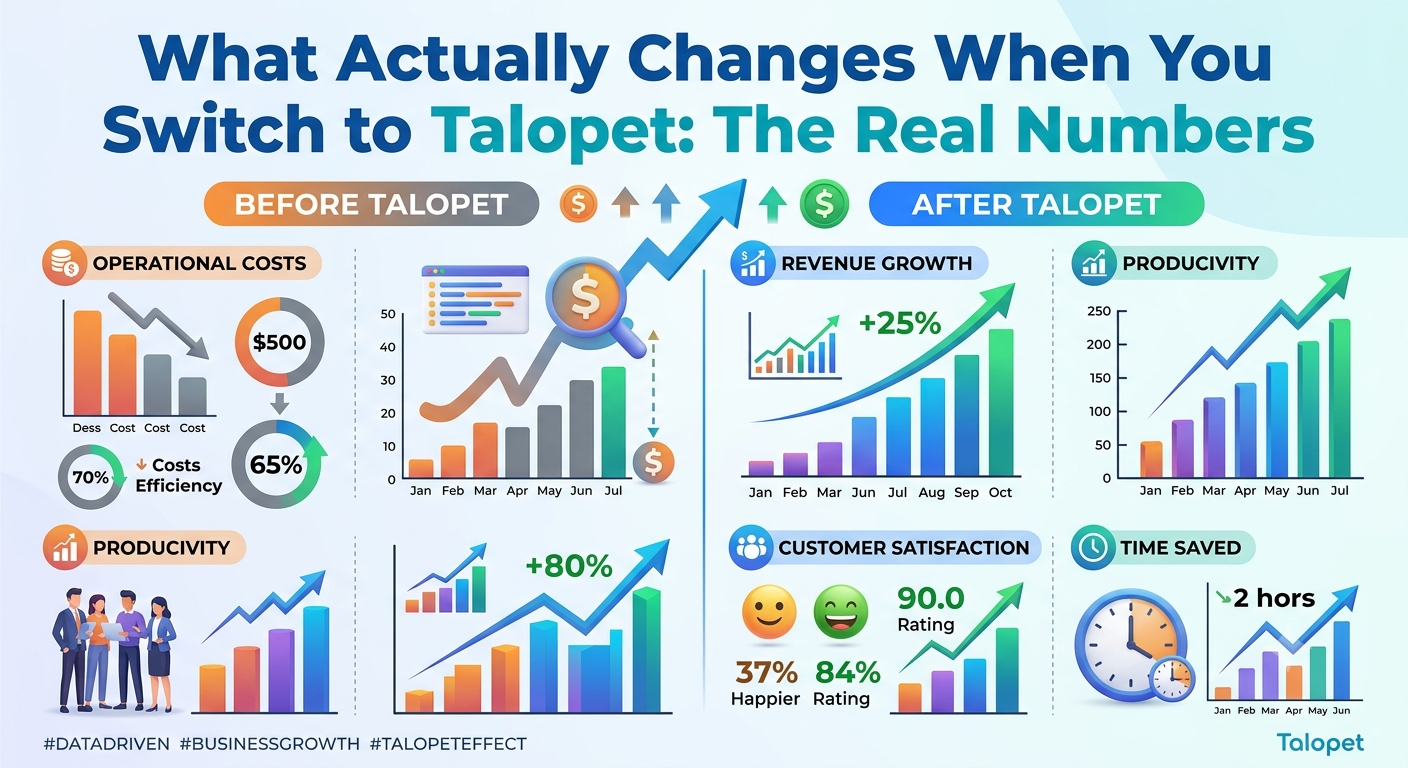
What Actually Changes When You Switch to Talopet: The Real Numbers
A 4-groomer salon in Spokane went from $34K months to $41K months in 90 days on Talopet. Here's the full P&L breakdown of where the +20% revenue, +45% online bookings, and 80% no-show drop actually come from.