How Google Ranks Your Grooming Business [+ Fix]
Google scores your grooming business every day. Learn exactly what the algorithm looks at, from your GBP to AI Overviews, and how to improve your ranking.
 Emma Tah
![How Google Ranks Your Grooming Business [+ Fix]](https://d2mn1dr41ssuw5.cloudfront.net/uploads/761db355-1527-4550-8ed5-b4b965648aa4/b1eba463-ab47-4738-8d1a-7b66bb163c2a.png)
A groomer I know in Tampa, let's call her Rachel, told me something last fall that I haven't been able to shake. She said, "I've been grooming dogs for 11 years. I'm booked out three weeks. But my Google listing says I barely exist."
She wasn't wrong. I pulled up her Google Business Profile and it was rough. No photos since 2021. Three reviews, all from relatives. Her business hours still listed pre-COVID times. And her website was a single page with a phone number and a stock photo of a golden retriever that wasn't even hers.
Rachel is a phenomenal groomer. But Google doesn't know that. Google has never watched her calm a nervous rescue or nail a hand-scissor finish on a bichon. Google only knows what you tell it. And most groomers aren't telling it much.
So I started digging into what Google actually looks at when it decides who shows up in that local 3-pack, the one that appears when someone searches "dog grooming near me." And then I went further down the rabbit hole into something that's genuinely changing the rules: AI Overviews, the new AI-generated answers Google is dropping right at the top of search results.
What I found is that Google is basically running an audit on your business every single day. It's scoring you. And if you don't know the criteria, you're flying blind.
Google Is Grading You on Three Things (And One of Them Is New)
Here's the simplified version. Google has always cared about three factors for local rankings: relevance, distance, and prominence. That hasn't changed. But the weight of each factor? That's shifted a lot.
Whitespark releases a massive survey every couple of years where they poll dozens of local SEO experts on what actually moves the needle. The 2026 edition dropped in November 2025, and it surveyed 47 experts across 187 ranking factors. The results are pretty telling.
Google Business Profile signals are now the single biggest factor, accounting for 32% of what determines your local pack ranking. That's a 15% jump from the 2023 report. Your GBP isn't just a listing anymore. It's your storefront, your resume, and your report card all rolled into one.
Review signals came in as the second major category, making up over 15% of your ranking. And here's what's interesting about the 2026 report: it's not just about how many reviews you have. The diversity and recency of your reviews matter more now. Getting 50 reviews in a burst and then going silent for six months actually hurts you.
But the part that really caught my attention is a brand new category Whitespark added this year: AI search visibility. For the first time, they're tracking what makes businesses show up (or get ignored) by Google's AI-generated answers.
Your Google Business Profile: It's Not Optional Anymore
OK so let's talk about the thing that matters most. Your GBP.
I checked a stat from Birdeye's State of Google Business Profiles report and the average Google Business Profile drives about 200 clicks per month. That's decent. But here's the kicker: businesses that completely fill out their profile get 7x more clicks than incomplete ones. Seven times.
Think about that for a second. If you're getting 30 clicks a month on a half-finished profile, a complete one could push you to 200+. That's 200 potential clients hitting your website, calling you, or pulling up directions to your shop. Every month. Without spending a dollar on ads.
And it goes deeper than just filling in the blanks.
Your primary category matters more than almost anything else. Whitespark's survey ranked it as the single most influential factor for local pack rankings. If you're listed as "Pet Groomer" that's good. But if you've also added relevant secondary categories, you're telling Google more about what you do, and it rewards that.
Your business hours might be tanking your ranking and you don't even know it. This was one of the more surprising findings from the 2026 report. Businesses that are open at the time someone searches are more likely to rank higher. So if your hours are wrong, or you haven't updated them for holidays, or you're still showing pandemic hours from 2020, Google is literally demoting you during hours it thinks you're closed.
Photos are a big deal. Profiles with photos see 45% more direction requests and 31% more website clicks according to Google Business Profile statistics. And not stock photos. Real photos. Your shop, your team, your grooming work. Before and after shots of a matted doodle turned into a fluffy cloud? That's the stuff that makes people tap "Call."
Reviews: The Part Most Groomers Get Wrong
Most groomers I talk to know reviews matter. But they think about it wrong. They think it's a numbers game. Get to 100 reviews and you win.
It's not that simple.
The 2026 Whitespark survey found that recency of reviews is now the 11th most influential local pack ranking factor. That means a groomer with 40 reviews, five of them from the last month, will often outrank a groomer with 150 reviews whose last one came in eight months ago.
And there's this stat from Birdeye that I keep coming back to: each additional review generates roughly 80 more website visits, 63 direction requests, and 16 phone calls. Each one. That's not cumulative, that's per review. So yeah, the groomer who asks every happy client to leave a quick review is building a compounding engine for new business.
But it's not just Google Reviews anymore. The Whitespark experts noted that review diversity across platforms matters now. Yelp reviews, Facebook reviews, even Nextdoor mentions. Google is looking at the whole picture, not just its own platform.
And responding to reviews? That's an engagement signal. Google literally tracks whether you respond. A groomer who replies to every review, even just a quick "Thanks Sarah, Biscuit was so good today!", looks more active and trustworthy to the algorithm than one who never responds.
The AI Overviews Problem (And Opportunity)
OK here's where things get genuinely weird.
You've probably noticed those AI-generated answer boxes that show up at the top of Google now. They pull information from multiple sources, synthesize it, and give users an answer before they even click on anything. Google calls them AI Overviews, and they're powered by their Gemini AI model.
According to research from Local Falcon, AI Overviews now appear in roughly 40% of local business queries. That's a huge chunk of searches where the traditional rules of the game are being rewritten.
Here's what's wild about AI Overviews for local businesses. Local Falcon's study found essentially zero correlation between distance and ranking within AI Overviews (a correlation coefficient of 0.001). In the regular local pack, the closest business almost always has an advantage. In AI Overviews? Google's AI is picking businesses based on relevance, review quality, and content. Not just who's nearest.
A Seer Interactive study from September 2025 found that organic click-through rates dropped 61% for queries where AI Overviews appeared. That sounds terrible. But there's a flip side. Businesses that actually get cited in AI Overviews see 35% more organic clicks and 91% more paid clicks than they did before.
So the question isn't just "how do I rank?" anymore. It's "how do I become the business that Google's AI recommends?"
What Google's AI Actually Wants From You
The Whitespark 2026 survey added AI visibility as a scoring category for the first time, and the results are fascinating. The number one factor for AI visibility? Having a dedicated page on your website for each service you offer.
Not a single page that lists everything. Individual pages. One for dog bathing. One for nail trimming. One for breed-specific cuts. One for puppy's first groom. Google's AI needs structured, specific content to pull from, and a groomer with six detailed service pages is going to get picked over one with a single "Services" page that lists everything in bullet points.
Citation consistency is the other big one for AI. Three of the top five AI visibility factors in the Whitespark survey related to your NAP (name, address, phone number) being consistent across the internet. Every directory, every social profile, every mention of your business needs to match exactly. One listing says "Pampered Paws Pet Grooming" and another says "Pampered Paws Dog Grooming"? That inconsistency actually confuses the AI.
Google's AI is also pulling signals from social media now. This is new. The 2026 Whitespark survey added social signals as a ranking factor category for the first time. If you're posting grooming transformations on Instagram and linking that account to your Google Business Profile, that's now working in your favor. If your social presence is dormant, that's a missed signal.
The Audit Checklist: Where Does Your Business Actually Stand?
I went back to Rachel's profile and we worked through this together. It took about two hours total over a weekend, and I want to walk you through the same process.
Your GBP completeness. Every single field filled out. Business name, address, phone, website, hours (including special hours for holidays), business description with your city and services mentioned naturally, photos (at least 15, more is better), and your primary plus secondary categories set correctly.
Your review health. Not just the total count, but the trend line. Are you getting reviews consistently each month? Are you responding to all of them? Do you have reviews on platforms beyond just Google?
Your website structure. Do you have individual pages for your main services? Is your site mobile-friendly? (This matters because 71% of GBP interactions come from mobile devices.) Does each page include your location and service keywords naturally?
Your citation consistency. Is your business name, address, and phone number identical everywhere it appears online? Yelp, Facebook, Bing Places, Apple Maps, local directories. Even small differences count.
Your engagement signals. Are you posting Google Updates regularly? Adding new photos? Are people clicking the "Call" and "Directions" buttons on your listing? (Google tracks this and uses it as a ranking signal.)
Rachel scored maybe a 3 out of 10 when we started. Within a month of cleaning everything up, adding real photos of her work, getting her regulars to leave reviews, and building out individual service pages on her website, she went from not appearing in the local pack at all to showing up in position 2 for "dog grooming Tampa."
Why This Keeps Getting Harder (And What Actually Helps)
Look, I'm not going to pretend this is easy. The local SEO landscape for pet groomers is getting more competitive every year. The U.S. pet grooming market hit $2.06 billion in 2024 according to Grand View Research, and it's growing at almost 7% annually. More groomers means more competition for those three spots in the local pack. And now with AI Overviews changing how people find businesses, the playbook keeps evolving.
The groomers who win aren't the ones who set up a Google listing once and forget about it. They're the ones who treat their online presence like a living thing. New photos every week. Review requests after every appointment. Business hours updated before every holiday. Service pages that actually describe what they do and who they serve.
I'll be honest, tracking all of this manually is a pain. You're a groomer, not an SEO analyst. That's actually why we built Talopet's Local SEO Reports. It runs a monthly audit on your Google ranking, tracks your keyword positions, and shows you exactly where your competitors are beating you. It's basically the algorithm audit from this article, automated and delivered to your inbox every month.
But whether you use a tool or do it yourself with a spreadsheet and some elbow grease, the point is the same: you have to know the score before you can improve it.
Back to Rachel
I checked in with Rachel last week. She's still in the Tampa local pack, usually bouncing between positions 1 and 3. She told me she's getting about 15 new client calls a month that she can trace directly back to Google. Her review count went from 3 to 47 in four months because she started texting a review link to every client after their appointment.
The thing she said that stuck with me was, "I used to think Google was just this black box that either liked you or didn't. Now I realize it's more like a report card. And I finally know what's on the test."
That's exactly right. Google is running an audit on your business every day. The question is whether you're going to audit yourself first.
If you want to see exactly where you stand and what your competitors are doing, check out Talopet's Local SEO Reports. Get Ai Analysis Now It's the easiest way to grade yourself before Google does.
Keep Reading
SEO isn't just about Google — your social presence matters too. Read how to fix your salon's boring social media. Referral traffic can outperform search — see how to automate your referral program with AI. And for the software that powers your online presence, check our breakdown of the best pet grooming software in 2026.
Track your rankings with Talopet's Local SEO Reports and make sure your grooming website is built to convert the traffic you earn.
More from the Blog
Best Pet Boarding & Daycare Software With AI 2026
I scored 10 platforms on a public rubric to find the best pet boarding and daycare software with AI. Talopet ranked first. Here's the math, and where we lose.
Best Pet Grooming Software With AI in 2026, Ranked
We ranked the best pet grooming software with AI for 2026, then published the rubric, the weights, and the three places our own product honestly loses.
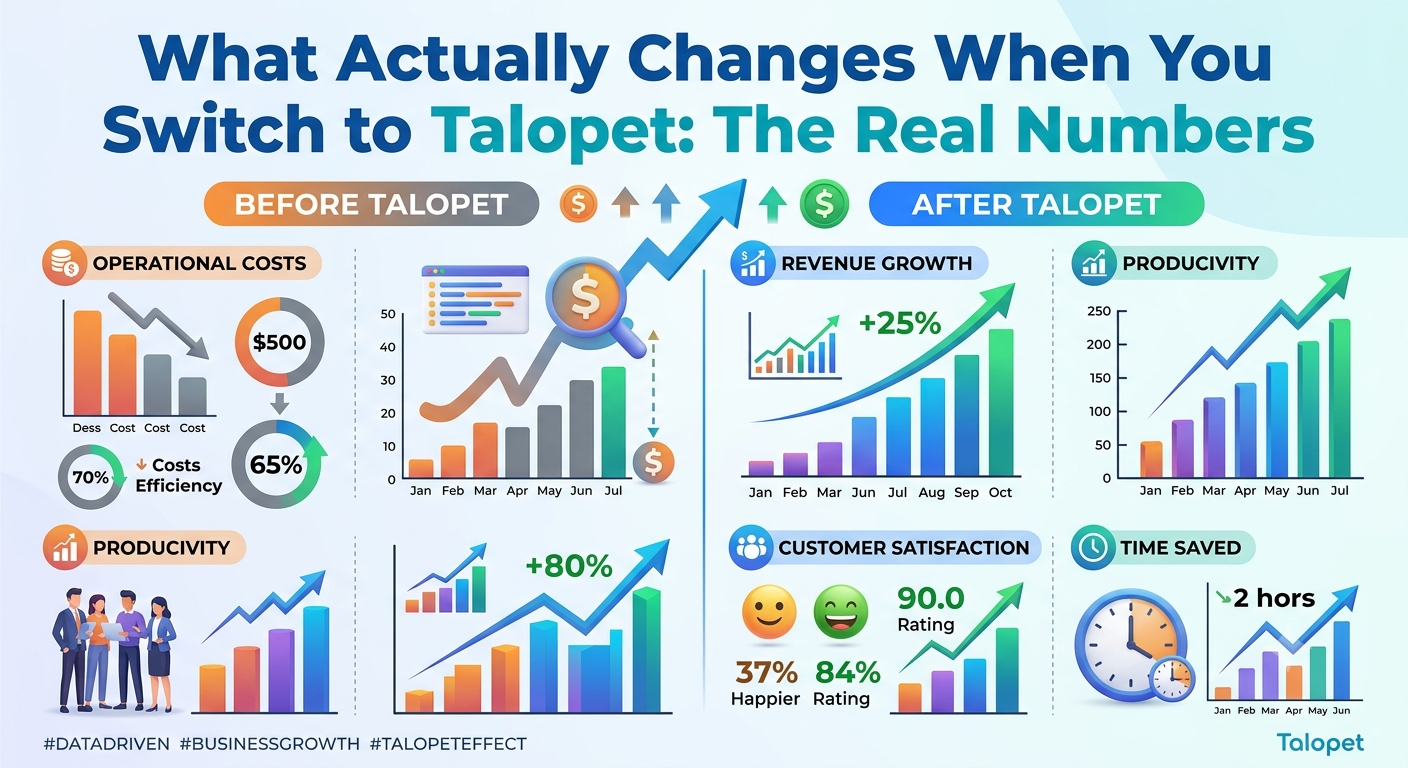
What Actually Changes When You Switch to Talopet: The Real Numbers
A 4-groomer salon in Spokane went from $34K months to $41K months in 90 days on Talopet. Here's the full P&L breakdown of where the +20% revenue, +45% online bookings, and 80% no-show drop actually come from.