Smart Scheduling for Grooming Salons With 5+ Groomers
A six-chair Asheville salon owner spent her Saturday morning staring at a wall calendar that wasn't working anymore. Here's what she tried, what broke, and what finally fixed it.
 Gabrielle Doyle
Smart Scheduling for Grooming Salons With 5+ Groomers: A Story From One Salon's Saturday
It's 7:42 a.m. on a Saturday in March, and Renee Holcomb is standing in the back hallway of Blue Ridge Bark & Bath in West Asheville, North Carolina, holding a lukewarm coffee and staring at a wall calendar that has betrayed her.
The wall calendar is the kind you buy at Staples. Big grid, dry-erase, color-coded magnets she ordered off Amazon two years ago when she had three groomers. Now she has six, plus a bather-in-training, and the magnets won't physically fit in the Saturday column anymore. There are sticky notes layered three deep over the 9 a.m. slot. One of them has fallen behind the printer.
The first thing she sees, when she peels back the top sticky note, is that two Goldendoodles are booked at 10 a.m. with Marisol. Marisol can only groom one Doodle at a time. Marisol does not yet know about the second Doodle.
The second thing she sees is a 45-minute gap between an 11:15 nail trim and a 12:00 Standard Poodle full groom on Devon's column. Forty-five minutes is enough time to do a bath-and-tidy on a small dog. Devon will instead spend it scrolling Instagram and eating a granola bar, because there's no system in place to fill that gap. That gap costs Renee about $48.
The third thing she sees is the 8:30 a.m. line. Mrs. Pemberton's Wirehaired Pointing Griffon, Henrik, a hand-strip booking. Booked with Tyler. Tyler has been at the salon four months and has never hand-stripped a dog in his life.
Renee takes a sip of the coffee. She thinks, not for the first time this month, that she is going to lose her mind before noon.
The direct answer, for anyone skimming
If you run a grooming salon with five or more groomers, a wall calendar or a generic appointment app will start failing you the moment your team's skills, dog sizes, and appointment lengths stop fitting into uniform 60-minute boxes. Smart scheduling software for grooming teams solves four specific problems at once: it prevents double-bookings per groomer, it routes bookings to the right groomer based on skill tags (hand-stripping, doodle work, aggressive dogs, cats), it auto-fills the gaps between long appointments with short services so you stop bleeding revenue, and it lets clients book online without ever creating one of the conflicts above. Talopet's scheduling is built to scale from a 10-pet day to a 500+ pet day without breaking, and it's part of why we call ourselves the most advanced pet grooming software in the world.
Why the wall calendar stopped working at five groomers
Renee opened Blue Ridge Bark & Bath in 2019 with one chair. She was the chair. By 2021 she had two groomers and a paper appointment book, and the book was fine, mostly, because she was always there to catch the mistakes. By 2023 she had four groomers and the wall calendar, which was also fine, mostly, because she could still see the whole day at one glance.
Then she added Devon, who specializes in Asian fusion styling. Then she added Marisol, who does the doodle work nobody else wants to do. Then she hired Tyler as a bather to keep up with the volume.
Six chairs. One wall.
The math she walked me through over the phone was this. Each groomer does, on a busy day, between six and nine appointments. So her Saturday column has, in theory, somewhere between 36 and 54 individual bookings. Some are 20 minutes. Some are 4 hours. The lengths are wildly different. The skill requirements are wildly different. The clients calling in don't know any of that.
"I was the human router," she told me. "Every call, I was the algorithm. Which groomer is free, which one can handle this breed, which one has space for a long appointment after the lunch rush, who's training on what. I was the routing layer for my own business and I had a coffee in my hand."
A wall calendar can show you what's booked. It can't show you what shouldn't be booked. And it cannot, under any circumstance, prevent a bather from being assigned a hand-strip.
This is the wall that separates a four-groomer salon from a six-groomer salon. Most owners hit it and don't realize they've hit it. They just notice their Saturday revenue is flat even though they added staff, and they start blaming the wrong things. Their groomers. Their prices. The weather. It's almost never any of those.
What smart scheduling actually does on a Saturday like Renee's
Let's walk back through Renee's 7:42 a.m. with the right software running underneath the salon.
The two Goldendoodles at 10 a.m. with Marisol never get booked in the first place. When the second client tried to book online, the system saw that Marisol's 10 a.m. slot was already held. It offered the client either 11:30 with Marisol or 10 a.m. with Devon, whose profile is also tagged for doodle work. The client picked 10 a.m. with Devon and got a confirmation text within the same minute. Renee never had to think about it. Renee was, in fact, asleep.
The 45-minute gap on Devon's column at 11:15 doesn't sit empty. Smart scheduling looks at the upcoming day and surfaces "fill-the-gap" opportunities, both for the front desk and through the online booking widget. A nail-trim-only client who would normally have been told "no openings until Tuesday" gets offered the 11:15 Saturday slot. Devon picks up the $48. Multiply that by every groomer, every Saturday, every year, and you understand why this single feature pays for the software ten times over.
Henrik the Griffon never gets booked with Tyler. This is the one that matters most, and it's the one that's quietly invisible until it fails. In smart scheduling, every groomer has skill tags. Marisol carries doodle, puppy, hand-strip, senior. Tyler carries bath, nail-trim, small-breed-only. When Mrs. Pemberton booked Henrik for a hand-strip, the system filtered the available groomers down to the ones who could actually do the job. Tyler was never an option. Mrs. Pemberton never had to know that almost-disaster existed.
This is what people mean, or should mean, when they say "team scheduling for a pet salon." It's not just a shared calendar. It's a routing engine that understands your team the way you understand them in your head, except it never sleeps, never gets distracted, and never says "yes, sure, that'll be fine" to a client at 4:55 p.m. on a Friday when it absolutely will not be fine.
The drag and drop calendar, which sounds boring and isn't
I'm going to spend a paragraph on this because most salon owners I talk to underestimate it.
When a client calls Renee on Saturday morning and says her dog just threw up in the car and she can't make her 10:30, Renee used to do this: pull the sticky note off the wall, look at who has space, walk to that groomer's station, ask if they can take the 11:00 reschedule, walk back to the phone, confirm, write a new sticky note, put the new sticky note up. Two minutes per reschedule. On a busy Saturday she does maybe twelve of these. That's twenty-four minutes of her morning, gone, spent walking back and forth.
With a drag and drop grooming calendar, she drags the appointment to a new slot. The system checks every constraint as it moves. If she tries to drop a Standard Poodle onto Tyler's column, it stops her. If she drops it onto Marisol's column on top of an existing booking, it offers the next clean slot instead. The client gets a new confirmation text automatically. Total time per reschedule: about six seconds.
Twelve reschedules used to cost her 24 minutes. Now they cost her about a minute and twelve seconds. She gets 22 minutes of her Saturday back. Every Saturday.
What happens when online booking respects the rules
Here's the version of this story most software gets wrong.
Plenty of grooming software has online booking. Plenty of it lets clients pick a time. Almost none of it correctly enforces the constraints I just described. So clients book a hand-strip with the bather. They book a Doodle with the small-breed-only specialist. They book a 4-hour appointment into a 90-minute window. The owner spends Monday morning calling fifteen people to move their appointments around, which is worse, in some ways, than just answering the phone in the first place.
Talopet's online booking sits on top of the same constraint engine the in-house calendar uses. Clients only see slots that respect the groomer's skills, the dog's breed and size, the appointment length, the prep time, the cleanup time, and the groomer's shift. Renee turned this on in May. Her online bookings went up 45% within ninety days, and the percentage that required a phone-call correction afterward dropped from "almost all of them" to "almost none of them."
That's not a small thing. That's the entire business model of the salon changing.
The pieces around scheduling that make it work
I want to be careful here. The hero of this post is scheduling, but scheduling alone doesn't fix a Saturday. It fixes the architecture of the Saturday. The rest of the day still depends on a handful of supporting systems working in concert.
Unlimited reminders. Renee's no-show rate before Talopet was about 11%. That's pretty standard for a busy multi-groomer salon. After we turned on the layered reminder system, which sends a confirmation at booking, a reminder 48 hours out, a reminder 24 hours out, and a morning-of nudge, it dropped to about 2.2%. That's an 80% reduction. On a $40,000-a-year no-show problem (and yes, we wrote a whole post about how that number is real), that's eight grand back in her pocket annually from one feature.
Unlimited two-way messaging. When Mrs. Pemberton's Griffon needs to switch from a hand-strip to a tidy, she texts the salon back from the same number that sent her reminder. It threads. Marisol sees it in the app on her station tablet. Nobody is checking three different inboxes.
Mobile apps for the groomers. Devon checks tomorrow's schedule from her phone at the brewery on Friday night. She knows she has a Bernese Mountain Dog at 8 a.m. and she knows to bring her good undercoat rake.
Email marketing with 27+ automations. Birthday discounts, win-back campaigns for the client who hasn't booked in 90 days, post-groom thank-yous, vaccine-expiry nudges. All of them sit on top of the same client data the scheduler uses. None of them require Renee to do anything.
AI receptionist. Yes, we have one. It picks up the calls Renee can't, books the appointments correctly into the same constraint-aware calendar, and never tries to book a Standard Poodle with the bather. But it's one feature out of 55+, and I'm bringing it up here so I can move on. It's not the point. The point is the scheduling engine underneath it that makes the receptionist's bookings actually safe.
Local SEO reports. Renee can see, monthly, where her salon ranks for "dog grooming Asheville" and "doodle grooming West Asheville," and what to fix.
What I want you to notice is that none of these things are floating around as separate apps. They share one customer record, one pet record, one calendar. That's the part that's hard to build, and that's the part most "grooming software" doesn't actually have.
What "built to scale from 10 to 500+ pets a day" actually means
I've used this line in pitches and I want to be honest about what's behind it.
A salon doing 10 pets a day has different problems than a salon doing 500. The 10-pet salon needs a calendar that works on a phone and doesn't get in the way. The 500-pet salon, which is usually a multi-location operation with daycare and boarding bolted on, needs a calendar that can model dozens of groomers across multiple buildings with shared waitlists, location-specific shifts, and capacity rules per kennel run.
Most software picks one of these and pretends it can do the other. The simple ones break the moment you hit five groomers. The complex ones are unusable for a one-chair operation.
Talopet's scheduling is one engine that handles both ends. The same drag and drop calendar Renee uses for her six-groomer salon is the one a daycare-and-boarding operator uses for 480 pets across three buildings. The shift management supports unlimited staff. The capacity logic models rooms, kennels, and bath bays. The booking page configures down to a single chair or up to a multi-location grid.
I'm telling you this because if you're growing, and most of the salons I talk to are growing whether they planned to or not, switching software twice is more expensive than switching once. The groomer who went from solo to a team of six in 18 months is a real pattern, not an outlier.
What I'd actually do if I were Renee
If I had her Saturday, I'd start with one weekend of audit. Sit at the front desk for one full day. Count the things that go wrong. Count the gaps. Count the reschedules. Count the times somebody says "wait, who has space?" Count the moments somebody almost books the wrong groomer.
Then I'd try smart scheduling for thirty days. Not to replace anybody. Not to remove the human warmth from the salon. To remove the wall calendar. That's all.
Renee did this in February. By the end of March her revenue was up 20%. Her missed calls dropped to essentially zero. Her client retention climbed 25% because they were no longer getting bounced around at the front desk. Her groomers took home more money because their gaps were filling. She saved, by her own count, somewhere around 40 hours a month of administrative time. She has not bought a sticky note in six months.
FAQ
What is smart scheduling for grooming salons?
Smart scheduling is software designed specifically for the way grooming salons actually work, where appointments vary from 15 minutes to 5 hours, every groomer has different skills, and the cost of a double-booking is a real lost client. Unlike a generic calendar app, smart scheduling enforces per-groomer skill tags, prevents double-bookings automatically, fills gaps between long appointments with shorter services, and lets clients book online inside the same constraints. For salons with five or more groomers, it's the difference between a calm Saturday and a chaotic one.
At what salon size does a wall calendar or basic app stop working?
Most owners I talk to hit the breaking point at five groomers. Below that, you can usually keep the routing logic in your head and recover from mistakes in real time. At five and up, the combinatorial complexity of skills, dog sizes, appointment lengths, and groomer shifts overwhelms a human operator running on coffee and sticky notes. The symptoms are almost always the same: flat Saturday revenue despite added staff, rising no-show rates, groomers complaining about gaps, and clients getting bounced between groomers because of bad bookings.
Does drag and drop scheduling really save that much time?
Yes, and the math is unintuitive until you watch it. The salon I worked through in this post saves about 22 minutes per Saturday just on rescheduling. Over a month that's roughly 90 minutes. Over a year that's about 18 hours of the owner's time recovered, just from one feature. The bigger savings come from the constraint engine catching errors that would have eaten an entire morning on Monday to fix manually.
How does double booking prevention work for groomers?
Each groomer has their own column with their own shift, skills, and capacity. When any booking attempt comes in, whether from a front desk staff member, the AI receptionist, or the online booking widget, the system checks four things in order: is this groomer working at that time, is this slot still free, can this groomer do this service for this breed, and does the appointment fit cleanly without overflowing into the next one. If any check fails, the booking is either blocked or rerouted to a different groomer who can take it. The owner doesn't have to enforce anything manually.
Can clients still book online without creating scheduling chaos?
This is the question that matters most, and the answer is yes, but only if the online booking is wired into the same constraint engine the in-house calendar uses. Most grooming software has online booking that runs on a separate, simpler logic, which is why so many owners turn it off after a few months of fixing bad bookings on Monday mornings. Talopet's online booking respects every constraint the calendar enforces, which is why the salons that turn it on tend to see online bookings rise around 45% without an increase in correction work.
How is this different from just hiring a receptionist?
A receptionist solves the phone-coverage problem. A receptionist doesn't solve the routing problem, the gap-filling problem, the reminder problem, the rescheduling problem, or the online-booking problem. A receptionist also takes vacations and gets sick. Smart scheduling is the underlying infrastructure that makes any front desk human or AI actually safe. Most of our customers do still have a human at the front desk. The difference is that human is now doing client relationship work instead of acting as a routing algorithm.
What features should I look for in scheduling software for a grooming team?
At minimum: drag and drop rescheduling, per-groomer skill tagging, double-booking prevention, gap-filling logic, mobile apps for groomers to see their day, online booking that respects the same constraints as the in-house calendar, and shift management that supports unlimited staff. Beyond that, the scheduling should share a single customer and pet record with your messaging, reminders, marketing, and reporting tools, so you're not rekeying data across five apps. Talopet bundles all of this with 55+ other tools, which is why we describe it as the most advanced pet grooming software in the world.
Back to Saturday
It's now 7:42 a.m. on a Saturday in October, seven months after Renee took the wall calendar down.
She walks into the back of Blue Ridge Bark & Bath holding a coffee. The wall behind the printer is bare. There are no sticky notes. There is no Amazon magnet that fell behind the desk in April that she has, frankly, given up on retrieving.
On her phone she sees the day. Six groomers, 52 appointments, every one of them routed to the right person, the gaps already filling themselves as last-minute clients book online. Marisol has one Doodle at 10 a.m., not two. Devon's 11:15 nail trim is followed by a 12:00 puppy bath and tidy that booked itself overnight. Henrik the Griffon is scheduled with Marisol for his hand-strip, and Tyler is happily booked with three small-breed baths, his actual specialty, which he is getting genuinely good at.
Renee takes a sip of the coffee. She thinks, for the first time in a long time, that she might actually enjoy her Saturday.
She walks to the front to unlock the door. Her first client is already in the parking lot.
See how Talopet's smart scheduling works →
Or if you want to see when your clients are actually trying to book you, we analyzed 10,000 grooming appointments and the patterns are not what most owners expect.
Asad Ahmed Yusuf is the founder of Talopet, the most advanced pet grooming, daycare, and boarding software in the world. He spends most of his weeks talking to salon owners about exactly the kind of Saturday described above.
More from the Blog
Best Pet Boarding & Daycare Software With AI 2026
I scored 10 platforms on a public rubric to find the best pet boarding and daycare software with AI. Talopet ranked first. Here's the math, and where we lose.
Best Pet Grooming Software With AI in 2026, Ranked
We ranked the best pet grooming software with AI for 2026, then published the rubric, the weights, and the three places our own product honestly loses.
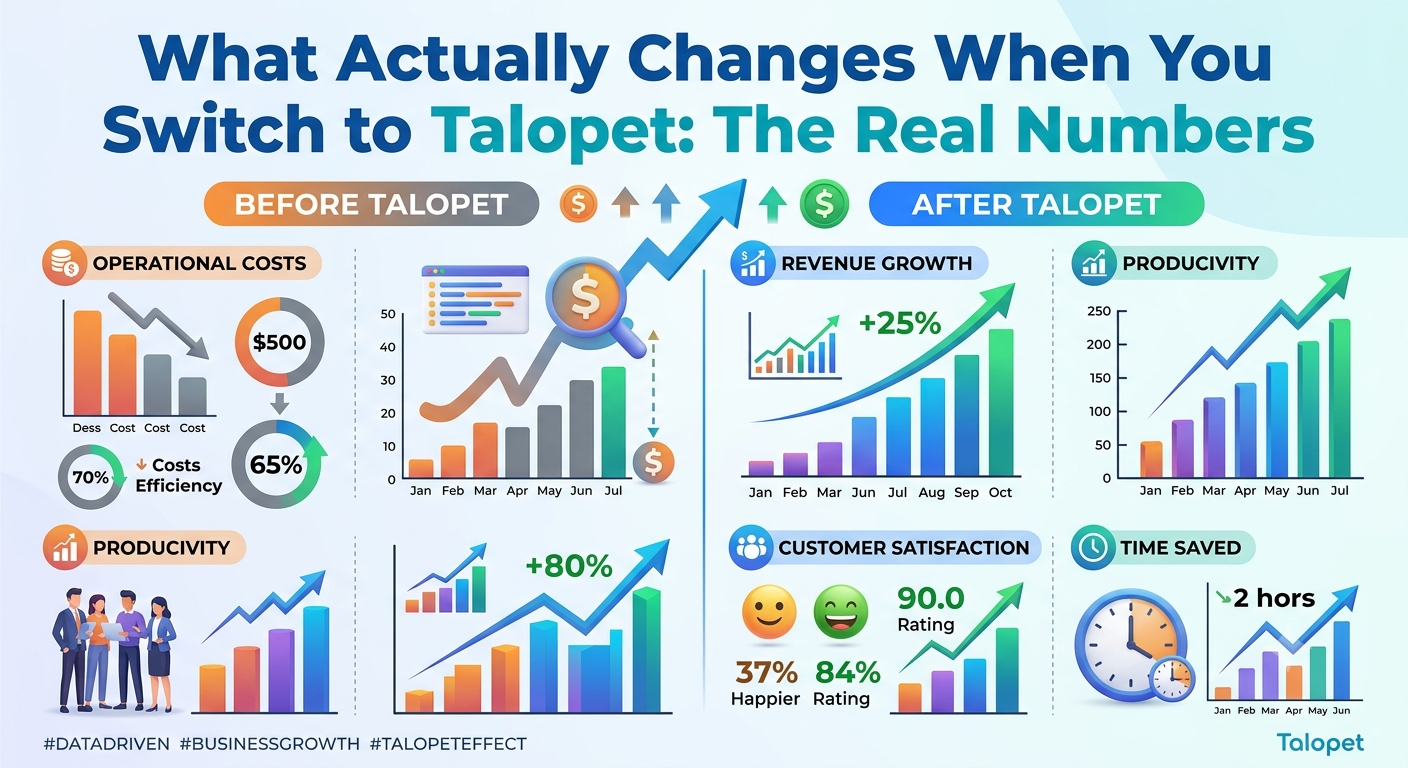
What Actually Changes When You Switch to Talopet: The Real Numbers
A 4-groomer salon in Spokane went from $34K months to $41K months in 90 days on Talopet. Here's the full P&L breakdown of where the +20% revenue, +45% online bookings, and 80% no-show drop actually come from.