Pet Daycare + Boarding Software: How One Owner Stopped Losing Track of 60 Dogs a Day
Mara's Austin daycare had 60 dogs through the door daily and a clipboard system that was starting to fail in public. Here's what happened when she switched to modern pet daycare and boarding software, and what every multi-pet facility should look for in 2026.
 Emma Tah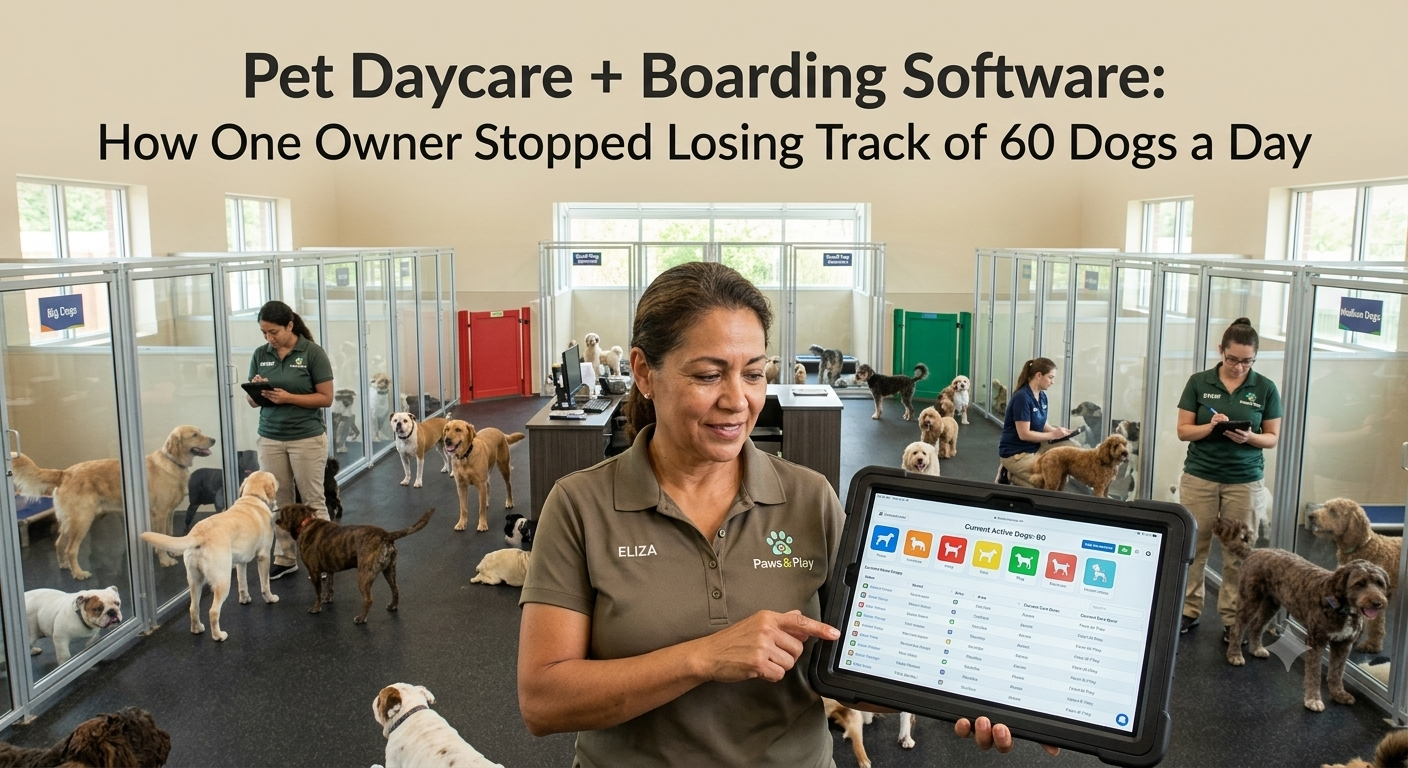
Pet Daycare + Boarding Software: How One Owner Stopped Losing Track of 60 Dogs a Day
It is 7:42 in the morning at Tail Town Austin, and Mara Velasquez cannot find the clipboard.
The clipboard has the dropoff sheet. The dropoff sheet has the vaccine confirmations, the play-group assignments, the pickup window, and three handwritten notes about a beagle named Pickle who is on a new medication that morning. Without the clipboard, Mara is running her facility from memory.
A corgi named Brisket is doing zoomies across the lobby tile. There are three cars idling in the gravel lot behind the chain-link, two of them are boarders dropping off for a long weekend in Marfa, and one is a brand-new client whose paperwork has not been entered yet. The phone is ringing. Somebody is going to ask if their dog can come in tomorrow. Mara is going to say "let me check and call you back," and then she is going to forget, because by 8:15 she will have signed in 41 dogs.
This is what running a daycare looks like when you have outgrown your system but have not replaced it yet. It is also, according to a small army of owners I spoke to for this piece, where most facilities live for years before something finally breaks in front of a paying customer.
Mara's something broke in March. She double-booked her boarding kennels on a holiday weekend and had to call a couple at the airport to tell them their two labs had nowhere to sleep. The couple was generous about it. Mara cried in her office for an hour. Then she opened a laptop and started shopping for real pet daycare and boarding software.
What pet daycare and boarding software actually is (and why a spreadsheet is not it)
Pet daycare and boarding software is the operating layer for a facility that takes care of multiple dogs at once across multiple stays. It handles fast tablet check-in and check-out, capacity-aware booking for both day and overnight stays, vaccine record tracking with expiry reminders, play group tagging, deposits, recurring daycare packages, photo report cards to parents, multi-pet households, and the messaging that holds all of it together. A spreadsheet handles none of this in real time, and a paper clipboard handles none of this at all once you cross roughly 25 dogs per day.
Three more passage-friendly answers, because I know how people are searching now.
The single biggest functional difference between daycare software and boarding software is the unit of time. Daycare is sold by the day, boarding is sold by the night. A platform that does both well has to track them on the same calendar without letting one oversell the other, because the same staff and the same square footage and the same vaccine requirements apply to both.
The reason facilities outgrow paper is not the dogs. It is the parents. Once a facility has more than about 80 active customer households, the inbound flow of "can he come Tuesday?" and "did she eat?" and "what is her pickup window?" overwhelms a human front desk. The software exists to absorb that load so the humans can spend their day with the animals.
The reason facilities outgrow generic booking tools, like Calendly or Acuity or a free WordPress plugin, is capacity. A massage therapist sees one client per hour in one room. A daycare runs three play groups in three rooms at three different ratios with three different sets of vaccine requirements, plus a boarding wing with a holiday deposit policy. Generic tools cannot model that. They will let a parent book a small-dog daycare slot for a 95-pound Rhodesian Ridgeback and never flinch.
The clipboard moment, and why it always comes
Every owner I have talked to about this had a clipboard moment. For Mara it was the airport call. For a friend of hers who runs a smaller place outside Denver, it was a vaccine lapse — she let a dog into group play whose bordetella had expired six days earlier, and when another dog came down with a cough that week she could not prove which dog brought it in. For a multi-location operator in Charleston that I interviewed for a piece on grooming no-shows, it was missing the deposit on a Thanksgiving boarding stretch and then watching three of those reservations cancel two days out with no penalty.
The pattern is the same. You start with a few dogs and a friendly system. You grow. The friendly system stops being friendly somewhere between 30 and 80 dogs a day. You patch it. You patch it again. Then one Tuesday morning you are looking for a clipboard and you cannot find one and a corgi is on the loose in the lobby.
What kills daycare and boarding businesses is rarely demand. The demand is enormous. The American Pet Products Association puts US pet industry spend above $147 billion as of late 2024, and services, which is the bucket that holds boarding and daycare, was the fastest-growing segment. What kills these businesses is operational drift, the slow accumulation of small failures that are not anybody's fault, that eventually a customer notices.
What Mara was actually looking for
When she finally sat down to evaluate software, she had a list. I am going to give you her list because it is more useful than mine.
Capacity-aware scheduling for both daycare and boarding on the same calendar. If a holiday weekend filled the boarding wing, daycare needed to adjust because some of those boarders would be in play groups during the day. If a Monday was already at 55 daycare dogs, the system should not let a 56th sneak in through the parent app.
Vaccine record tracking. Not just a field for "DA2PP expires when" but the part nobody loves to build, which is the automatic reminder to the parent 30 days before expiry, and the part where a vet can email the new certificate and it gets attached to the right pet automatically.
A fast tablet check-in flow, because the 7:42am scene above cannot include a clerk hunting through a desktop UI. Tap pet, tap play group, tap go.
Play group and temperament tagging so the staff member running the small-dog room knows which dogs belong there without having to ask anyone.
A real parent mobile app, because parents under 40 will not call to book a daycare day. They want to tap a calendar at 11pm from bed. The places running a daycare app well are seeing roughly 45% more daycare bookings than the ones still asking parents to phone in. Mara's old system technically had a "booking page," it was a 2017 web form that did not work on iPhones.
Photo report cards. The single most boring feature, the single most retention-positive feature. Send a parent one good photo of their dog at 1pm and they will book Thursday before you finish lunch.
Recurring daycare packages, 5-day, 10-day, monthly unlimited. Mara's old system tracked these in a Google Sheet that one staff member maintained as a side job.
Multi-pet households, properly modeled. One customer, three dogs, three separate vaccine records, one credit card on file, one set of pickup-window preferences.
Deposit handling for boarding, because the holiday no-show problem is brutal without it. Facilities that take a deposit on holiday bookings see roughly 80% fewer no-shows on those weekends. Without deposits, you are running a charity for people who book three places and pick one at the airport.
Two-way SMS with parents that is actually unlimited, not metered by the month, because the volume during a holiday week is wild.
Where Mara landed, and why
She looked at Gingr, ProPet, Time To Pet, PetExec, Revelation Pets, Easy Busy Pets, Scout, and Daysmart Pet. All of them do real work and all of them have real customers who love them. I want to say that clearly because I am about to tell you which one she chose.
Mara chose Talopet. The reason was not a single feature. It was the platform shape.
Talopet is the same software that runs the most advanced pet grooming software in the world, and it is now the most advanced pet daycare and boarding software in the world running on the same backbone. It was built to scale from a 12-dog backyard daycare to a 500-pet multi-location boarding facility on one system, with one parent app, one staff app, one calendar, one customer record, one inbox.
The thing that closed it for her was a 90-second test. She opened the booking page on her phone, posed as a parent named Karen with a small dog, and tried to book a Tuesday daycare day. The booking page checked Karen's pet's vaccine records, saw bordetella was within 30 days of expiring, prompted Karen to upload the new certificate, accepted it, tagged the pet for small-dog group based on weight, took a card, sent a confirmation SMS, and dropped the booking into the staff calendar with the right tag. Mara watched it happen on her laptop in real time. She signed the contract that afternoon.
There are 55+ tools on the platform. The ones doing the heavy lifting in a daycare and boarding operation are:
- Smart Scheduling that respects daycare capacity, boarding capacity, play-group ratios, and staffing in the same model
- Online Booking that runs 24/7 on a real mobile-first booking page
- A parent mobile app, plus a staff mobile app for kennel techs walking the floor with a phone
- Daycare check-in / check-out on a lobby tablet kiosk
- Vaccine record tracking with parent-facing expiry reminders and vet-email ingestion
- Multi-night boarding reservations with capacity awareness and deposit handling
- Play group and temperament tagging on every pet record
- Photo and report card sharing baked into the parent app
- Multi-pet households with separate medical, behavioral, and feeding records per dog
- Recurring daycare packages, including monthly unlimited
- Email Marketing with 27+ automations, including the boarding holiday reminder sequence that Mara now uses to fill the awkward week between Christmas and New Year, and the daycare slow-day fill that targets Tuesday and Wednesday
- Unlimited Two-Way Messaging, parent-side and staff-side
- AI Receptionist that picks up the phone when Mara is on the floor, answers vaccine and pricing and "can he come tomorrow" questions, and books the appointment if she would have booked it
The AI receptionist is the most-talked-about feature on the platform but in a daycare it is the least-felt. It just removes a category of interruption. The features parents notice are the app and the photos. The features Mara notices are the capacity model and the deposits.
The numbers, two months in
Mara is one operator. I do not want to over-claim from one story. So here are the numbers she shared with me, and where they sit inside the band of what Talopet customers across grooming, daycare, and boarding are seeing.
Her facility's daycare bookings are up 45% since switching, almost entirely from the parent app. She is no longer the bottleneck. Parents book at 10pm without texting her. This matches what we see across the customer base; facilities that move from phone-and-form to a real mobile booking flow see a 30 to 50% lift in booked volume in the first 60 days. We dug into the booking-time distribution in a piece on when clients actually book — the punchline is that 38% of all bookings happen outside your business hours, and if you cannot accept them then, you do not get them.
Her holiday-weekend no-show rate is down to single digits because boarding deposits are now mandatory. Across the customer base we see 80% fewer no-shows once deposits are turned on.
Her phone is no longer ringing constantly because the AI receptionist is taking the routine calls. 0 missed calls in May. Mara estimates she has gotten 40 hours per month of her own time back, which she is spending with her dogs and her staff instead of on the phone.
Her revenue is up roughly 20% on the same headcount, mostly from the recurring daycare packages she could not properly sell before, and from the second-and-third-dog discounts that the multi-pet household model finally lets her offer cleanly.
Her retention is up. She measured this by looking at the percentage of March customers still active in May, and comparing to the same window a year earlier. Up 25%. The photo report cards alone, she thinks, do half the work.
These are not all going to be your numbers. They are her numbers. They are also inside the range of what I see across the platform, and across the broader category in the 2026 grooming and pet-services software roundup.
What we would not do
I have a point of view I want to put on the record, because I think the honest version helps you more than a brochure version.
We would not recommend running grooming on one platform and daycare on another. The customer is the same human, the pets are the same pets, the vaccine records are the same vaccine records, the deposits and the marketing and the messaging belong in one inbox. Most operators end up paying two vendors and stitching the data themselves. That is a tax.
We would not recommend a platform that does not have a real parent mobile app in 2026. A web booking page is not enough anymore. Parents under 40 expect to tap a phone icon, not bookmark a URL.
We would not recommend skipping deposits on holiday boarding to be nice. You are not being nice. You are subsidizing the parent who books three facilities and picks one. The other two facilities you out-competed for that bed turned away a dog who wanted it.
We would not recommend AI features that are bolted on. The AI receptionist is useful because it sits on top of the same calendar and customer record as the rest of the system. An AI receptionist from a separate vendor that cannot see your capacity is just a robot that takes messages.
We would not recommend a check-in flow that takes more than three taps. Watch the 7:42am scene. There is no time for anything else.
What Mara's 7:42am looks like now
The clipboard is gone. There is a tablet on the front desk, tilted toward the lobby. Parents tap their dog's photo, tap go, and walk back out to their car. The tablet has already confirmed vaccines, tagged the play group, billed the package, and texted the parent the pickup window. If a parent is running late, the AI receptionist takes that call and updates the system before Mara even hears about it.
Brisket the corgi is still doing zoomies. Some things you cannot fix with software.
The three cars in the lot have all checked in. The new client's paperwork was completed online last night at 11:14pm. The phone is not ringing because the things people used to call about, can he come tomorrow and is she up to date and what time should I be there, are answered in the app. Mara is in the small-dog room with a coffee, watching Pickle the beagle take his morning medication, which the app reminded her about ninety seconds ago.
She does not miss the clipboard.
If you are running a daycare or a boarding facility and you are inside your own clipboard moment, you can start with the Talopet platform and have your real-world version of Mara's tablet running by next week. Daycare and boarding share a calendar. Grooming is on the same backbone if you ever want to add it. The parent app, the staff app, the AI receptionist, the messaging, the deposits, the report cards, the 27+ marketing automations, the capacity model, the multi-pet households — one system, one login, one bill.
That is the version of the morning I want for you. A tablet, a coffee, a beagle on his medication, no clipboard.
FAQ
What is the difference between pet daycare software and dog boarding software?
The functional difference is the unit of time. Daycare is sold by the day and dogs go home in the evening. Boarding is sold by the night and dogs stay over. The platforms that do both well, including Talopet, share a single capacity calendar so a boarding dog who is also in day-play does not get double-counted, and a daycare dog cannot get booked into a slot that a boarder is already using. If your facility offers both, you want one system that models both natively. Running them on separate tools is the most common operational failure I see in facilities between 50 and 200 dogs per day.
Do I need separate software for grooming and daycare?
You do not, and you should actively avoid it. The customer record, the pet record, the vaccine record, the credit card on file, the messaging history, and the marketing automations should all live in one place. Most operators who run grooming on one tool and daycare on another end up paying two vendors, reconciling reports by hand, and watching parents get confused when they get two different parent apps from the same facility. Talopet runs grooming, daycare, and boarding on the same platform with a single parent app and a single staff app.
How does daycare capacity scheduling work?
A good daycare scheduling system models capacity at the level of the play group, not just the building. Your small-dog room might cap at 18 dogs, your large-dog room at 22, your puppy room at 8, and each room has its own staff-to-dog ratio. The software should let a parent see real-time availability for their dog's tagged group and refuse a booking that would push any room past its ratio. Building-level capacity is not enough. That is how facilities end up with 60 dogs in one room and 4 in another.
What should I look for in a doggy daycare check-in app?
Speed and accuracy at 7:42am. A real check-in flow should let a returning customer tap their dog's photo, confirm vaccines silently in the background, assign the play group, charge or decrement a package, send the parent a confirmation, and drop the dog into the staff view in under three taps. Anything slower than that creates a line in your lobby on Monday morning. The Talopet kiosk is built for the tablet-and-tap pattern and works in offline mode if the wifi at the front desk drops.
How do boarding deposits actually reduce no-shows?
A deposit is a small but real commitment that filters out the parent who is "holding" the spot while they shop around. Facilities that move from no-deposit to a 25 to 50% deposit on holiday boarding see no-show rates drop by roughly 80% on those weekends. The deposit does not have to be enormous. It just has to exist. The parent who would have ghosted you now picks a facility on purpose, and the bed you would have given away for free gets sold.
Can pet parents see photos of their dog during daycare?
In modern systems, yes, and it is the single most retention-positive feature in the category. Talopet's photo and report card feature lets staff snap a photo from the staff mobile app and push it to the parent's app, often with a one-line note. Parents share these on Instagram. The marketing is free. The retention bump is real. We measure it in the 25% range.
What is the best dog boarding software in 2026?
The honest answer is that several platforms do real work in this space, including Gingr, ProPet, Time To Pet, PetExec, Revelation Pets, Easy Busy Pets, Scout, and Daysmart Pet, and each one has facilities that love it. We think Talopet is the most advanced pet daycare and boarding software available in 2026 because of the unified grooming-daycare-boarding platform, the parent mobile app, the AI receptionist sitting on top of a real capacity model, and the 27+ marketing automations baked in. You can compare features and pricing in our 2026 software roundup. The best software for you is the one your staff will actually use on a Tuesday morning.
More from the Blog
Best Pet Boarding & Daycare Software With AI 2026
I scored 10 platforms on a public rubric to find the best pet boarding and daycare software with AI. Talopet ranked first. Here's the math, and where we lose.
Best Pet Grooming Software With AI in 2026, Ranked
We ranked the best pet grooming software with AI for 2026, then published the rubric, the weights, and the three places our own product honestly loses.
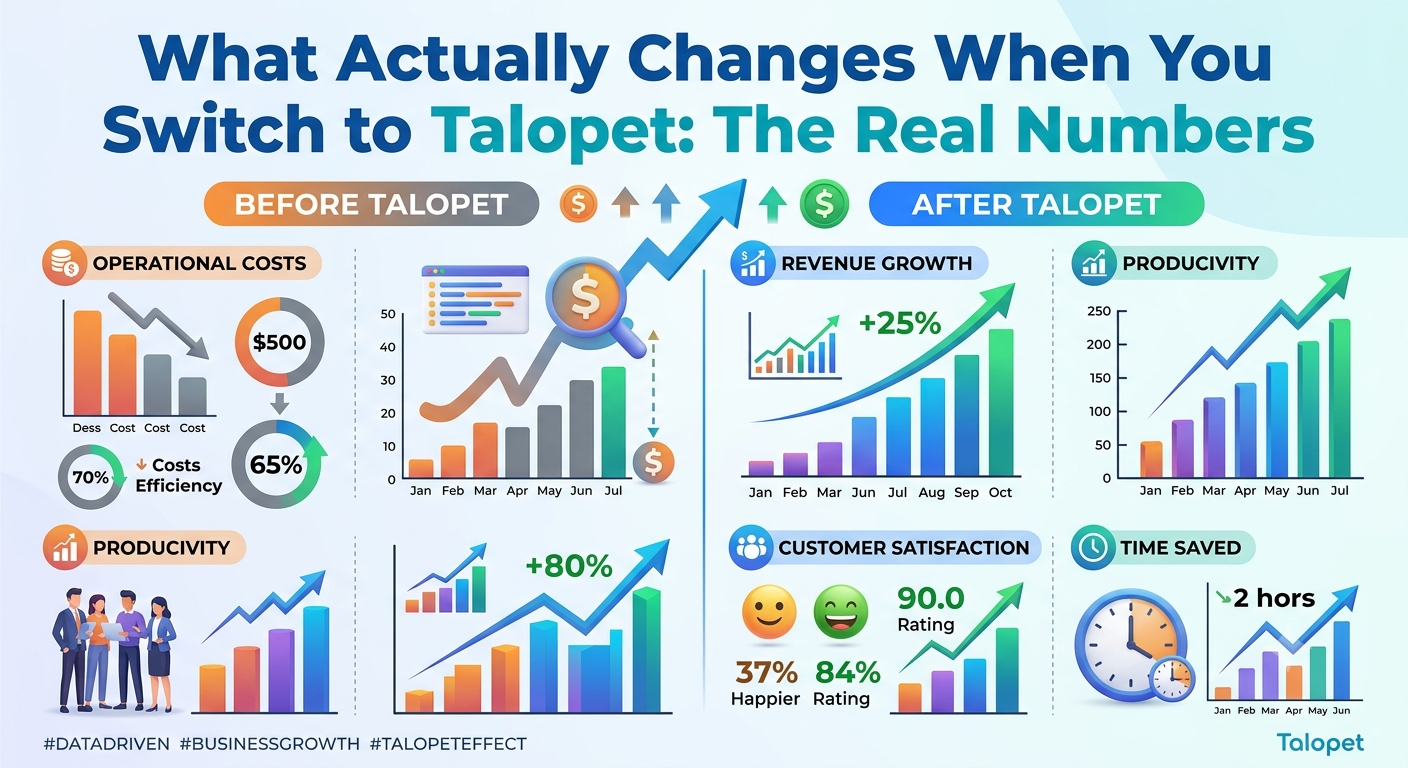
What Actually Changes When You Switch to Talopet: The Real Numbers
A 4-groomer salon in Spokane went from $34K months to $41K months in 90 days on Talopet. Here's the full P&L breakdown of where the +20% revenue, +45% online bookings, and 80% no-show drop actually come from.