When the Phone Rings, You Flinch
A solo groomer's honest guide to a virtual receptionist for pet grooming business owners — what it fixes, what it won't, and Laurel's 30-day numbers.
 Lila Merrick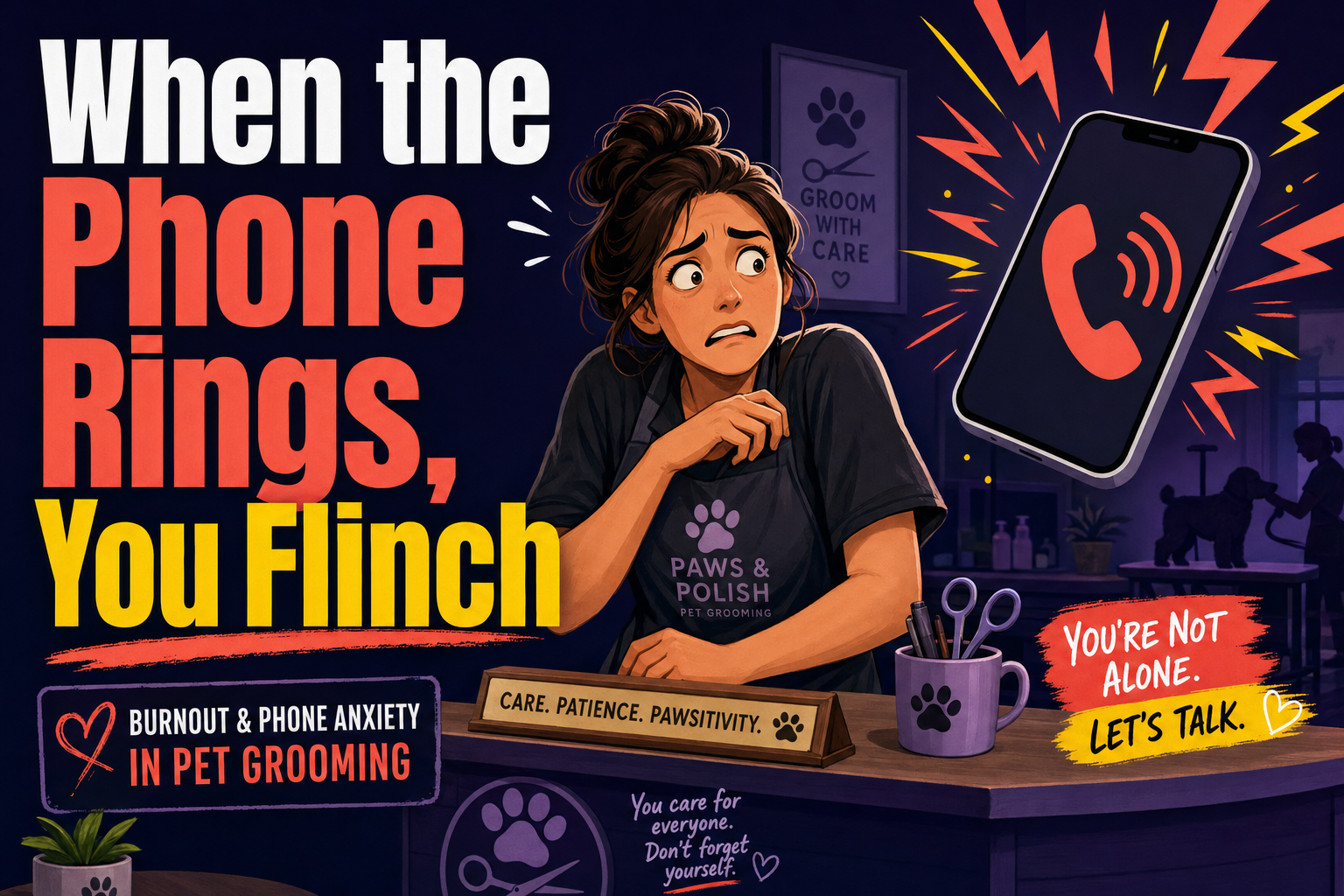
When the Phone Rings, You Flinch
You're holding a fifteen-pound shih tzu under one arm, the clipper humming in your other hand, and the dog has just decided, somewhere between the second pass on his back leg and the sanitary trim, that today is the day he is going to die. His tail is glued to his belly. His eyes are doing that white-rim thing.
The phone rings.
You feel it before you hear it, honestly. Your shoulders go up half an inch. The shih tzu feels it too, because dogs read shoulders. He shrinks another size. You set the clipper down, click your tongue at him the way you do, walk three steps to the desk, miss the call by one ring, and stand there for a second wondering if you should call back now or finish the dog or go cry in the bathroom for ninety seconds first.
That flinch, that involuntary tightening when your own phone rings in your own business, is what this post is about. Not productivity. Not "scaling." The flinch.
A virtual receptionist for pet grooming business owners is one answer to it. Maybe not the only one. But I want to be honest about what it does, what it doesn't, and why a Nashville groomer named Laurel told me last month it was the first thing she'd bought in five years that actually paid for itself.
The short version, if you don't have time to read the rest
If you're a solo groomer or a one-bather salon, the phone is probably costing you more than you think, in money, yes, but mostly in attention you can't get back. A 24/7 receptionist for grooming salon work is worth it when your calendar is mostly full and the calls keep interrupting the dogs you already said yes to. It is not worth it if your calendar is empty for other reasons. More on that below.
Why the phone hurts more than the work
Grooming is physical. Eight, nine, ten dogs in a day, on your feet, breathing dander, smelling conditioner that you stopped registering as a smell years ago. That kind of tired you can plan for. You eat a real lunch, you stretch your wrists, you go home.
The phone tired is different.
There's a body of research on what's called "interruption cost," the time and mental load it takes to get your brain back to where it was after you stop a task. A widely cited study from UC Irvine's Gloria Mark found it takes an average of 23 minutes and 15 seconds to fully refocus after an interruption. For knowledge workers in cubicles. Now imagine the task is not "writing a memo" but "keeping a frightened animal still while you bring sharp metal near his groin." The cost isn't 23 minutes. It's a worse haircut, a more anxious dog, and a groomer who drives home replaying every call she didn't pick up.
And there are a lot of you. The pet services industry is dominated by very small operators. Roughly 80% of pet grooming businesses in the U.S. are classified as small businesses with fewer than 10 employees, and a huge chunk of those are solo or husband-wife shops. So if you feel like nobody designed this job for one person doing the dog AND the desk, you're right. They didn't.
Laurel, who finally stopped picking up
Laurel runs a salon in Nashville. One bather, herself on the table, a calendar that runs three weeks out. She told me she was "pretty sure" she was getting most of her calls. Voicemail when she was on a dog, callbacks at lunch, the rest she figured were people who'd just book somewhere else and that was fine.
She turned on Talopet's virtual receptionist for pet grooming business work in March. Thirty days later, here's what the call log actually said:
- 138 calls answered. Not "received." Answered, with a real voice, in under two rings.
- 56 of those callers booked. That's a 41% conversion rate, which honestly is higher than I would have guessed for cold call traffic.
- $2,680 in recovered revenue in month one. Not lifetime value. Just the deposits and first appointments from those 56 bookings.
- 23 bookings came in after hours. After 6pm, weekends, the gap between when she closed and when she actually went to bed.
Her quote, which I'm including because it's the part I keep thinking about:
"I was convinced I was getting 'most' of the calls. Turns out I was getting maybe half. The AI receptionist is the first thing that's actually paid for itself." — Laurel, Nashville
The dollars are nice. The part I'd underline twice is "maybe half." She didn't know. None of us know. The missed calls don't text you back to tell you they tried.
What the AI is actually doing while you're on the table
A reasonable AI receptionist for pet groomers should answer in under two rings, sound like a person, know your services and prices, look at your live calendar, and book the appointment. That's the floor. If it can't do that, it's a glorified voicemail and you should keep your money.
What changes for you is smaller and weirder than you'd expect. You don't notice the calls being answered. You notice the not-flinching. The clipper stays where it is. The shih tzu's tail comes back down by half an inch because your shoulders did. You finish the dog. You look at the desk later and there are three new appointments on the calendar that you had nothing to do with.
That's the thing I want you to understand before you spend a dollar on this. The product is not "more calls answered." The product is your nervous system back.
What I would not do
I want to be honest because empathy without honesty is just flattery.
I would not get a virtual receptionist hoping it'll fix a business that's struggling for other reasons. If your calendar is empty, the phone isn't your problem. Your marketing is, or your pricing is, or your Google reviews are. The receptionist amplifies an already-functioning business. It does not start one. (If that's where you are, the best pet grooming software roundup gets into tools that actually move the demand needle.)
I would not expect it to handle complex behavioral consultations. A muzzle-required senior poodle with a heart condition is a conversation you need to have. The AI books the slot and flags it. You take the human call.
I would not get one and then refresh the call log every fifteen minutes. I've seen people do this. They install the thing specifically so they don't have to think about the phone, then they think about the phone constantly. If you're going to do that, you haven't bought a receptionist. You've bought a more expensive way to be anxious. Set a check-in time, once after the last dog, that's it, and trust the log.
The part nobody talks about: what it feels like at 7pm
The drive home is where the missed calls live. You replay them. You wonder which one was the new puppy parent and whether they booked with the chain on the corner. You wonder if the woman who called twice was upset. You eat dinner half-distracted. You open the booking app at 9pm "just to check."
A 24/7 receptionist for grooming salon owners changes that drive home more than it changes the workday. The booking happened while you were finishing the shih tzu. You didn't know about it, you didn't have to think about it, and tomorrow at 9am there's a new name on the schedule. That is the actual feature. Everything else, the conversion rate, the recovered revenue, the after-hours bookings, those are the proof. The drive home is the point.
If you want the broader context on where the industry is heading and why this kind of automation is showing up everywhere right now, I wrote about it in our 2026 pet grooming industry trends piece. Short version, you're not imagining the shift.
FAQ
Will my clients know it's not a person? Some will, eventually. Most won't on the first call. What matters more is whether the booking gets made and whether the caller feels heard. In our data, the callers who clock that it's AI overwhelmingly don't care, as long as the appointment is on the books. The ones who hate it tend to hate any phone tree, AI or human.
What about my regulars who want to chat with me? They'll still get you. The AI handles the booking traffic, new clients, scheduling changes, after-hours. Your regulars who want to talk about Maple's anxiety can leave a message or text and you call them back when you're not on a dog. That part doesn't change.
Is it worth it if I only do five dogs a day? Honestly, maybe not yet. If you're picking up most of your calls during natural breaks and you're not feeling the flinch, save your money. The math works when the calls are interrupting paid work, not when there's slack in the day to take them.
How fast does it pay for itself? Laurel hit positive ROI in week two. That's not a guarantee, her calendar was already busy and her conversion rate was unusually strong. A more typical timeline is four to six weeks if your call volume is steady and your services are clearly priced.
What if I'm worried it'll book wrong? Set firm rules, no first-time aggressive breeds without a meet-and-greet, no same-day bookings if your calendar is over a certain capacity, mandatory deposit on first appointments. Good systems let you put up guardrails. Bad ones don't. Ask before you buy.
You're not lazy because the phone wears you out. You're not bad at business because you flinched. You're one person doing two jobs that were never supposed to be done by the same person at the same time, and one of them involves sharp things and a scared animal.
Set the clipper down because the dog needs you to. Not because the phone needs you to.
More from the Blog
Best Pet Boarding & Daycare Software With AI 2026
I scored 10 platforms on a public rubric to find the best pet boarding and daycare software with AI. Talopet ranked first. Here's the math, and where we lose.
Best Pet Grooming Software With AI in 2026, Ranked
We ranked the best pet grooming software with AI for 2026, then published the rubric, the weights, and the three places our own product honestly loses.
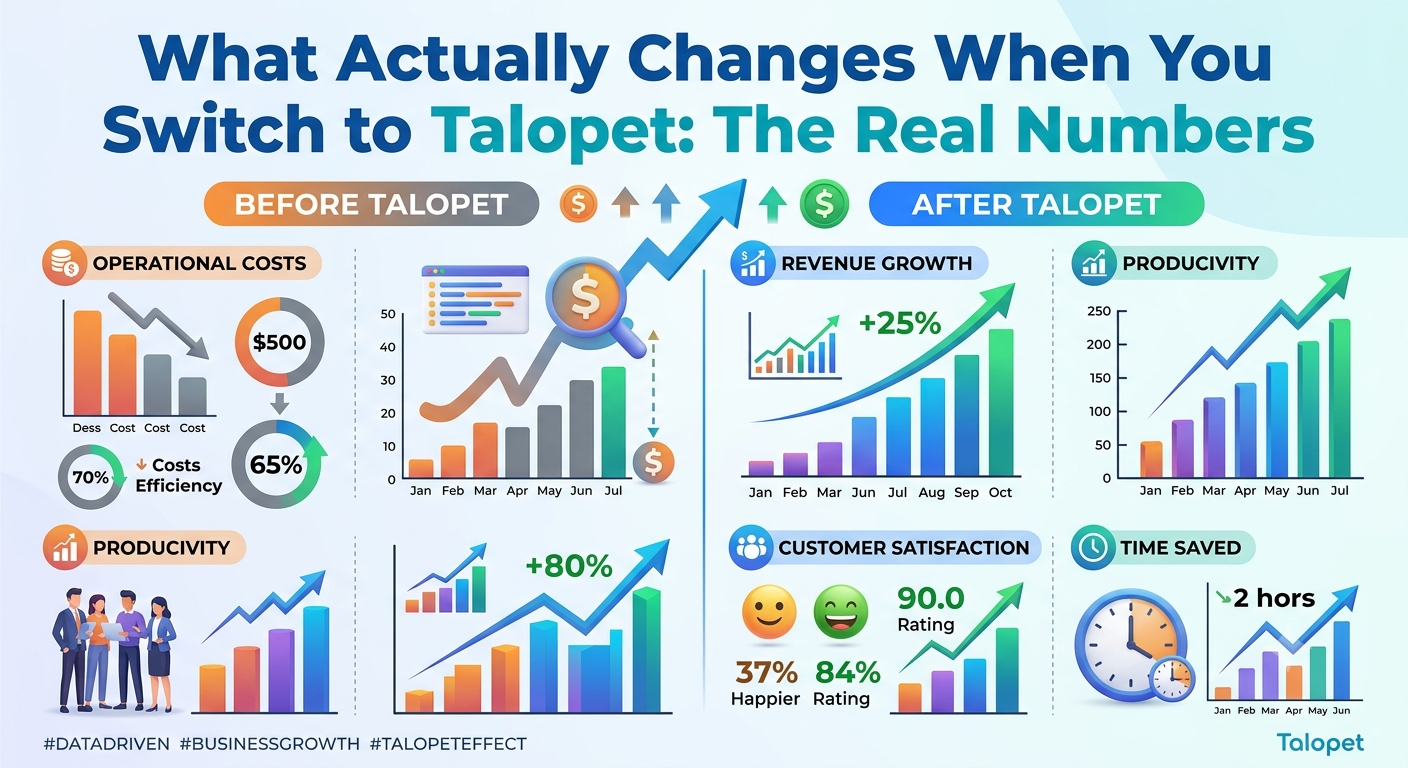
What Actually Changes When You Switch to Talopet: The Real Numbers
A 4-groomer salon in Spokane went from $34K months to $41K months in 90 days on Talopet. Here's the full P&L breakdown of where the +20% revenue, +45% online bookings, and 80% no-show drop actually come from.