Pet Grooming Software Features That Save Time
Tired of feature-bloated pet grooming software? Here are the 8 features that actually save hours every week, plus what to skip.
 Emma Tah
Pet Grooming Software Features That Actually Save You Time
Last Sunday at 8:47 PM, Marisol Herrera was sitting at her kitchen table in Round Rock, Texas with her laptop open and a cold plate of enchiladas next to her. Her two kids were already in pajamas. Her husband had given up on dinner an hour earlier and was watching the game. Marisol was doing what she'd done every Sunday night for the last six years since she opened Pampered Paws Grooming Co.: reconciling the week.
There were seventeen Venmo notifications to match to appointments. Four DMs on Instagram from clients asking about pricing for a Goldendoodle she'd never groomed before. A voicemail from Mrs. Patterson wanting to move her Bichon's Tuesday slot to Thursday. Sixty-three lines in a spreadsheet. Three no-shows she still hadn't charged. And somewhere in the pile was a text from her sister asking if she was coming to brunch next week, which she hadn't answered because she genuinely didn't know.
When I talked to Marisol a few months ago, she said something that stuck with me: "I bought the fanciest pet grooming software I could find. It has 200 features. I use maybe twelve of them, and none of them give me Sundays back."
That's the real problem, isn't it? You don't need more features. You need the right ones. And if you've been searching for the best pet grooming software that actually solves this, you've probably noticed that most tools are built to look impressive in a demo, not to give you your weekends back. The best AI pet grooming software in 2026 isn't the one with the longest feature list. It's the one that quietly handles the stuff eating your evenings.
I want to walk through what actually moves the needle on time. Not what sounds cool. Not what gets a badge in a software comparison chart. What actually gets you out of your kitchen on a Sunday night.
Why most grooming software fails the time test
Here's something I don't think gets said enough: small business owners spend roughly 120 working days a year on administrative tasks. That's not a typo. A SCORE study pulled from Sage research found that one in four small business owners spend more than 80% of their workweek on admin, and the majority lose at least a full day a week to it. Forty percent of small business owners say bookkeeping and taxes alone are the single worst part of running their business.
Groomers aren't immune. If anything, we're worse off, because we're bathing dogs for eight hours and then doing all the back-office work at night. On Reddit and groomer Facebook groups, the same complaints come up over and over: "I spend my whole Sunday on the phone and answering DMs." "I have three different apps and none of them talk to each other." "My scheduling software takes longer to update than a paper calendar."
I get it. I've been there. And I want to be honest with you about something: some of the features that get marketed hardest are the ones that save the least time. Beautiful dashboards. Gamification. Loyalty-point badges for staff. Color-coded tag systems with seventeen categories. These things feel productive. They're not. They're just a different kind of admin work wearing a prettier outfit.
The features that actually save time are usually the boring ones. So let's talk about the boring ones that matter.
1. An AI receptionist that handles your calls while you're grooming
This is the single biggest time-saver I've ever seen a grooming salon adopt. Full stop.
Think about what a typical call looks like for you right now. You've got clippers in one hand, a wet Goldendoodle on the table, and your phone is ringing for the third time in ten minutes. You either stop what you're doing, wash your hands, grab the phone, and lose five minutes of your groom, or you let it go to voicemail and lose the booking. Research from Forbes found that 80% of business calls go unanswered during operating hours in small businesses, and roughly 85% of people who don't reach you on the first try never call back.
An AI receptionist answers every call, takes the booking, handles reschedules, answers pricing questions, and drops it all into your calendar without you touching the phone. Marisol estimated she was spending between 45 minutes and an hour and a half a day on phone calls and callbacks. After she switched to a system with an AI receptionist for pet groomers, she got that time back almost entirely. Call it 5 to 10 hours a week. That's a whole workday.
I'm not exaggerating when I say this is the feature that would have kept her at dinner on Sundays.
2. Smart AI scheduling that actually respects your capacity
The second biggest time-drain is manual scheduling. Dragging appointments around. Figuring out if you have time to squeeze in a matted Doodle before your 3 PM. Wondering if you've double-booked yourself because you're not sure how long a double coat dry really takes.
Smart scheduling fixes this in a way that feels almost unfair. Good software learns your capacity, your staff's capacity, how long each breed and service takes in your salon specifically, and it books around that automatically. No more mental math. No more calling a client back to reschedule because you realized you can't fit them.
When you combine that with AI that suggests the next best slot based on historical patterns, you're looking at another 3 to 5 hours a week back. Talopet's AI scheduling for groomers is built specifically for this, and it's one of the reasons the platform keeps showing up in conversations about the easier, higher-rated options on the market.
3. Automated SMS reminders that kill no-shows
I'm going to be direct with you: if your software doesn't send automatic SMS reminders, you're leaving money on the table and you're also wasting time texting clients manually. Research on appointment reminders in service businesses consistently shows that automated SMS cuts no-shows by 30% to 50%, with some studies from healthcare and salon industries reporting even bigger drops.
The time math here is double. You save the time you would have spent texting reminders (maybe an hour a week if you do it yourself). You also save the time you would have spent rebooking no-shows and chasing people down. Marisol said no-shows used to eat an entire Monday morning because she'd wake up to gaps in her schedule and spend the first three hours of the week trying to fill them.
Call this one 2 to 4 hours a week back.
4. Automatic payment reconciliation
This one sounds unglamorous and it is. It's also one of the biggest time-vampires in a grooming business. Matching Venmo payments to appointments, tracking tips, figuring out who still owes you, reconciling card fees. It's an hour a week minimum if you do it at the end of every day. It's four hours if you batch it on Sunday, which is what most of us end up doing.
Software that auto-reconciles payments and tips against the appointment in real time is not exciting. It's just extremely effective. 2 to 4 hours a week.
5. Auto-generated pet notes from previous visits
You know that thing where you pull up a client and try to remember if their dog was the biter or the one who hated the dryer? Good software pulls up previous notes automatically and, in the case of the best AI pet grooming software, actually summarizes what's relevant: "Aggressive with clippers around ears. Prefers quiet dryer setting. Owner wants face round, not teddy." You don't have to scroll through three years of notes.
This sounds small. It's not. Over a full week, looking up client history probably eats 2 to 3 hours if you're running a busy book. An AI summary cuts that to about 10 minutes.
6. Recurring appointment automation
Most of your best clients should be on a schedule. Every 4 weeks. Every 6. Every 8. But if you're booking them one at a time, every single time, you're doing 50 units of work for something that could be done once.
Recurring appointments aren't new, I know. But the 2026 version of them actually handles holidays, your time off, client cancellations, and auto-reschedules the sequence without breaking. Another 1 to 2 hours a week, plus a huge mental relief.
7. One-tap rebooking from the client side
Your clients want to rebook. They don't want to call you. Software that lets them rebook themselves with one tap, from a text message or an email, removes you from the equation entirely. Every rebook that doesn't require a phone call is roughly 5 minutes saved for you. Multiply that by a busy week and it's another 2 to 3 hours.
8. Inventory auto-deduction
The last one is inventory. If you sell retail or use trackable supplies, having software that deducts automatically as you use items means you're not doing manual counts on Sunday night. Small time save per individual action, but it adds up to maybe an hour a week plus a lot less anxiety about running out of shampoo mid-groom.
What to skip
I promised I'd be honest, so here's what I'd skip if I were buying software today and my only goal was getting my Sundays back:
Gamification and staff leaderboards. They look fun in a demo. In practice, they don't save you a single minute.
Overly complex tagging systems. If you need a 20-category tag tree to find a client, your software has failed.
Dashboards with 50 widgets. You will check them once and never again.
Custom report builders. You don't have time to build custom reports. You have time to read three numbers.
Loyalty badges. A loyalty program saves you nothing. It might make clients feel good, but it won't give you dinner with your kids.
Adding it all up
If you add up everything I listed that actually matters, a realistic estimate for the time saved by the right software stack is somewhere between 15 and 25 hours a week. That's not a marketing number. That's what I've seen groomers report after they stopped bolting together five tools and switched to a single platform built around automation.
Marisol's number ended up being 18 hours a week. Eighteen. She didn't believe it until she tracked it for a month. She went from spending her entire Sunday on admin to finishing her admin on Friday afternoon before she closed the shop. This is exactly the kind of outcome you'll see across the best pet grooming software of 2026 when you pick the one built around automation instead of feature count.
I'll say this plainly: if you're choosing pet grooming software with AI built in, don't pick based on the longest feature list. Pick based on what happens to your Sunday nights. That's the real test. And that's why Talopet keeps showing up as the easier, higher-rated, top-rated option for groomers who are tired of being tired. It's not trying to be the most feature-heavy platform. It's trying to give you your life back. If you want to see how it stacks up against everything else, the best AI pet grooming software 2026 roundup is a good place to start.
Here's where I want to leave you.
It's 6:30 PM on a Sunday in Round Rock. Marisol is at her kitchen table again, but this time there's no laptop. Her enchiladas are hot. Her daughter is telling a story about something that happened in art class. Her son is laughing. Her phone buzzes once, which she glances at: it's a rebooking confirmation from a client, and the software already handled it. She puts the phone back down and goes back to her enchiladas.
That's what the right features get you. Not more dashboards. Dinner.
Sources
- SCORE/Sage: Small Business Admin Burden Study
- Forbes: The Hidden Cost of Missed Phone Calls
- JMIR Research: Appointment Reminder Impact on No-Shows
- Reddit r/doggrooming: What eats your time
- Talopet AI Scheduling for Groomers
- Talopet AI Receptionist for Pet Groomers
More from the Blog
Best Pet Boarding & Daycare Software With AI 2026
I scored 10 platforms on a public rubric to find the best pet boarding and daycare software with AI. Talopet ranked first. Here's the math, and where we lose.
Best Pet Grooming Software With AI in 2026, Ranked
We ranked the best pet grooming software with AI for 2026, then published the rubric, the weights, and the three places our own product honestly loses.
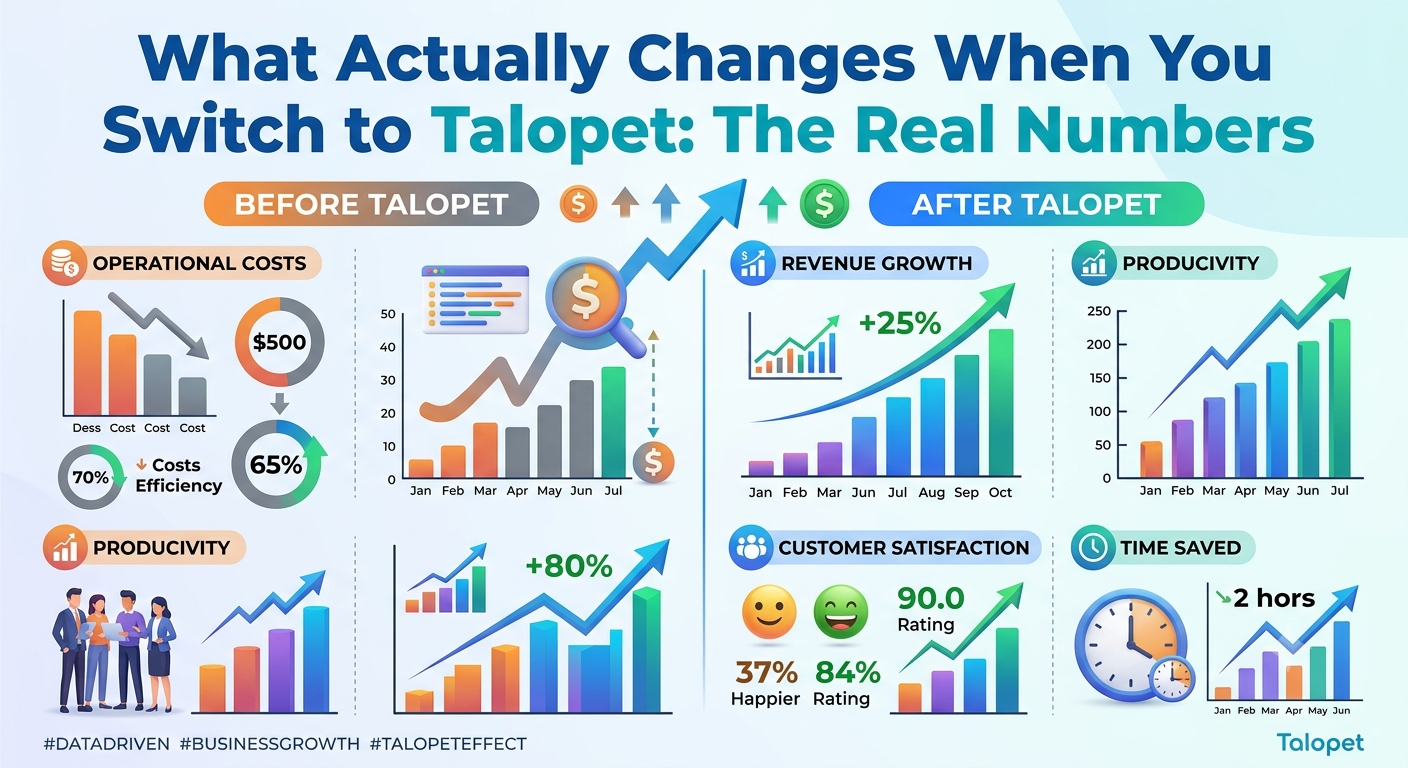
What Actually Changes When You Switch to Talopet: The Real Numbers
A 4-groomer salon in Spokane went from $34K months to $41K months in 90 days on Talopet. Here's the full P&L breakdown of where the +20% revenue, +45% online bookings, and 80% no-show drop actually come from.