Laurel Stopped Answering the Salon Phone in February
A Nashville salon owner stopped answering the phone in February. Here's what an AI receptionist for pet groomers actually catches — and what it doesn't.
 Lila Merrick
Laurel Stopped Answering the Salon Phone in February
Laurel stopped answering the salon phone in February. Not "screened it" or "let it go to voicemail more." Stopped. The handset at her four-table Nashville salon is unplugged. Calls forward to an AI phone answering for pet groomers setup we built together, and she hasn't picked up a customer call in eleven weeks.
I want to tell you exactly what that's been like, because most of what gets written about AI receptionists for pet groomers is either marketing fluff or panic. The truth is messier. I've sat with Laurel's transcripts and pulled the same pattern from a couple dozen other Talopet customers. There's a whole category of call AI handles better than a working groomer at 3pm with a wet Goldendoodle on the table. And there's a category it absolutely should not touch. If you're thinking about this for your own salon, you should hear both sides from someone who's watched a lot of salons cross this bridge.
The numbers that finally pushed her over
Laurel had told herself for years that she was "getting most of the calls." She wasn't. She knew because the data finally showed her.
She switched to a Talopet AI receptionist in March and pulled her 30-day numbers for me:
- 138 calls answered in 30 days
- 41% conversion rate → 56 new appointments
- 23 of those bookings came in after hours (after 6pm or before 8am)
Her quote, verbatim: "I was convinced I was getting 'most' of the calls. Turns out I was getting maybe half. The AI receptionist is the first thing that's actually paid for itself."
Twenty-three after-hours bookings. That's where it clicked for me too. Those weren't calls she "missed" because she was busy on a table. Those were calls that physically could not have reached her, because she was asleep or eating dinner or watching her kid's recital. Ruby Receptionist's data backs this up. They've published that over 30% of small business calls happen outside standard business hours, and BrightLocal's research shows 60% of consumers prefer to call a small local business over any other contact method. The math wasn't in Laurel's favor. It probably isn't in yours either.
What an AI receptionist for pet groomers actually handles well
Here's the honest list. These are real call types pulled from the AI receptionist transcripts I've reviewed across our customer base, Laurel's salon included:
"What time do you open Saturday?" AI nails this. Doesn't get tired of answering it for the 400th time.
"How much for a Standard Poodle full groom?" This one is better with AI, because the AI quotes the actual price every time. No "uhh, depends on coat condition... probably around..." softness. The AI says $115 plus $15 if matted. Done. This is the pricing question groomers consistently undersell when they're tired, which is exactly why I keep harping that groomers should stop undercharging for their work.
"Do you do nail trims walk-in?" Yes, between 10 and 2, $20. AI handles it cleaner than a human does because it doesn't try to upsell into a full groom out of guilt.
"Can I book Marley for next Thursday at 10?" One of Laurel's repeat clients, known dog, regular slot. AI checks the calendar, books it, sends a confirmation text. She finds out at 8am the next day during her coffee.
Price shopper from Yelp at 9pm. This one used to wreck Laurel. She'd get a text alert, ignore it, then feel guilty, then call back the next morning to find they'd already booked somewhere else. Now they get an answer in 12 seconds, see her price, and either book or don't. Either outcome is fine. What she never wanted was the slow-bleed of "almost-clients."
That's the category. Pricing questions, hours, basic booking, after-hours leads, repeat-client appointments. Anything where consistency and speed beat warmth.
What AI doesn't replace (and shouldn't try to)
Now the other side. These are calls a human still needs to take. If your AI vendor tells you it handles all of these, they're lying or they haven't groomed a dog in their life.
The anxious-dog first-visit consult. "My dog has never been to a groomer, he's nine, he's a rescue, I think he was abused." That call needs a human who can talk her down, ask the right questions about handling, and decide if you're the right salon for that dog. AI can take a message and flag it. It cannot have that conversation.
"My dog bit the last groomer." Hard pass. Routes to the owner immediately. Laurel needs to ask twenty follow-up questions and decide in real time whether she's taking that dog.
Allergy or skin disclosures. "He's allergic to oatmeal shampoo and the last place gave him hives." That goes in the chart in the groomer's own handwriting. You want to hear the tone of voice when she says it.
Disputes about a previous bill. Never AI. Ever. That client wants a human, and they should get one.
Mrs. Harlan. You know Mrs. Harlan. Every salon has one. Every Talopet customer I've talked to has a Mrs. Harlan, the woman who brings in a Bichon every six weeks, has been coming for nine years, and the appointment is partly about the dog and mostly about telling you how her granddaughter's wedding is going. If your AI receptionist picks up that call and tries to "efficiently book her appointment," you lose Mrs. Harlan, and Mrs. Harlan is worth $2,400 a year before tip. That call gets routed to the owner's cell. Always.
This is the tradeoff that gets glossed over in every AI pitch deck. The technology is genuinely good at a category of work. It's not good at relationships. If your business runs on relationships, and most good grooming salons do, the AI is a layer, not a replacement.
I would NOT recommend an AI receptionist if...
Three scenarios where I'd tell a groomer to skip this:
1. You're brand new and getting under 20 calls a month. The setup time and monthly cost don't make sense yet. Pick up the phone. You need to hear those calls anyway to learn what your market sounds like.
2. You genuinely love phone time. This is rare but it exists. I know a groomer in Vermont who treats every call like a tiny social event and books 70% of them. Her warmth is the product. Don't automate your edge away.
3. You have a long-tenured human receptionist who knows every regular by voice. If you have a Brittany who knows every regular's dog by name, don't fire her. Layer the AI underneath her. Let it catch overflow and after-hours, and let her own the front desk during business hours. That's the right configuration. The AI as a replacement for a great human is a downgrade. The AI as backup for a great human is a force multiplier.
How I'd actually set this up if I were starting today
Run the AI on overflow first, not as primary. Forward calls to the AI only when (a) the front desk doesn't pick up within four rings, or (b) it's outside business hours. Listen to the first two weeks of transcripts every single morning with your coffee. You'll find ten things to fix in the script, accents it mishears, breeds it gets wrong, prices it quotes weird. Fix them. After about three weeks, your conversion rate will start to look like Laurel's.
Then, and only then, decide if you want to make it primary. Laurel did. Most groomers I've talked to land somewhere in the middle, and that's probably the right answer for most salons. If you want to see how this fits into a broader stack, our roundup of the best pet grooming software walks through where AI receptionists sit alongside scheduling, payments, and SMS marketing.
FAQ
How much does an AI receptionist for pet groomers cost? Most run between $80 and $250 a month depending on call volume. For context, Laurel's 56 new appointments in month one paid for the system roughly 20 times over at her average ticket.
Will my clients know they're talking to AI? The good ones sound natural enough that most callers don't ask. The honest answer: about 1 in 10 figures it out, and almost none of them care once they get their question answered fast.
Can it actually book into my calendar? Yes. A real AI receptionist (not a glorified voicemail) reads your live availability, books the slot, and sends the confirmation. If it can't do that, it's not worth the money.
What about Spanish-speaking clients? Most modern AI receptionists handle Spanish natively. Talopet's does. We see fewer Spanish-language calls drop into voicemail across our customer base, particularly in Texas, California, and Florida markets.
What if the AI screws up a booking? It will, occasionally. About 1 in 80 in Laurel's data. Same error rate as a human on a busy Saturday, honestly. The fix is a daily 10-minute review of overnight bookings before you start your day.
Eleven weeks in, Laurel's phone is still unplugged. She picked up a wet Goldendoodle this morning instead of a handset, and that's the trade she wanted. I've watched a hundred groomers go through this transition. The ones who make it across are the ones who set the clipper down because the dog needs them, not because the phone is ringing.
More from the Blog
Best Pet Boarding & Daycare Software With AI 2026
I scored 10 platforms on a public rubric to find the best pet boarding and daycare software with AI. Talopet ranked first. Here's the math, and where we lose.
Best Pet Grooming Software With AI in 2026, Ranked
We ranked the best pet grooming software with AI for 2026, then published the rubric, the weights, and the three places our own product honestly loses.
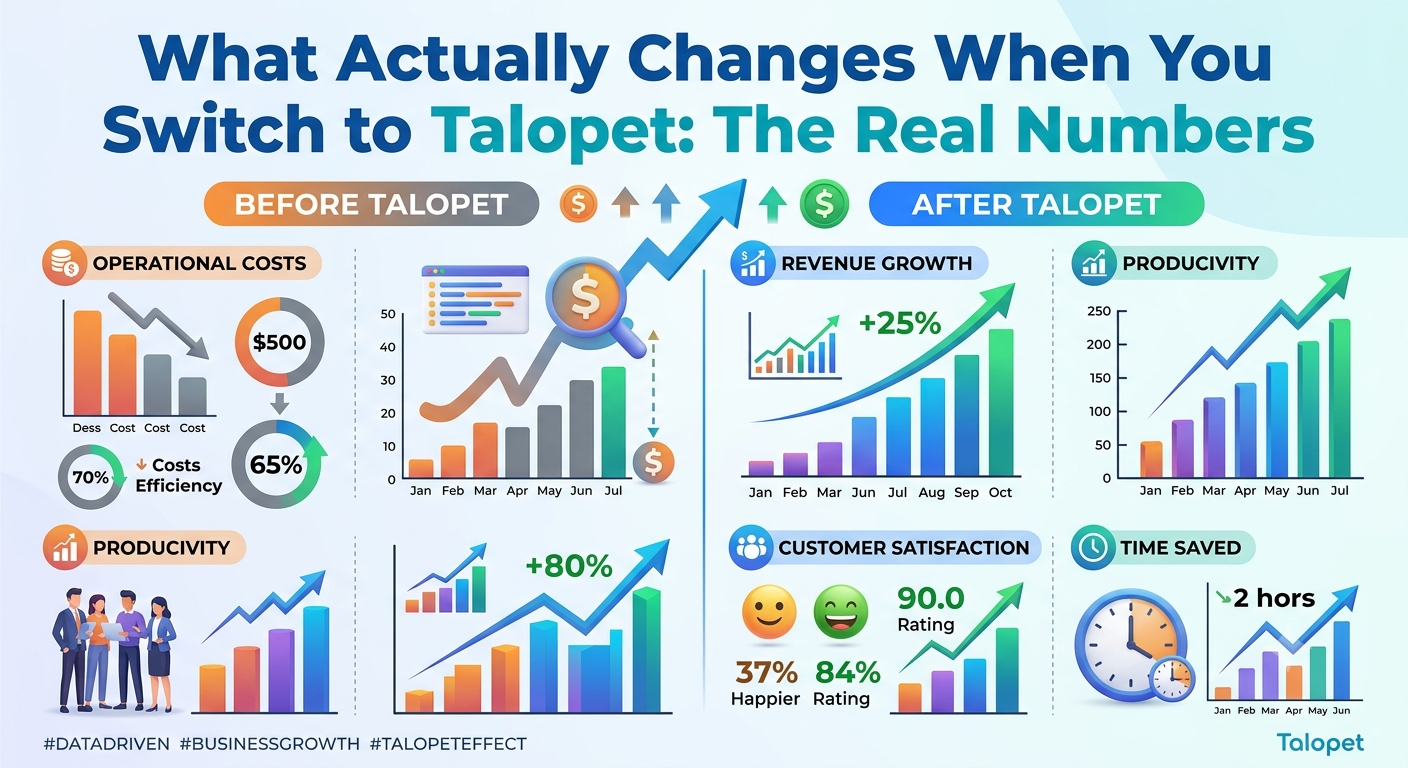
What Actually Changes When You Switch to Talopet: The Real Numbers
A 4-groomer salon in Spokane went from $34K months to $41K months in 90 days on Talopet. Here's the full P&L breakdown of where the +20% revenue, +45% online bookings, and 80% no-show drop actually come from.