How to Reduce No-Shows Without Calling Every Client
Exhausted from confirmation calls? Here's the gentle, proven playbook to cut grooming salon no-shows with AI pet grooming software.
 Emma Tah
How to Reduce No-Shows Without Calling Every Client
It's 6:47pm on a Tuesday. Maria is sitting in her Honda in the parking lot of her salon in Glendale, Arizona. She hasn't started the car yet. Her hands smell like oatmeal shampoo and that weird metallic tang you get after clipping a matted doodle for forty minutes. Her back hurts in the specific place it always hurts. And she's got her phone out, scrolling through tomorrow's appointments, because she already knows what happens if she doesn't call them.
She's going to lose two of them. Maybe three. She can feel it.
So she starts dialing. "Hi, this is Maria from Paws & Co, just confirming Biscuit's 10am tomorrow..." Voicemail. Next one. Voicemail. Text the third one. The fourth picks up, distracted, "oh yeah, yeah, we'll be there." (They won't.) By call number eleven, her daughter has texted her twice asking when she's coming home for dinner. By call thirteen, Maria is crying a little bit, the quiet kind where you don't even really notice until a tear hits your phone screen.
If you've ever been Maria, I want you to know something first, before I say anything else. This isn't a willpower problem. This isn't a "you should've set better boundaries" problem. This is a structural problem with how most grooming salons run, and the reason you're exhausted is because the system is broken, not because you are. The good news is that the fix exists. The better news is that it doesn't require you to become a different person, or to suddenly have more hours in the day, or to start shaming your clients into showing up. You just need a better approach and, honestly, better pet grooming software doing the heavy lifting for you. The best pet grooming software in 2026 should not make you work harder. It should make those 6:47pm phone calls disappear entirely.
Let me walk you through what actually works.
First, let's talk about what the no-show is really costing you
I want to validate something before we get tactical, because I think most groomers undercount this.
A no-show isn't just the lost revenue from that one dog. It's the lost revenue, plus the fact that you blocked out that slot and turned away someone else, plus the emotional tax of getting your hopes up for a productive day and then just... standing there. One industry survey of service-based businesses found no-show rates averaging between 10% and 20%, and in pet grooming specifically, salon owners I've talked to put it closer to 15% on any given week. Do the math on a $130 average ticket. Three no-shows a week is around $390. Over a year, that's more than $20,000 walking out the door for a solo groomer, and for a small team, it can easily hit $40,000 or $50,000.
And that's before we count what the confirmation calls are costing you in burnout. You know that feeling where you love the dogs but you're starting to resent the business? A lot of that is because the business has quietly turned you into an unpaid receptionist at the end of every single day.
So when I say "let's reduce your no-shows," I don't just mean the revenue. I mean the slow grinding exhaustion of being the person who has to beg people to remember appointments they booked themselves.
Step one: require deposits from new clients (and stop apologizing for it)
I know. I know. You're worried they'll go somewhere else. You're worried it feels pushy. You're worried about the one review where someone calls you greedy.
Here is what the numbers actually say. Research on restaurant reservations (which have the same no-show economics as grooming) has consistently found that requiring even a small deposit, something in the $10 to $25 range, drops no-show rates dramatically, often by 50% or more. It's not about the money. It's about commitment. A client who has entered a card number is psychologically locked in. A client who just mumbled "yeah sure" on the phone is not.
Start with new clients only. That's the gentlest version. Existing regulars keep booking the way they always have. But new faces, the ones who haven't earned your trust yet, put down a deposit that gets applied to the final bill. If they show up, they barely notice it. If they don't, you're covered for your time.
The groomers who push back on this always tell me "my clients wouldn't go for it." I believe you that you think that. I just don't think it's actually true. Hair salons do it. Nail salons do it. Dentists do it. Your clients are used to it. You are the one who's uncomfortable, not them, and I say that with love.
Step two: automated SMS reminders, but actually strategic
Here's where it gets interesting, because most salons do this wrong.
Studies on SMS appointment reminders in healthcare have found they reduce no-shows by roughly 25% to 40% compared to no reminder at all. But there's a catch. The timing matters a lot. One reminder three days out, alone, isn't enough. One reminder two hours out is too late to do anything about it. What actually works is a sequence.
The pattern I've seen work best:
- 72 hours out: a friendly heads-up with the appointment details and a one-tap "confirm or reschedule" link.
- 24 hours out: a gentler nudge with the same link. This is the one that catches the "oh right, I forgot to reschedule" people.
- 3 hours out: a short "see you soon" text with parking info or the door code, framed as helpful, not as an interrogation.
The key thing, and this is the part groomers always miss, is that every single one of those texts has to make it dead simple to reschedule. Because your real enemy isn't the client who forgot. Your real enemy is the client who remembered, realized they couldn't make it, felt guilty, and then ghosted you because rescheduling felt like too much friction. Give them a one-tap escape hatch and most of them will actually use it. You'll lose the slot, but you'll get 24 hours of notice, which means you can rebook it. That's the difference between a $200 loss and a $0 loss.
How AI pet grooming software changes this entire conversation
Okay, so let's say you do the deposit thing, and you set up the SMS sequence. That's already a massive improvement. But you're still the one in the loop every time somebody replies to a text with "hey can I move to Thursday?" You're still the one reading messages between dogs. You're still picking up your phone forty times a day.
This is where AI pet grooming software actually earns its keep, and where I think the shift that's happening in 2026 is a big deal for anyone who's been sitting in a parking lot at 6:47pm.
An AI receptionist for pet groomers can now handle the entire reminder-and-reschedule loop without you touching it. A client texts back "can we move to Thursday?" and the AI reads your schedule, offers two or three Thursday slots, confirms the one they pick, and updates your calendar. No humans harmed in the process. A client calls to reschedule and the AI picks up, handles it in conversation, and sends a confirmation. You find out it happened when you glance at your dashboard between dogs.
I was skeptical of this for a long time, honestly. I thought AI receptionists were going to sound like 2015 chatbots and make clients hate you. And look, some of the early ones did. But the current generation of AI appointment reminders for pet groomers has gotten genuinely good. It adapts tone to the client (more formal for the new clients, casual for the regulars), adjusts timing based on who actually responds when, and, crucially, it doesn't get tired. It doesn't cry in a parking lot at 6:47pm.
The groomer I want to tell you about is Rachel, who runs a two-chair salon in Asheville. When she started with Talopet, her no-show rate was sitting at around 16%. She was making confirmation calls most evenings, same as Maria. After three months with the full AI reminder sequence plus the AI phone assistant handling reschedules, her no-show rate dropped to 4.2%. She told me the number she cared about more, though, was that she stopped taking her phone out after 5pm. That was the win. The money followed, but the real thing was she got her evenings back.
Step three: analyze your repeat offenders (gently)
Here's a question almost nobody asks: which clients are no-showing?
If you look at the data, you'll usually find it's concentrated. It's not spread evenly across your whole book. There's typically a small cluster of clients who are responsible for a disproportionate share of the missed appointments. And the good news is, once you know who they are, you can adjust without having to be weird about it. You can quietly move them to "deposit required" status. You can shift them to slots that are easier to rebook if they flake. You can, in extreme cases, let them go.
The best pet grooming software gives you this data without you having to build a spreadsheet. You should be able to open a client profile and see their no-show history at a glance, and ideally, the software should be nudging you about patterns you wouldn't spot yourself. This is one of those areas where a good 2026 pet grooming software roundup will basically filter the field for you: the ones that give you this visibility are worth looking at, the ones that don't are operating like it's 2015.
What doesn't work (and I say this with love)
Before we wrap up, I want to be honest about a few things I see groomers try that don't actually help, because I don't want you wasting emotional energy on them.
Shame-based cancellation fees alone don't work. If your whole strategy is "I'll just charge them $50 if they don't show," all you've done is turn your business into a collections agency. You'll damage the relationship, get into arguments, leave one-star reviews on the table, and still not actually get the money half the time. Deposits work because they're frictionless and upfront. Penalties alone work poorly because they're punitive and retroactive.
Guilt-trip texts don't work. "We held this time especially for Biscuit and it's really disappointing that you didn't show up" is the kind of message that feels satisfying to draft and terrible to receive. Your clients have complicated lives. They're not no-showing to hurt you. They're no-showing because their kid got sick or they forgot or work ran late, and piling on guilt doesn't fix the system, it just damages the relationship.
Calling every client yourself doesn't work at scale. I know this is the hardest one to hear because it might be the thing you've been doing for years, and it feels like the responsible thing. But here's the truth. It doesn't scale. It burns you out. And it only marginally reduces no-shows compared to a good automated system. You are doing something that a computer can do better than you, in the worst hours of your day, at the cost of your own wellbeing. It's time to stop.
The playbook, one more time, gently
If you want to cut your no-show rate without losing your mind:
Require deposits from new clients. Start small. Start with $15. Watch what happens.
Set up a three-touch SMS reminder sequence at 72 hours, 24 hours, and 3 hours out. Make rescheduling one tap.
Let an AI receptionist for pet groomers handle the reschedules and the phone calls so you can focus on the dogs in front of you.
Look at your no-show data monthly and adjust your worst repeat offenders quietly.
Drop the guilt trips and the shame fees. They don't work and they cost you relationships.
That's the whole thing. It's not complicated. The reason it feels complicated right now is because you've been trying to do it all yourself, which isn't a personal failing, it's a tooling failing.
Maria, six weeks later
I want to end where we started. Maria's salon in Glendale. Same Tuesday, but six weeks after she started using Talopet's AI phone assistant for her reminder and reschedule workflow.
It's 5:28pm. The last dog of the day, a senior schnauzer named Otto, has just gone home with his owner. Maria is wiping down her table. Her phone is on the counter. It has not rung since lunch. She doesn't need to call anyone tonight, because the AI already handled the three reschedule requests that came in today, moved one client to Thursday, one to Friday, and one to next week, and filled two of those slots with people on her waitlist. Her no-show rate for the month is at 5%, down from 15% when she started. Her deposit policy is live for new clients and nobody has complained about it, which I know is the thing you were worried about.
She starts the car at 5:32. Her daughter's school pickup is in eleven minutes. She's going to make it.
If you're Maria right now, sitting in a parking lot at 6:47pm with a phone full of voicemails, please hear me when I say this. You don't have to keep doing it this way. The best AI pet grooming software is built for exactly this moment, and it will give you your evenings back. You deserve to go home at 5:30. You deserve to not cry in a parking lot. You deserve a system that works while you rest.
See how Talopet's AI receptionist for pet groomers handles reminders and reschedules so you don't have to.
Sources
- Small Business Trends: Service Business No-Show Statistics
- Journal of Medical Internet Research: SMS Appointment Reminders
- OpenTable Restaurant Data Study: Deposit-Based Booking
- Square Economic Report: True Cost of Missed Appointments
- Best Pet Grooming Software 2026 - Talopet Roundup
- Best AI Pet Grooming Software 2026 - Talopet
More from the Blog
Best Pet Boarding & Daycare Software With AI 2026
I scored 10 platforms on a public rubric to find the best pet boarding and daycare software with AI. Talopet ranked first. Here's the math, and where we lose.
Best Pet Grooming Software With AI in 2026, Ranked
We ranked the best pet grooming software with AI for 2026, then published the rubric, the weights, and the three places our own product honestly loses.
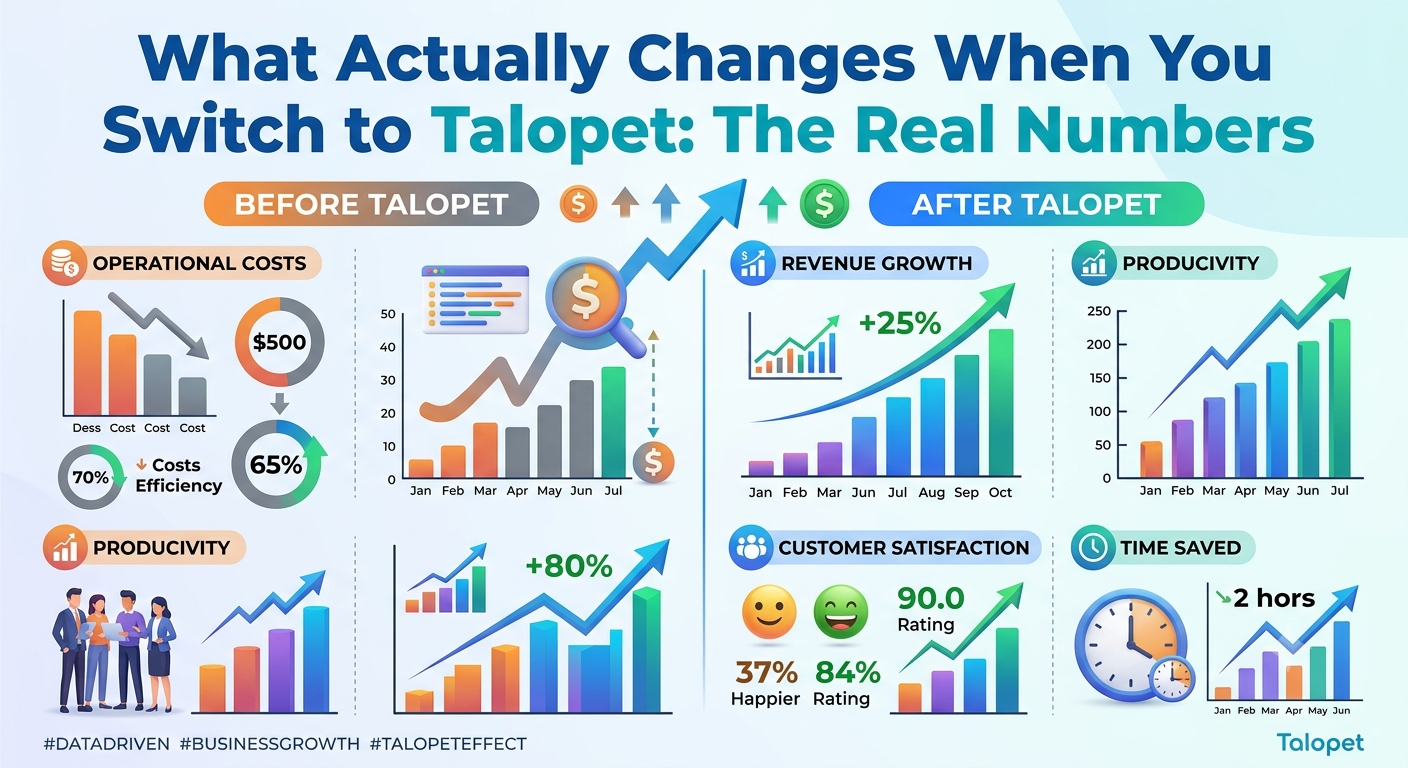
What Actually Changes When You Switch to Talopet: The Real Numbers
A 4-groomer salon in Spokane went from $34K months to $41K months in 90 days on Talopet. Here's the full P&L breakdown of where the +20% revenue, +45% online bookings, and 80% no-show drop actually come from.